UCP vs ACP: What Brands Need to Know About the Agentic Commerce Infrastructure Wars

 Add as a preferred source on Google
Key Takeaways
- UCP (Google + Shopify) covers the full commerce lifecycle from product discovery to post-purchase support across any AI surface, using REST, MCP, or A2A transport protocols with 20+ launch partners including Visa, Mastercard, Target, and Walmart.
- ACP (OpenAI + Stripe) specializes in delegated payment flows within conversational AI experiences like ChatGPT, using time-bound payment tokens and centralized product listings accessed by 800+ million weekly active ChatGPT users.
- Both protocols are open and compatible. They operate at different layers. UCP standardizes the full transaction lifecycle across AI surfaces, while ACP handles checkout session management, payment authorization, and delegated purchase flows within conversational assistants. Both can work together in the same shopping journey.
- Product data quality becomes mission-critical because AI agents prioritize structured attributes, accurate inventory, and complete schemas over traditional SEO signals when making purchasing recommendations.
- Implementation costs vary dramatically: Shopify merchants activate agentic commerce with zero technical integration, while custom implementations require 12-16 weeks and $75K-$250K+ in development resources.
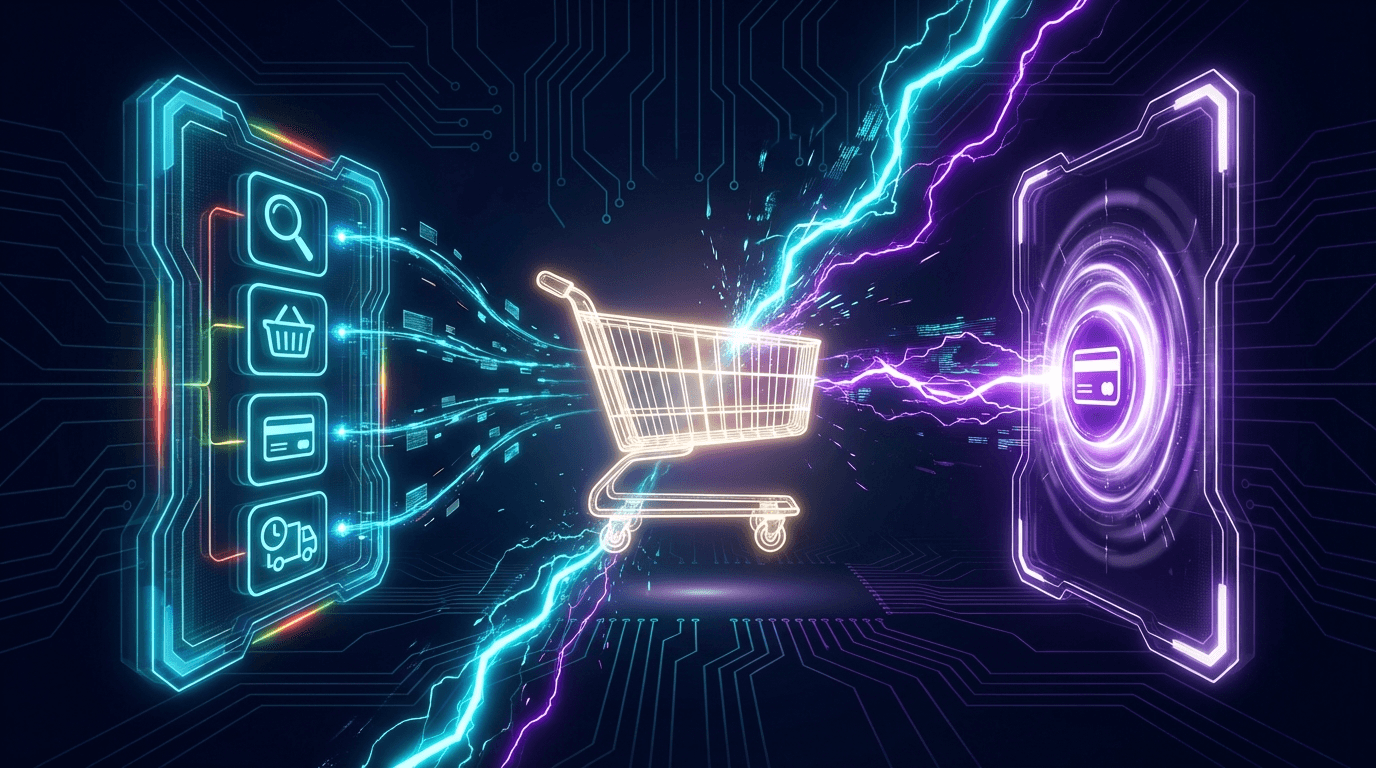
Two competing protocols are reshaping how AI agents buy products: Google's Universal Commerce Protocol (UCP) and OpenAI's Agentic Commerce Protocol (ACP). UCP standardizes the entire shopping journey from discovery to post-purchase across any AI surface, while ACP focuses on secure checkout within conversational AI assistants. UCP is an open standard backed by a broad industry coalition, while ACP is fully open-source under Apache 2.0. Both are compatible with multiple payment providers and designed to coexist.
The protocol wars are not about technical superiority. They are a competition for which AI interface captures the buyer, while the protocols themselves remain technically interoperable at the merchant infrastructure layer. Brands must prepare for both, because the winners will be merchants who optimize product data for machine consumption rather than human browsing.
Last Updated: February 13, 2026 • Reading Time: 18 minutes
What Is Agentic Commerce and Why Should Brands Care?
Agentic commerce refers to transactions initiated and executed by AI agents acting on behalf of consumers within conversational interfaces. It moves purchasing decisions from human-navigated websites to AI-mediated discovery, comparison, and checkout, eliminating traditional browsing, cart abandonment, and multi-step conversion funnels.
How It Works in Practice
When a consumer asks ChatGPT "find me running shoes under $150 with good arch support," the AI agent queries structured product data across merchants, evaluates options based on user preferences, and completes checkout without the consumer ever visiting a retailer's website. This transformation fundamentally changes how brands compete for visibility. AI agents consume product schemas and attribute data rather than responding to traditional advertising or SEO optimization.
The Market Opportunity
The stakes are significant. McKinsey projects that by 2030, the US B2C retail market alone could see up to $1 trillion in orchestrated revenue from agentic commerce, with global projections reaching $3 trillion to $5 trillion.
- Brands visible to AI agents during the decision phase capture demand.
- Brands without structured data integration become invisible.
Why Protocols Matter
Without standardization, every AI agent would require custom integrations with every merchant and payment provider, creating an N×M complexity problem that prevents scaling. UCP and ACP emerged as competing solutions to this infrastructure challenge, each backed by different technology ecosystems and optimized for different parts of the commerce journey.
What Is the Universal Commerce Protocol (UCP)?
UCP is Google's open standard for enabling AI agents to execute complete shopping journeys across any consumer surface, merchant system, and payment provider using standardized APIs and data schemas. Announced by Sundar Pichai at the National Retail Federation conference in January 2026, UCP was co-developed with Shopify, Etsy, Wayfair, Target, and Walmart. Source: CDO Magazine
Full Lifecycle Coverage
The protocol covers the full transaction lifecycle:
- Product discovery.
- Cart management.
- Shipping calculation.
- Payment processing.
- Order confirmation.
- Fulfillment tracking.
- Returns and post-purchase support.
UCP integrates with existing protocols including Agent Payments Protocol (AP2), Agent2Agent (A2A), and Model Context Protocol (MCP), creating interoperability across the broader AI agent ecosystem. Source: Google Developers
Composable Architecture
UCP operates as a composable, vendor-agnostic framework where merchants declare supported capabilities and platforms autonomously discover and configure integrations. A brand might implement product discovery and checkout while delegating payment authorization to AP2-compliant providers. This modularity allows merchants to adopt incrementally rather than requiring full-stack integration upfront. Source: UCP GitHub
The protocol's architecture centers on two core concepts:
- Capabilities (such as Checkout and Order management that businesses implement).
- Extensions (such as Discounts and Fulfillment that enhance the consumer experience without bloating core definitions).
UCP is compatible with A2A for agent-to-agent communication, AP2 for secure payment authorization, and MCP for contextual data access. Merchants remain the merchant of record, controlling pricing, inventory truth, customer data, and post-purchase relationships. UCP standardizes how AI agents communicate with those merchant-owned systems.
Launch Partners and Distribution
Launch partners include:
- Payment networks: Visa, Mastercard, American Express.
- Payment processors: Stripe, Adyen.
- Major retailers: Best Buy, Macy's, The Home Depot.
- International platforms: Flipkart, Zalando.
- Commerce platforms: Shopify.
This cross-industry coalition supports the standard. Google plans to deploy UCP across Search AI Mode, Google Shopping, and Gemini apps, enabling U.S. shoppers to complete purchases directly within AI-powered product research flows. Source: Google Blog
What Is the Agentic Commerce Protocol (ACP)?
ACP is OpenAI's open-source protocol for enabling AI assistants to coordinate product discovery and execute delegated purchases on behalf of users within conversational interfaces. Launched in September 2025 and developed with Stripe, ACP powers ChatGPT Instant Checkout and is licensed under Apache 2.0 for implementation by any AI assistant or payment processor. Source: Stripe
The Agent-as-Interface Model
The protocol emphasizes the agent-as-interface model where the AI assistant actively participates in buyer journey navigation through:
- Conversational discovery
- Product comparison
- Preference refinement
- Purchase confirmation
ACP focuses on three core functions:
- Retrieving structured product data so agents can make accurate recommendations.
- Confirming user intent before finalizing purchases.
- Transmitting secure payment authorization to merchants using time-bound, single-use tokens.
Delegated Payments
The delegated payments approach preserves user control while enabling autonomous checkout. When a consumer confirms a purchase within ChatGPT, ACP generates a cryptographic payment token that authorizes the transaction within defined parameters: specific merchant, exact amount, and time window. Stripe's Shared Payment Token serves as the reference implementation for this delegated payment specification, though the protocol supports any compliant payment service provider. Source: Stripe Docs
Merchant Integration Requirements
For merchants, ACP integration requires three technical components:
- A product feed or API providing structured catalog data.
- REST endpoints implementing the Agentic Checkout Spec.
- Webhooks notifying OpenAI of order status changes.
Merchants using ACP must support high-quality product schemas with consistent attributes, accurate pricing and inventory, and clear fulfillment promises. AI agents base recommendations directly on this structured data. Source: ACP GitHub
Distribution Advantage
ACP's distribution advantage centers on ChatGPT's 800+ million weekly users and the behavioral shift toward conversational commerce. When consumers already use ChatGPT for research, recommendations, and decision-making, completing purchases within the same interface eliminates friction. The protocol extends to any AI assistant, but OpenAI's ecosystem provides the initial demand channel. Source: OpenAI
Monetization
OpenAI says merchants pay a small fee on completed purchases but has not published the rate, and Shopify's Agentic Storefronts terms let it charge a fee on these transactions for some channels, with no public rate. The service remains free for consumers and does not affect product pricing. Product results within ChatGPT are organic and unsponsored, ranked purely on relevance to the user. This shifts the competitive dynamic from paid placement to product data quality and relevance signals. Sources: OpenAI, Shopify
How Do UCP and ACP Differ Architecturally?
UCP and ACP solve related but distinct infrastructure problems, operating at different layers of the commerce stack with fundamentally different design philosophies. UCP optimizes the full transaction lifecycle from discovery through post-purchase support across any AI surface. ACP optimizes checkout session workflows, managing payment authorization and delegated purchase tokens within conversational interfaces.
Comparison Table
| Attribute | Universal Commerce Protocol (UCP) | Agentic Commerce Protocol (ACP) |
|---|---|---|
| Developers | Google + Shopify + industry coalition | OpenAI + Stripe |
| Launch Date | January 2026 (NRF announcement) | September 2025 (3-month head start) |
| Scope | Full commerce journey (discovery to post-purchase) | Checkout and transaction flows |
| Primary Use Case | Full commerce lifecycle standardization across any AI surface | Checkout and delegated payment flows within conversational AI |
| Transport Protocols | REST API, compatible with A2A and MCP; additional transports possible as ecosystem evolves | REST API (Stripe infrastructure) |
| Payment Architecture | Agent Payments Protocol (AP2) with cryptographic mandates | Delegated payment tokens (time-bound, single-use) |
| Distribution Model | Decentralized discovery across any AI surface | Centralized listing through OpenAI/Shopify catalog |
| Launch Partners | 20+ (Visa, Mastercard, Target, Walmart, Shopify, Etsy) | OpenAI (800M+ weekly active users) + Stripe + Shopify |
| Merchant Role | Merchant of record, full control over pricing/inventory | Merchant of record, full control over pricing/inventory |
| Monetization | Ads via "Direct Offers" in Google surfaces | Transaction fees per completed purchase |
| Interoperability | Compatible with AP2, A2A, MCP protocols | Compatible with any payment provider supporting Delegated Payment Spec |
| Implementation Complexity | Modular (select capabilities), multiple transport options | Simpler (REST-only), focused on checkout |
| Key Surfaces | Google AI Mode, Search, Gemini, third-party agents | ChatGPT, Salesforce Commerce Cloud |
Sources: Google Developers, OpenAI Commerce Docs
Coexistence, Not Conflict
This architectural separation means the protocols can coexist without conflict. A consumer might discover products through an AI assistant using ACP-style interactions, while the actual checkout and payment execution leverages UCP standardization for broader merchant compatibility. The protocols address different moments in the commerce lifecycle rather than competing for the same function.
Technical Design Differences
From a technical standpoint, UCP's composable architecture supports diverse merchant implementations. Businesses declare supported Capabilities in a standardized profile, allowing platforms to autonomously discover and configure integrations. Additional transport and protocol bindings are possible as the ecosystem evolves.
ACP's REST-only approach reduces complexity but limits architectural options for merchants with specialized requirements. Source: Google Developers
What Are the Other Protocols in the Agentic Commerce Ecosystem?
Five major protocols now define how AI agents interact with commerce systems, payment providers, and each other. UCP and ACP are the commerce-layer standards, while MCP, AP2, and A2A handle data access, payment security, and agent communication respectively. Understanding this ecosystem prevents confusion about what each protocol controls and where they intersect.
Model Context Protocol (MCP) - Anthropic
MCP is an open standard introduced by Anthropic in November 2024 for connecting AI assistants to external data sources, business tools, and development environments. In December 2025 Anthropic donated it to the Linux Foundation's Agentic AI Foundation. Source: Anthropic, Anthropic
The protocol standardizes how large language models access context beyond their training data, enabling AI agents to query product databases, retrieve customer information, or interact with enterprise systems.
In agentic commerce, MCP serves as a transport binding that UCP can leverage. Instead of merchants building custom APIs for every AI agent, they expose data through MCP servers that any MCP-compatible agent can query. OpenAI, Google DeepMind, and Anthropic all support MCP, creating cross-platform compatibility for product catalog access. Source: Google Developers Blog
MCP's three core primitives map directly to commerce workflows:
- Tools (actions agents can perform) = checkout operations.
- Resources (data agents can access) = product catalogs.
- Prompts (templates agents can invoke) = personalized recommendations.
Agent Payments Protocol (AP2) - Google
AP2 handles secure payment authorization for AI-initiated transactions using cryptographic mandates as tamper-proof digital contracts proving user authorization. Developed by Google with PayPal and payment industry partners, AP2 solves a fundamental trust problem: how can a merchant verify that an autonomous agent has legitimate authority to spend a user's money? Source: Google Cloud
The protocol uses mandate-based transaction authorization where users grant specific, bounded permissions to AI agents. These permissions are defined by:
- Merchant identity.
- Amount limits.
- Time windows.
- Transaction parameters.
The cryptographic mandate cannot be altered or replayed, providing security guarantees that traditional payment flows assume through direct human interaction with trusted websites.
UCP integrates AP2 for payment authorization, separating the commerce orchestration layer (UCP) from payment security infrastructure (AP2). This modular design allows merchants to support UCP commerce flows while using any AP2-compliant payment provider.
Agent2Agent Protocol (A2A) - Google / Linux Foundation
A2A enables communication between autonomous AI agents using JSON-RPC 2.0 over HTTPS. Originally developed by Google and now managed by the Linux Foundation with 150+ supporting organizations, A2A creates a standard messaging format for agent collaboration and task delegation. Sources: Google Developers Blog, Google Developers Blog (Linux Foundation donation)
In commerce scenarios, A2A allows a consumer's personal AI agent to negotiate with a merchant's business agent: comparing product specifications, confirming availability, arranging custom configurations, or coordinating delivery schedules. This agent-to-agent negotiation pattern extends beyond simple transactions into complex B2B procurement and enterprise commerce.
UCP supports A2A as a transport protocol, meaning merchants can expose commerce capabilities through A2A endpoints that other agents discover and invoke. This creates a more distributed, peer-to-peer architecture compared to centralized platform models.
How the Five Protocols Interact
The A.G.E.N.T.I.C. Framework emphasizes ecosystem interoperability as essential for sustainable agentic commerce infrastructure. The protocol stack demonstrates this principle in practice:
Scenario: Consumer asks their AI assistant to buy sustainable coffee.
- MCP: Assistant queries multiple merchant product catalogs through standardized MCP connections, retrieving structured data on coffee products, sustainability certifications, and pricing.
- ACP or UCP: Assistant presents options to consumer. Upon selection, uses ACP (if within ChatGPT) or UCP (across broader ecosystem) to initiate checkout.
- AP2: Payment authorization flows through AP2, with cryptographic mandate confirming user approved the specific transaction.
- A2A: If the selected merchant is out of stock, the consumer's agent uses A2A to negotiate with the merchant's business agent for alternative products or delivery timelines.
- Post-Purchase: Order confirmation, tracking, and support queries continue through the same protocol stack, with UCP managing status updates and A2A handling any agent-mediated customer service.
This multi-protocol coordination creates resilience. If one protocol faces adoption challenges or technical limitations, others provide fallback mechanisms. Merchants implementing comprehensive agentic commerce strategies integrate the full stack rather than betting exclusively on UCP or ACP.
Why Does This Matter for Brands Right Now?
The protocol wars represent a distribution war disguised as an infrastructure debate. The real competition is not about technical superiority; it is about which companies control the interfaces where consumers discover and purchase products.
The Three Major Distribution Controllers
Google owns intent through search queries. When consumers use Google AI Mode or Gemini to research products, UCP enables frictionless checkout within those Google-controlled surfaces. The monetization model uses "Direct Offers" advertising, where brands pay to influence AI recommendations at the moment of high purchase intent. Source: Google
OpenAI owns conversation through ChatGPT's more than 800 million weekly users. When consumers already trust ChatGPT for decisions, completing purchases within the same conversational flow eliminates platform switching. The monetization model uses transaction fees, with merchants paying a small fee on completed purchases. Source: OpenAI, OpenAI
Microsoft owns enterprise through Copilot integration across Windows, Microsoft 365, and Edge browser. Copilot Checkout embeds commerce directly into workflows where professionals already operate, capturing B2B and high-value consumer purchases through existing enterprise relationships.
The Infrastructure Winners
Shopify, Stripe, and PayPal win regardless of which protocol dominates. They provide the backend infrastructure all approaches depend on:
- Shopify powers commerce operations for both UCP and ACP implementations.
- Stripe processes payments for ACP while also supporting UCP through AP2 compatibility.
- PayPal participates in both ecosystems as a payment provider.
Strategic Implications for Brands
For brands, the strategic implication is preparation for protocol pluralism. The question is not "UCP vs ACP" as mutually exclusive choices. The question is "when and how to support both?"
- Brands depending on search traffic for customer acquisition must prioritize UCP because Google surfaces drive that demand.
- Brands succeeding through conversational commerce and AI-native discovery must prioritize ACP because ChatGPT users represent that behavioral shift.
The Timeline Is Compressing
The timeline compresses rapidly. ACP launched September 2025, giving it a three-month operational head start. UCP was announced January 2026 with immediate availability for Google Merchant Center participants. Brands delaying implementation until standards "mature" cede market position to competitors already capturing AI-driven demand. Sources: Stripe Blog, Google Blog
Data from early adopters proves the channel viability. Journeys that include Copilot led to 53% more purchases within 30 minutes of interaction compared to those without. Shopify merchants enabling Agentic Storefronts see new customer acquisition from AI surfaces without cannibalization of existing web traffic, suggesting additive demand rather than channel substitution. Source: Microsoft Advertising
What Are the Implementation Costs and ROI Considerations?
Implementation investment varies dramatically based on existing commerce platform, technical infrastructure, and integration approach. Shopify merchants can activate agentic commerce for nearly zero cost, while custom implementations range from $75K to $250K+ over 14-20 weeks.
Understanding the cost structure prevents underestimation of resources and enables accurate ROI projections.
For Shopify Merchants
Cost: $0 - $2,500 (configuration and optimization only).
Shopify merchants activate agentic commerce through the admin panel with zero custom development. The primary investment involves data quality optimization, Knowledge Base configuration, and channel selection. Merchants already maintaining clean product catalogs and metafields face minimal additional work.
ROI Timeline: 30-90 days to first AI-driven sales.
Shopify Catalog uses multimodal LLMs to automatically enrich product data, inferring categories and extracting attributes from descriptions and images. Merchants enabling ChatGPT Instant Checkout or Google UCP integration typically see first orders within 30 days, with volume scaling as AI agents learn product inventory. Source: Shopify Engineering
Early directional data from Shopify suggests AI commerce channels deliver customer acquisition costs 40-60% lower than paid search because product visibility within AI recommendations is organic rather than auction-based. These figures are based on early adopter reports and may vary by category and implementation quality.
For Non-Shopify eCommerce Platforms
Cost: $15,000 - $75,000 (Shopify Agentic Plan + integration)
Brands on other platforms can access UCP and ACP through Shopify's Agentic Plan without migrating their primary storefront. This requires product feed synchronization, order management integration, and inventory coordination between systems.
Implementation typically involves:
- Product data transformation and feed setup: 2-4 weeks, $8,000-$15,000.
- Order management webhooks and APIs: 2-3 weeks, $5,000-$12,000.
- Testing and channel activation: 1-2 weeks, $2,000-$8,000.
ROI Timeline: 90-180 days including integration and channel ramp.
Based on early adopter reports, Salesforce Commerce Cloud merchants integrating ChatGPT Instant Checkout have seen average implementation timelines of 12-14 weeks with agencies handling the technical integration. First sales occur during testing phases, with meaningful volume developing 60-90 days post-launch. Source: Salesforce
For Custom or Headless Commerce Implementations
Cost: $75,000 - $250,000+ (direct protocol implementation).
Direct implementation of UCP or ACP protocols requires significant engineering resources and ongoing maintenance. This approach makes sense for enterprise brands with unique requirements, existing headless architectures, or strategic reasons to avoid platform dependencies.
Direct UCP implementation requires:
- Business profile configuration (.well-known/ucp/business-profile.json): 1 week.
- Product catalog API with structured schemas: 3-4 weeks.
- Checkout endpoints (cart, shipping, payment, confirmation): 4-6 weeks.
- Order management and webhook infrastructure: 2-3 weeks.
- Payment provider integration (AP2 or delegated tokens): 2-4 weeks.
- Testing across multiple AI surfaces: 2-3 weeks.
Total engineering time: 14-20 weeks with 2-3 full-time developers, translating to $120,000-$200,000 in labor costs plus ongoing maintenance.
ROI Timeline: 6-12 months including full protocol compliance.
Enterprise implementations face longer ramps due to infrastructure complexity, security reviews, and multi-system coordination. However, brands processing $50M+ annual revenue with high customer lifetime value often justify the investment through improved conversion efficiency and reduced customer acquisition costs across AI channels.
Ongoing Costs and Maintenance
Platform Fees:
- ACP (ChatGPT): OpenAI charges merchants a small fee on completed purchases and has not published the rate; on Shopify, any fee is set per channel rather than in a public schedule. Source: OpenAI, Source: Shopify
- UCP (Google): No protocol fees, but "Direct Offers" advertising available for competitive positioning.
- Shopify Agentic Plan: Standard Shopify pricing plus potential transaction fees depending on plan tier.
Data Optimization:
- Continuous product feed updates and quality improvements: $1,000-$5,000/month.
- Image enhancement and multimodal optimization: $500-$3,000/month.
- Knowledge Base updates (FAQs, policies, brand voice): $500-$2,000/month.
Attribution and Analytics:
- Tracking AI channel performance across multiple surfaces.
- A/B testing product descriptions for AI comprehension.
- Monitoring recommendation patterns and conversion drivers.
ROI Calculation Framework
Brands should evaluate agentic commerce ROI using the following metrics:
- Incremental Revenue = (AI Channel Sales) - (Cannibalized Traditional Channel Sales).
- Customer Acquisition Cost = (Platform Fees + Implementation Costs + Ongoing Optimization) / (New Customers Acquired Through AI Channels).
- Net Benefit = (Incremental Revenue × Gross Margin) - (Total Investment + Ongoing Costs).
How Should Brands Prioritize Protocol Implementation?
The decision framework depends on current revenue sources, target customer behaviors, and competitive positioning. No single answer fits all brands, but clear patterns emerge based on business model and market position. Most brands with diversified channels and $10M+ revenue should plan for both protocols within 12 months.
Prioritize ACP (OpenAI + Stripe) When:
Customers already use ChatGPT for research and recommendations. Brands in categories where consumers ask ChatGPT for advice (beauty products, supplements, tech accessories, home goods) capture demand by enabling checkout where decisions happen.
Conversational commerce drives purchase intent. Products requiring explanation, comparison, or personalization benefit from AI assistant guidance. Complex purchases like "running shoes for overpronation under $150 in sustainable materials" match ChatGPT's strength.
Brand differentiation comes from product attributes rather than price. ChatGPT ranks results by relevance, not advertising spend. Brands with unique features, certifications, or specifications visible in structured data gain organic visibility. Source: OpenAI
Direct-to-consumer relationships matter more than marketplace presence. ACP maintains merchant-of-record status and customer data ownership. Brands prioritizing lifetime value and repeat purchases benefit from controlling the relationship.
Prioritize UCP (Google + Shopify) When:
Search traffic drives most customer acquisition. Brands dependent on Google for discovery must integrate where that intent converts. UCP enables checkout directly within Search AI Mode and Google Shopping surfaces.
Product categories have high purchase intent search volume. Consumers searching "best wireless headphones under $200" demonstrate buying readiness. UCP captures that intent without requiring platform switching to complete checkout.
Competitive positioning requires paid visibility. UCP's "Direct Offers" advertising allows brands to influence AI recommendations during high-intent moments. Categories with established paid search strategies extend that investment into AI surfaces.
Omnichannel integration matters. Google surfaces connect across Search, Maps, YouTube, and Android devices. UCP provides unified commerce infrastructure across this ecosystem.
Implement Both Protocols When:
- Revenue exceeds $10M annually with diversified acquisition channels.
- Product catalog has sufficient depth (500+ SKUs) for AI discovery.
- Engineering resources support protocol maintenance, including ongoing data optimization and performance monitoring.
- Competitive intelligence shows rivals activating AI channels, making first-mover advantages critical.
The Quarterly Implementation Timeline
A phased approach reduces risk while building organizational capabilities:
Q1: Foundation and Data Readiness (Months 1-3)
- Audit product catalog for completeness, accuracy, structured attributes.
- Implement or enhance metafields providing AI-consumable product data.
- Configure Knowledge Base with FAQs, policies, brand voice guidelines.
- Select initial protocol based on primary demand channel (ACP for ChatGPT users, UCP for Google search traffic).
- Activate through Shopify if applicable, or begin custom integration planning.
Q2: Initial Deployment and Learning (Months 4-6)
- Launch first protocol integration with limited product catalog (top 100-200 SKUs).
- Monitor AI channel attribution, order patterns, customer feedback.
- A/B test product descriptions for AI comprehension and recommendation rates.
- Document common AI agent questions to improve Knowledge Base coverage.
- Measure baseline metrics: AI channel conversion rate, average order value, customer acquisition cost.
Q3: Optimization and Expansion (Months 7-9)
- Expand product coverage to full catalog based on performance learnings.
- Implement second protocol to diversify AI distribution channels.
- Enhance product images and multimedia for better AI representation.
- Build reporting dashboards tracking AI commerce separately from traditional channels.
- Test pricing strategies specific to AI-mediated discovery (transparency vs. promotional complexity).
Q4: Advanced Capabilities and Integration (Months 10-12)
- Deploy Business Agent for Google Search (if applicable).
- Integrate post-purchase support through AI channels (order tracking, returns, exchanges).
- Establish cross-functional workflows connecting product, engineering, and marketing teams.
- Set annual targets for AI commerce as percentage of total revenue.
- Plan roadmap for emerging protocols and surfaces (MCP integrations, A2A negotiations, new AI platforms).
This timeline assumes Shopify or platform-based implementation. Custom integrations extend timelines by 8-12 weeks in Q1 for infrastructure development.
What Do Industry Experts Say About Agentic Commerce?
Industry leaders from Shopify, Visa, and Google have signaled that agentic commerce is a fundamental platform shift, not an incremental feature. Their perspectives highlight the convergence of AI discovery, payment infrastructure readiness, and long-term strategic commitment.
"This is one of the really exciting parts about agentic. It's really good at finding people who have specific interests and finding the product that is just perfect for them. This kind of serendipity is where the best of commerce happens."
Lütke's perspective emphasizes the discovery advantage AI agents provide over traditional search and browse patterns. For Shopify merchants, this represents new demand channels where product-market fit matters more than advertising budgets.
“We are seeing impressive progress in how AI will transform commerce, with many real-world transactions completed by Visa’s deep network of partners. In 2026, AI agents won’t just assist your shopping ; they will complete your purchases, powered by Visa’s global scale, standards leadership, and unparalleled commitment to secure agentic commerce.”
Visa’s involvement signals that the payment infrastructure layer is ready for agentic commerce at scale. With over 100 partners building in the Visa Intelligent Commerce sandbox and hundreds of real-world agent-initiated transactions already completed, the shift from experimentation to production is accelerating faster than most brands realize.
"While you once had to sort through pages of results, AI can do the hard work of narrowing down exactly what you're most interested in buying. We are introducing the Universal Commerce Protocol, designed for the era of agentic commerce."
Pichai's remarks at NRF 2026 confirmed that Google views agentic commerce as a fundamental platform shift, not an incremental feature. With Google processing over 90 trillion tokens on its API in December 2025 (an 11x year-over-year increase), the infrastructure investment signals a long-term commitment to AI-mediated commerce across Search, Shopping, and Gemini surfaces.
What Are the Common Implementation Mistakes to Avoid?
Brands rushing into agentic commerce without strategic planning encounter predictable failure patterns. The five most common mistakes involve treating AI commerce as marketing rather than infrastructure, neglecting data quality, betting on a single protocol, ignoring post-purchase experience, and underestimating maintenance costs.
Treating AI Commerce as a Marketing Channel Rather Than Infrastructure
Agentic commerce is not a marketing tactic. It is a fundamental change in how products reach consumers. Brands assigning AI protocol implementation to marketing teams without engineering and product collaboration create fragmented, unmaintainable solutions.
Solution: Establish cross-functional ownership with engineering responsible for technical integration, product teams managing catalog quality, and marketing optimizing for AI-driven discovery patterns.
Neglecting Product Data Quality Until After Launch
Poor product data creates poor AI recommendations, which damages brand reputation and results in abandoned transactions. AI agents prioritize structured attributes over promotional copy, making incomplete or inaccurate data directly visible to consumers.
Solution: Audit and remediate product data before activating protocols. Ensure every SKU has complete attributes, accurate inventory, high-quality images, and clear fulfillment promises.
Implementing Only One Protocol Based on "Picking a Winner"
The protocol wars framing encourages binary thinking, but brands need distribution across multiple AI surfaces. Betting exclusively on UCP or ACP creates dependency on a single ecosystem.
Solution: Implement the easier protocol first (typically through Shopify), then expand to secondary protocols within 6-9 months as capabilities mature.
Ignoring Post-Purchase Experience in AI Channels
Brands optimize for checkout without considering order tracking, customer service, or returns management through AI interfaces. This creates broken experiences where consumers must switch to traditional channels after purchase.
Solution: Implement full lifecycle support including order status queries, shipping notifications, return initiations, and support escalations through the same AI channels handling transactions.
Underestimating Ongoing Maintenance Requirements
Protocol compliance is not a one-time project. Product feeds require continuous updates, Knowledge Bases need refinement as AI agents ask new questions, and optimization never ends.
Solution: Budget 15-20% of initial implementation costs for ongoing monthly maintenance and optimization. Assign dedicated resources rather than treating this as "extra work"for existing teams.
The Agentic Commerce Opportunity: What Brands Must Do Now
The protocol wars are not about choosing sides. They are about preparing commerce infrastructure for AI-mediated demand. Brands delaying implementation while waiting for “one standard to emerge” misunderstand the competitive dynamic. Multiple protocols will coexist, just as retail supports both online and offline channels, mobile and desktop experiences, social and search advertising.
Immediate action items for brands:
- Audit product data quality across all SKUs: structured attributes, accurate inventory, complete descriptions, high-quality images.
- Activate available protocol integrations through existing commerce platform: Shopify merchants enable Agentic Storefronts, others evaluate Agentic Plan or direct implementation.
- Establish AI channel attribution in analytics: separate tracking for ChatGPT, Google AI Mode, and other agentic surfaces.
- Assign cross-functional ownership: engineering, product, and marketing collaboration required for success.
- Set quarterly milestones: foundation in Q1, deployment in Q2, optimization in Q3, advanced capabilities in Q4.
The brands succeeding in agentic commerce share a common pattern: they treat protocols as infrastructure rather than marketing experiments, invest in foundational data quality, and implement across multiple AI surfaces rather than betting exclusively on one ecosystem.
The window for early-mover advantage remains open, but it closes rapidly as competitors activate AI channels and establish presence in recommendation algorithms. The protocol wars will define agentic commerce economics for the next decade. Brands must engage now, not when the debate concludes.
Frequently Asked Questions
- Which protocol should brands implement first, UCP or ACP?
- Brands driving most traffic through Google Search should implement UCP first because it captures high-intent shoppers already in Google's ecosystem. Brands succeeding with conversational commerce or targeting ChatGPT users should implement ACP first. Shopify merchants can activate both simultaneously through Agentic Storefronts without choosing.
- Are UCP and ACP mutually exclusive or can they work together?
- The protocols are complementary, not competitive. UCP standardizes the full transaction lifecycle across AI surfaces while ACP handles checkout and delegated payment flows within conversational assistants. A consumer can discover products through ACP within ChatGPT, then complete checkout using UCP infrastructure for broader payment provider compatibility. Most brands will eventually support both.
- What happens to traditional SEO and paid search if AI agents control discovery?
- Traditional SEO remains relevant for driving traffic to owned properties, but AI-native discovery requires structured product data optimization instead of keyword targeting. Paid search budgets will partially shift to "Direct Offers" within AI surfaces and algorithmic bidding for AI recommendation placement. The measurement framework changes from clicks and impressions to influence signals and agent conversions.
- How do brands maintain control over pricing and inventory with AI agents?
- Both UCP and ACP preserve merchant-of-record status. Brands control all pricing, inventory truth, and fulfillment promises. Protocols simply standardize how AI agents communicate with merchant systems. Real-time inventory synchronization becomes critical because AI agents expect accurate availability data when making recommendations.
- What data do brands receive about AI-driven purchases?
- Brands receive complete order data including products purchased, payment confirmation, shipping details, and customer information (subject to privacy policies). Attribution includes which AI surface originated the transaction (ChatGPT, Google AI Mode, etc.). However, brands typically do not receive full conversational transcripts showing how the AI agent researched and recommended products. That context remains within the AI platform.
- Do small brands have the same access as large retailers?
- Protocol access is platform-agnostic. A single-person Shopify store can activate UCP and ACP with the same technical ease as a Fortune 500 retailer. The differentiation comes from product data quality, catalog depth, and brand visibility. Brands that are AI search optimized with complete structured data and sufficient SKU selection perform better in AI recommendations regardless of company size.
Make Your Brand Protocol-Ready
ACP and UCP are live. The brands that integrate now are already capturing agent-initiated transactions. If you want to know which protocols apply to your stack and where to start, the A.G.E.N.T.I.C. Framework maps it out phase by phase.
Ready to implement agentic commerce protocols? Book your Agentic Commerce protocol audit
About This Article and Author
Authored by Shahzad Safri, Founder and AEO/GEO expert at agenticplug.ai, combining insights from McKinsey, CDO Magazine, Google, Stripe, OpenAI, Visa, Shopify, and Pew Research.