How GEO and AEO Will Replace Traditional SEO in 2026

 Add as a preferred source on Google
Key Takeaways
- GEO (Generative Engine Optimization) ensures your content is cited and synthesized when AI models like ChatGPT generate product recommendations during the discovery phase. This requires authoritative long-form content, technical depth, and community reputation signals.
- AEO (Answer Engine Optimization) structures data for instant extraction by voice assistants and autonomous agents during the transaction phase. This requires Schema.org markup, declarative sentences, and API-ready data.
- Two-layer content structure combines extractable answers for AEO (direct facts in topic sentences) with synthesizable depth for GEO (detailed technical context and comparisons).
- Citation-worthy authority comes from off-page signals like Reddit discussions, forum mentions, and verified reviews that AI models prioritize over branded marketing copy.
- Structured data implementation uses Schema types like Product, MerchantReturnPolicy, and PriceSpecification so agents can programmatically verify transaction parameters without human intervention.
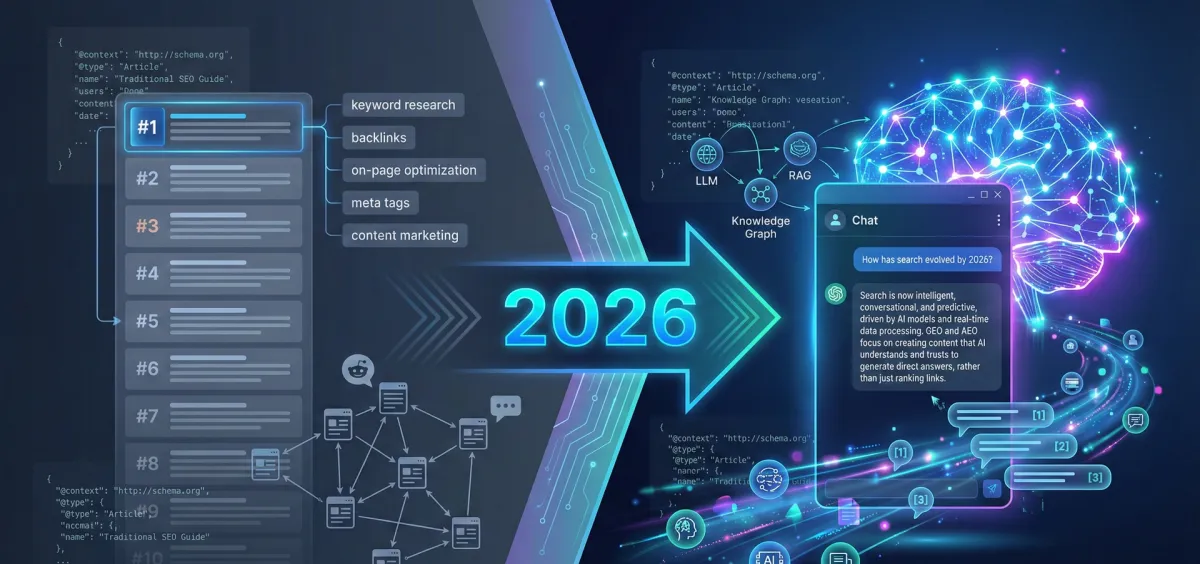
Generative Engine Optimization (GEO) and Answer Engine Optimization (AEO) are replacing traditional SEO as AI-powered commerce accelerates in 2026. Gartner predicts 90% of B2B buying will be AI agent intermediated by 2028, with consumer adoption following close behind as AI platforms like ChatGPT and Perplexity integrate shopping capabilities. GEO focuses on being cited in AI responses, while AEO structures content for voice assistants and autonomous shopping agents. Source: Gartner
Last Updated: January 26, 2026
What's the Difference Between SEO, GEO, and AEO?
Traditional SEO optimizes for keyword rankings to drive clicks, while GEO and AEO optimize for AI synthesis and extraction.
Key distinctions between the three approaches:
- SEO targets search engine algorithms to rank links for keyword queries and drive website traffic. Success is measured through keyword rankings and click-through rates.
- GEO targets large language models to cite your content when generating recommendations. It answers complex queries like "Compare the top 3 espresso machines under $300" by providing synthesizable depth.
- AEO targets retrieval systems and voice assistants to extract specific facts like price, availability, and specifications. It captures zero-click answers where users never visit a website.
| Feature | SEO | GEO | AEO |
|---|---|---|---|
| Primary Target | Search Engine Algorithms | Large Language Models (LLMs) | Voice Assistants & Agents |
| Core Objective | Rank links & drive traffic | Be cited in AI synthesis | Direct fact extraction |
| Success Metric | Keyword rankings & CTR | Citation frequency | Zero-click answer capture |
| Ideal Content | Keyword-optimized landing pages | Authoritative depth & context | Structured data & direct facts |
The fundamental shift is from matching keywords to providing context (GEO) and facts (AEO) that AI systems can use during discovery and transaction phases. Research from Princeton University shows that generative engines prioritize content depth and source consensus over traditional ranking signals. Source: Princeton University
How Does GEO Power AI Product Discovery?
GEO optimization makes your content citation-worthy when AI models synthesize product recommendations and industry answers.
Critical GEO strategies for 2026:
- Create comprehensive product detail pages with technical specifications, material breakdowns, and sustainability certifications that AI models can parse as authoritative evidence.
- Build "digital word-of-mouth" through active participation in Reddit, Quora, and niche forums where LLMs source consensus data during retrieval-augmented generation.
- Structure comparisons and use case scenarios that help AI models understand trade-offs and make contextual recommendations based on user needs.
- Implement E-E-A-T signals (Experience, Expertise, Authoritativeness, Trustworthiness) through author credentials, expert analysis, and third-party validation.
- Develop long-form content with semantic richness since AI agents function as "super-readers" that consume entire pages to form synthesized opinions.
Partnerships between major AI companies and Reddit, including Google's Reddit Data API agreement and OpenAI's ChatGPT integration, demonstrate how heavily AI systems weight community consensus. If forum discussions consistently mention product failures, no on-page optimization overcomes that signal when ChatGPT or Perplexity generates recommendations.
Why Does AEO Matter for Autonomous Agents?
AEO enables AI agents to execute transactions by providing machine-readable, verifiable data.
Essential AEO implementation elements:
- Deploy Schema.org markup including Product, Offer, MerchantReturnPolicy, and FAQPage types so agents can programmatically verify purchase parameters.
- Write extractable topic sentences at the start of each section with direct, declarative facts like "The Dyson V15 Detect runs for 70 minutes on low power."
- Optimize API response times under 2-3 seconds for inventory and pricing checks since agents prioritize merchants with instant data retrieval.
- Structure policies in dual formats with return policies, shipping details, and warranty information in both human-readable format and structured data formats.
- Eliminate ambiguity from product specifications since autonomous agents cannot complete purchases without confirmed price, availability, and policy verification.
While autonomous purchasing remains in pilot stages, Google's AI shopping features leverage Schema markup for product discovery. Structured data positions merchants to capture agent transactions as autonomous purchasing scales through 2026.
What's the Two-Layer Content Model?
The Two-Layer Content Model structures each page section with extractable answers followed by synthesizable depth, optimizing for both AEO and GEO simultaneously.

Implementation structure:
- Layer 1 (Extractable Answer): Open every section with a complete, factual sentence containing specific numbers, timeframes, or specifications. Voice assistants can quote this directly.
- Layer 2 (Synthesizable Depth): Follow with detailed evidence, technical context, comparative analysis, and supporting data. Generative models use this for comprehensive understanding.
Keep extractable answers front-loaded within the first 20-30 words of each section for optimal voice search and featured snippet capture. Include comparison context like "compared to standard models which average X" so AI models can synthesize relative performance. Include technical specifications, material composition, and test results that establish authority for GEO citation while supporting the extractable fact for AEO.
For example: "The Dyson V15 Detect runs for 70 minutes on low power. The 3600mAh lithium-ion battery maintains consistent suction throughout discharge, outperforming budget cordless vacuums that lose power as battery depletes."
When Should Merchants Implement GEO and AEO?
Q1 2026 implementation captures early market share as agent commerce scales through the year.
Quarterly implementation timeline:
- Q1 2026: Deploy core Schema.org types (Product, Offer, FAQPage), audit pages for extractable topic sentences, and establish baseline AI citation tracking metrics.
- Q2 2026: Add advanced Schema (MerchantReturnPolicy, PriceSpecification), optimize API response times, and launch community engagement programs for "generative PR."
- Q3-Q4 2026: Integrate agent transaction analytics, A/B test content structures for citation optimization, and develop agent-specific product feeds as platforms release specifications.
Measurement focus: Track citation frequency in AI responses, zero-click answer capture rates, Schema validation scores, and agent-assisted conversion rates. Merchants implementing in Q1 capture disproportionate share as agent commerce continues to exponentially scale in 2026. Late adopters face 6-12 month catch-up while early movers establish citation patterns.
Implementation Considerations
Successful GEO and AEO implementation requires integrated strategy across content, technical infrastructure, and community engagement.
Critical success factors:
- Start with Schema.org basics (Product, FAQPage) for immediate Google rich snippet benefits, then expand to advanced types (MerchantReturnPolicy, PriceSpecification) for agent readiness.
- Allocate budget between content optimization ($3000-$7500+ per month for SMBs, $15,000+ per month for enterprises with large catalogs) and ongoing community engagement.
- Monitor brand mentions in Reddit, forums, and review platforms as actively as on-site metrics since these drive AI model consensus.
- Optimize API endpoints for sub-3-second response times on inventory and pricing queries to meet emerging agent performance standards.
Early implementation costs are offset by competitive advantages in AI visibility as competitors capture agent transactions and citation authority.
What Industry Experts Say
"Reddit is the largest corpus of human conversation that's accessible on the internet."
"We are thrilled to partner with Reddit to enhance ChatGPT with uniquely timely and relevant information, and to explore the possibilities to enrich the Reddit experience with AI-powered features."
"Agentic will be a paradigm shift for e-commerce. With greater digitization of consumers' wallets, this could shake up the e-commerce funnel with implications across retailers and digital advertising players."
How to Prepare your Business for Agentic Commerce
A quarterly implementation timeline for merchants to optimize for AI discovery (AEO/GEO) and agent transactions throughout 2026.
Q1 2026: Deploy Core Infrastructure
Deploy core Schema.org types including Product, Offer, and FAQPage. Audit all product and content pages for extractable topic sentences that AI can quote directly. Establish baseline AI citation tracking metrics to measure progress.
Q2 2026: Add Advanced Schema and Optimize APIs
Implement advanced Schema types including MerchantReturnPolicy and PriceSpecification for agent commerce readiness. Optimize API response times to under 2-3 seconds for inventory and pricing queries. Launch community engagement programs for 'generative PR' on Reddit, forums, and review platforms.
Q3-Q4 2026: Integrate Analytics and Scale
Integrate agent transaction analytics to track AI-assisted conversions. A/B test content structures to optimize citation frequency. Develop agent-specific product feeds as platforms release specifications. Monitor and refine based on citation frequency, zero-click capture rates, and Schema validation scores.
Frequently Asked Questions
- How is GEO different from traditional SEO?
- GEO optimizes for AI synthesis and citation, not keyword ranking. While SEO targets search algorithms to rank links, GEO targets how ChatGPT and Perplexity understand and reference content. GEO prioritizes authoritative depth, technical accuracy, and forum consensus over keyword density and backlinks.
- What Schema.org types are most important for AEO in 2026?
- Product, Offer, MerchantReturnPolicy, PriceSpecification, and FAQPage are critical for agent commerce. Product and Offer provide transaction data (price, availability), MerchantReturnPolicy enables return verification, PriceSpecification supports dynamic pricing, and FAQPage structures voice search extraction.
- How long does it take to see results from GEO and AEO implementation?
- Basic Schema delivers immediate benefits through improved Google rich snippets within 2-4 weeks. GEO content optimization shows citation improvements within 2-3 months. Agent commerce ROI materializes through 2026 as autonomous purchasing scales.
- Do I still need traditional SEO if I implement GEO and AEO?
- Yes, traditional SEO remains important because Google Search still drives significant traffic in 2026. However, SEO alone is insufficient as conversational AI tools like ChatGPT Search, Perplexity, and Gemini are rapidly gaining adoption for product research and discovery. A hybrid strategy is optimal, maintain SEO fundamentals while adding GEO for AI discovery and AEO for agent transactions to capture the full spectrum of user behavior.
Get Ahead of the GEO and AEO Shift
Traditional SEO rankings are no longer the primary measure of search visibility. The brands that invest in GEO and AEO now will own the AI-answer layer before their competitors realize the game has changed.
Ready to future-proof your search strategy? Book your GEO and AEO audit
About This Article and Author
Authored by Shahzad Safri, Founder and AEO/GEO expert at agenticplug.ai, combining insights from Princeton University, Gartner, Reddit, OpenAI, and Morgan Stanley.