What Is WebMCP and Why It Matters for Agentic Commerce

 Add as a preferred source on Google
Direct Answer
WebMCP is a proposed web standard that lets websites expose structured, callable tools directly to AI browser agents, through a JavaScript API at document.modelContext and through annotations on HTML forms. It is developed by engineers at Google and Microsoft in the W3C Web Machine Learning Community Group, whose draft is not a W3C Standard. Chrome opened an early preview on February 10, 2026 and has run an origin trial since Chrome 149; Microsoft Edge has run one since Edge 150.
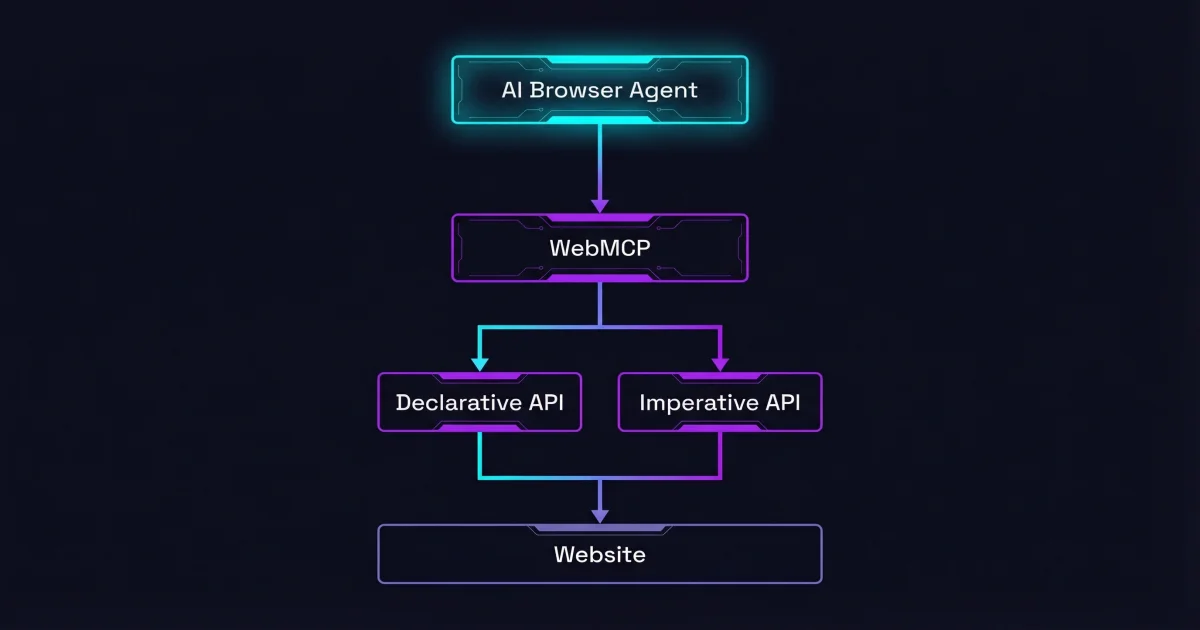
Instead of AI agents scraping HTML or processing screenshots to interact with a website, WebMCP gives them a structured interface to call defined functions directly. Chrome implements two APIs: the Imperative API, which the specification defines, registers tools in JavaScript with document.modelContext.registerTool(), and a Declarative API that Chrome is testing, not yet in the specification, turns existing HTML forms into tools with attributes such as toolname and tooldescription.
Key Takeaways
- WebMCP is a proposed web standard, developed by Google and Microsoft engineers in the W3C Web Machine Learning Community Group, that lets websites expose structured, callable tools directly to AI browser agents through the document.modelContext API and annotated HTML forms.
- Chrome implements two APIs: the Imperative API, defined by the specification, handles complex, dynamic interactions in JavaScript; a Declarative API for existing HTML forms is being tested by Chrome and is not yet in the specification.
- Local businesses stand to gain significantly. A restaurant, hotel, or professional services firm that implements WebMCP lets AI agents check availability and fill in bookings and service requests for the customer to confirm, without screen-scraping workarounds.
- WebMCP is in origin trials in Chrome and Edge, not yet on by default there. Chrome has offered an origin trial since Chrome 149 and Microsoft Edge since Edge 150, so sites can test it on live pages, and the API can still change. ChatGPT's desktop app already uses WebMCP tools in its built-in browser for accounts with access, where OpenAI calls them site tools. The readiness work starts now.

WebMCP is a proposed web standard that lets websites expose structured, callable tools directly to AI browser agents, through a JavaScript API at document.modelContext and through annotations on HTML forms. Developed by engineers at Google and Microsoft in the W3C Web Machine Learning Community Group, it opened to early-preview testing in Chrome on February 10, 2026, and has been in origin trials in Chrome since Chrome 149 and in Microsoft Edge since Edge 150.
This is not another AI feature announcement. WebMCP is infrastructure. It defines how AI agents can interact with every website that chooses to implement it, including yours.
Why WebMCP Exists: The Problem with How AI Agents Browse the Web Today
When an AI browser agent visits a website today, it has no native way to understand what actions are available. It is reduced to guessing, using one of two expensive and fragile approaches:
- Screenshot-based scraping: The agent passes images of your website into a multimodal model like Claude or Gemini. The model must identify what is on screen, locate interactive elements, and attempt to click them. Every step costs tokens and time, and each one is open to interpretation by the model.
- DOM parsing: The agent ingests your raw HTML, CSS, and JavaScript. It is a massive file full of structural markup irrelevant to the agent's task, filling the context window and adding cost with every page load.
The result: a task a person finishes in a few clicks can take an agent many sequential steps, each a separate model call, with no guarantee of success.
WebMCP ends this by giving websites a way to speak the agent's language directly.
Sources: Chrome for Developers, February 10, 2026, Chrome for Developers: WebMCP
How WebMCP Works: Two APIs in Chrome
Chrome implements two complementary APIs that serve as a bridge between websites and AI browser agents: a JavaScript API at document.modelContext, which the WebMCP specification defines, and HTML attributes that turn a form into a tool, a declarative approach the WebMCP explainer describes as being explored separately from the specification. Early drafts placed the API at navigator.modelContext; the specification now defines it on the document. Chrome describes WebMCP as a set of "MCP-inspired" APIs rather than a JavaScript implementation of MCP: it is not an extension or a replacement of MCP.
The Declarative API
The Declarative API handles standard actions that can be defined directly in existing HTML forms. For organizations with well-structured forms already in production, this pathway requires minimal additional work. By adding a toolname and a tooldescription attribute to an existing form, developers make it callable by agents, with the form's fields as the tool's parameters. When an agent calls it, the browser fills in the form where the user can see it, and by default the user clicks Submit; a toolautosubmit attribute lets the tool submit the form itself.
This matters significantly for local businesses. A restaurant's reservation form, a hotel's booking widget, a law firm's intake form. All of these can become agent-callable with minimal changes to existing code.
The Imperative API
The Imperative API handles more complex, dynamic interactions that require JavaScript execution. Through document.modelContext.registerTool(), a website registers a tool with a name, a natural-language description, a schema for its inputs and a function that runs it. The tool definitions are conceptually similar to the tool definitions sent to the OpenAI or Anthropic API endpoints, but they run entirely client-side in the browser.
For example, an e-commerce site can register a searchProducts(query, filters) tool that lets the agent make one structured function call and receive structured JSON results, rather than clicking through filter dropdowns, scrolling paginated results, and screenshotting each page. A single WebMCP tool call can replace many separate browser-use steps.
Sources: Chrome for Developers: Imperative API, Chrome for Developers: Declarative API, Chrome for Developers: WebMCP and MCP, WebMCP Draft Community Group Report
WebMCP vs Web Scraping: Why the Old Approach Is Costing You Customers
To understand why WebMCP matters, it helps to understand what AI browser agents are doing without it today. The contrast makes the value proposition concrete.
When an AI browser agent visits a website without WebMCP support, it has two choices. The first is visual screen scraping: passing screenshots of your website into a multimodal model like Claude or Gemini, which must then identify what is on screen, locate interactive elements, and attempt to click them. Every screenshot costs tokens and time. The second is DOM parsing: ingesting your raw HTML, CSS, and JavaScript, a massive file full of structural markup that is irrelevant to the agent's task but still fills the context window and adds cost.
Either way, the agent is translating between what your website was built for (human eyes) and what the model needs (structured data about available actions). A product search or a reservation that a person finishes in a few clicks can take an agent many sequential steps, each a separate inference call with its own cost and latency, with no guarantee of success.
| Dimension | Web Scraping (Today) | WebMCP (Structured Tools) |
|---|---|---|
| How the agent reads your site | Screenshots or raw HTML parsed by the model | Structured tool definitions the agent calls directly |
| Token cost per interaction | A model call for every screenshot or DOM parse | Minimal: one structured function call and response |
| Steps to complete a booking | Many sequential interactions, each an inference call | One structured tool call (for example, make_reservation), with the user in the loop |
| Reliability | Fragile: breaks when UI changes, fails on dynamic elements | Stable: tool interface is explicitly maintained by the website |
| What happens when it fails | Agent may give up and try a site that is easier to navigate | Structured error response the agent can handle gracefully |
| What it requires from the business | Nothing. The agent does the hard work, badly. | Implement Declarative or Imperative API on key interaction flows |
The critical business implication is buried in that last failure mode. When a web scraping approach fails, the agent does not retry indefinitely; it may move on to a competitor whose website is easier to navigate. In our view, agents will favor whoever is most transactable, not necessarily whoever has the best product or the lowest price. WebMCP tips that decision in your favor by removing friction from the agent's path.
Sources: Chrome for Developers: WebMCP, Chrome for Developers: WebMCP and MCP
Why WebMCP Matters for Local Businesses
WebMCP is often discussed in the context of large e-commerce platforms and enterprise IT. That framing undersells where the most significant near-term opportunity lies: local businesses with transactable services.
Restaurants, hotels, medical practices, law firms, salons, gyms, and professional services businesses all have one thing in common: their core conversion action is a booking, reservation, or inquiry. That is exactly the interaction WebMCP is designed to streamline for AI agents.
Consider what happens today when a user asks an AI browser agent to "book me a dinner reservation at an Italian restaurant in Miami this Saturday." The agent must identify candidates, navigate to each restaurant's website, figure out where the reservation widget is, attempt to interact with it through DOM parsing or screenshotting, and handle any errors along the way. The process is slow, fragile, and frequently fails.
With WebMCP implemented, a browser agent that supports it can call a structured make_reservation tool with the date, time and party size instead. The form fills in front of the user, who confirms the booking. The restaurant that implements WebMCP gives the agent a reliable path; the one that does not leaves it guessing.
WebMCP Use Cases by Business Type
- Restaurants: Expose reservation availability and booking as agent-callable tools. An AI assistant can check availability and fill in the reservation through a structured tool, with the diner confirming it, instead of navigating a booking widget step by step.
- Hotels and vacation rentals: Expose room availability, pricing, and booking flows. An agent helping a user plan a trip can compare options and fill in the booking on the hotel's own page, with the guest confirming it.
- Medical and dental practices: Expose appointment scheduling for new and returning patients. An AI assistant can fill in an appointment request on the practice's page for the patient to confirm, without the patient working through a portal step by step.
- Law firms and professional services: Expose intake forms and consultation scheduling. A user asking for legal help can be connected to the right practice area and have an initial consultation request filled in for them to confirm.
- Salons and spas: Expose service menus and appointment availability. An AI assistant helping a user prepare for an event can book a haircut and color appointment, with the user only confirming it.
- Gyms and fitness studios: Expose class schedules and registration. An AI assistant can browse schedules and fill in a class registration for the user to confirm.
The common thread is that any business whose conversion action is a form submission, a booking, or a reservation stands to benefit from WebMCP. In our view, being agent-transactable is becoming a competitive differentiator for these businesses.
WebMCP operates at the browser interaction layer of agentic commerce. Protocols like ACP and UCP handle the checkout transaction once a product or service has been selected. WebMCP handles the structured interaction that gets the agent there. In our view, for service businesses, restaurants, and hotels, WebMCP may be the agentic commerce protocol that matters most.
Current Status: Origin Trials in Chrome and Microsoft Edge
- Where it stands: WebMCP is a Draft Community Group Report of the W3C Web Machine Learning Community Group, edited by engineers from Microsoft and Google. It is not a W3C Standard and is not on the W3C Standards Track.
- Chrome: Chrome opened an early preview on February 10, 2026, with a developer trial behind a flag from Chrome 146. Since Chrome 149 (June 2026) it has run an origin trial, now extended through Chrome 162.
- Microsoft Edge: Edge has offered a WebMCP origin trial since Edge 150. The trial expires on March 30, 2027, and Edge's trial terms note that the feature may never be enabled beyond it.
- What an origin trial means: A site registers for the trial and can then use the API on its own live pages for a limited time. It is an experiment: the API can still change, and in Chrome and Edge nothing is turned on for sites that have not registered.
- ChatGPT and Shopify: ChatGPT's desktop app supports WebMCP in its built-in browser for accounts with access, where OpenAI calls the tools site tools, and ChatGPT asks for confirmation before purchases and other sensitive actions. Shopify serves WebMCP tools that let browser agents read and update its checkouts.
- Other browsers: Mozilla's standards position on WebMCP is neutral. Apple's WebKit team has said it opposes the proposal, so Safari support should not be assumed.
- Production timeline: Neither Google nor Microsoft has announced when WebMCP will ship by default in Chrome or Edge.
- What you can do today: Readiness preparation requires no trial registration. Cleaning up HTML form structure, documenting interaction patterns, and identifying Declarative vs Imperative API candidates is the same structural work that improves your site for human users and current AI crawlers in the meantime.
Sources: Chrome for Developers, June 9, 2026, Chrome Platform Status, Microsoft Edge 150 release notes, Microsoft Edge origin trial, WebMCP Draft Community Group Report, Mozilla standards position, WebKit standards position, OpenAI Help Center, Shopify developer changelog
What Businesses Should Do Now
Chrome and Edge have not turned WebMCP on by default yet, and its API is still changing during the origin trials. In our view, early mover advantages in protocol adoption are real, and the preparation work has compounding benefits regardless of when WebMCP stabilizes.
-
Audit your conversion forms. Identify every form on your website that represents a business transaction: reservations, bookings, quote requests, contact forms, checkout flows. These are your WebMCP candidates. For each one, document what data it collects, what it triggers, and what the success state looks like.
-
Clean up your HTML form structure. The Declarative API is designed to work with well-structured HTML forms. Forms that rely on JavaScript state machines, custom widgets, or non-semantic HTML will require more work to make agent-callable. The cleanup improves accessibility and form conversion rates today while positioning you for WebMCP tomorrow.
-
Document your site's callable actions. What can an AI agent do on your site on a user's behalf? Write out the list in plain language: "search available dates," "make a reservation for X people on Y date," "get a price quote for X service." These become your Imperative API tool definitions when you implement WebMCP.
-
Join the WebMCP origin trial when you are ready to test on a live site. Registering for Chrome's origin trial, and Microsoft Edge's, lets your developers run WebMCP tools on your real pages and send feedback while the API is still being shaped. Engaging early is also a chance to give feedback on how it accommodates your use case.
-
Test locally with the Chrome flag, DevTools and the Model Context Tool Inspector. Enable
chrome://flags/#enable-webmcp-testingin Chrome, use the WebMCP panel in Chrome DevTools to inspect the tools your page registers, and install the Model Context Tool Inspector extension to try them with an agent. This is low-risk prototyping that requires no production changes. -
Plan your security layer. WebMCP tools are callable actions exposed to external agents. Before any production implementation, define authentication requirements, rate limits, and user consent flows for each tool. Treat WebMCP tools with the same discipline you would apply to a public API: validate inputs, return meaningful error responses, and require appropriate permissions for sensitive actions like checkout or booking.
-
Layer WebMCP readiness with broader agentic commerce readiness. WebMCP does not exist in isolation. If your product data is unstructured, your Schema.org markup is missing, or your entity graph is ambiguous, AI agents will struggle to discover and evaluate you before they ever reach the WebMCP interaction layer. The full agentic commerce readiness picture includes all of these layers working together.
The A.G.E.N.T.I.C. Angle: Network and Convert
WebMCP maps to two phases of the A.G.E.N.T.I.C. Framework for agentic commerce readiness:
- Phase 4: Network: Making your business part of the agentic web by establishing the connections and protocols that allow AI agents to interact with your brand. WebMCP is a Network-phase implementation. A business that registers its booking form as a WebMCP tool is wiring itself into infrastructure that AI browser agents can use to act on behalf of buyers.
- Phase 7: Convert: Being transactable. For e-commerce businesses, Convert focuses on ACP and UCP protocol readiness. For service businesses, restaurants, hotels, and professional services firms, WebMCP is often the primary Convert-phase implementation: the protocol that lets an AI agent complete a booking on your site, with the customer confirming it, instead of navigating your pages step by step.
The businesses that complete the full A.G.E.N.T.I.C. Framework stack, covering discovery through transaction, will be positioned ahead of competitors who are still treating AI search as an SEO variant rather than a new infrastructure layer requiring its own preparation.
If you want to understand where your business stands across all seven phases, start with an AI visibility audit. The gaps are almost always in the structural layers, not the content layers, and WebMCP readiness is part of the same structural foundation.
Frequently Asked Questions
- What is WebMCP?
- WebMCP is a proposed web standard that lets websites expose structured, callable tools directly to AI browser agents, through a JavaScript API at document.modelContext and through annotations on HTML forms. Instead of agents scraping HTML or taking screenshots to interact with a website, WebMCP gives them a structured interface to call directly. It is developed by engineers at Google and Microsoft in the W3C Web Machine Learning Community Group. Chrome opened an early preview in February 2026, and Chrome and Microsoft Edge now run origin trials.
- How is WebMCP different from web scraping?
- Without WebMCP, an AI agent has to pass screenshots or raw HTML into a model and work out what to click, step by step, which is slow, costs tokens at every step, and breaks when a website's interface changes. WebMCP replaces that with structured tool calls: the agent calls a defined tool, such as make_reservation, and receives a structured response. Chrome's documentation says this can significantly improve the performance and reliability of agent actuation. If a site is hard to navigate, an agent may try another one; WebMCP gives it a reliable path through yours.
- What are the two WebMCP APIs?
- Chrome implements two complementary APIs: the WebMCP specification defines the Imperative API, and the Declarative API is a form-based approach Chrome is testing that the specification does not yet include. The Declarative API turns existing HTML forms into tools: a toolname and a tooldescription attribute on the form, with its fields as the tool's parameters, so well-structured forms need little extra work. The Imperative API handles complex, dynamic interactions in JavaScript: with document.modelContext.registerTool(), a website registers a tool with a name, a natural-language description, a schema for its inputs and a function that runs it, entirely client-side in the browser.
- What does WebMCP mean for local businesses?
- WebMCP lets local businesses expose their reservation, booking, and inquiry flows as structured agent-callable tools. A restaurant can make its reservation form callable by AI agents directly. A hotel can expose room availability and checkout. A law firm can expose intake forms. With the Declarative API, the browser fills in the form where the customer can see it, and by default the customer submits it, so they stay in control of the booking. Businesses that prepare early will be ready as more browsers and agents support it.
- When will WebMCP be available for production use?
- Chrome and Microsoft Edge have not turned WebMCP on by default yet. Chrome opened an early preview program on February 10, 2026, then an origin trial in Chrome 149 (June 2026) that now runs through Chrome 162. Microsoft Edge has offered an origin trial since Edge 150, and its trial expires on March 30, 2027. ChatGPT's desktop app already supports WebMCP in its built-in browser for accounts with access, where OpenAI calls the tools site tools, and Shopify serves WebMCP tools that let browser agents work with its checkouts. An origin trial lets a site use the API on its own live pages for a limited time while the design is still changing; for local development, Chrome also offers a flag. Neither Google nor Microsoft has announced a date to ship it by default, and Apple's WebKit team has said it opposes the proposal, so Safari support should not be assumed. The readiness work is worth starting now.
- How does WebMCP relate to agentic commerce?
- Agentic commerce is the emerging model where AI agents discover, evaluate, and transact on behalf of buyers without constant human direction. WebMCP provides the browser-layer infrastructure that makes websites transactable by those agents. Without WebMCP or a protocol like it, agents must scrape and screenshot their way through checkout flows. WebMCP removes that friction by giving agents a structured interface. It sits between the agent (who operates in the browser) and the website (which needs to expose its capabilities in a structured way).
Make Your Website Transactable by AI Agents
WebMCP is in origin trials in Chrome and Microsoft Edge, and the readiness work starts now. The businesses that structure their forms, document their callable actions, and plan their agent-facing interfaces today will be ready as more browsers and agents support it.
Ready to find out where you stand? Book your free Agentic Commerce audit
About This Article and Author
Authored by Shahzad Safri, Founder and Agentic Web expert at agenticplug.ai, combining insights from Chrome for Developers, Microsoft Edge, and the WebMCP specification.