How to Choose an Agentic Commerce Optimization Provider in 2026

 Add as a preferred source on Google
Direct Answer
To choose an agentic commerce optimization provider, evaluate whether they can deliver across all seven phases of the A.G.E.N.T.I.C. Framework: Audit (AI visibility diagnosis), Graph (entity architecture), Equip (citation-ready content), Network (protocol implementation), Track (AI citation measurement), Influence (external corroboration), and Convert (agent transaction optimization). The provider should be able to run your brand through buyer-intent queries across ChatGPT, Claude, and Perplexity live, implement commerce protocols like ACP, UCP, and MCP, and, on AI platforms that support branded apps such as ChatGPT, deploy an AI Branded Storefront where agents can complete transactions without sending consumers to your website.
Red flags include providers who measure success by keyword rankings instead of citation rates, treat every AI platform the same, cannot explain the difference between AEO and GEO, have no protocol implementation capability, or do not mention entity architecture. Expect initial AI citations within 3 to 6 weeks and meaningful ROI by month 4.
Key Takeaways
- Agentic commerce optimization prepares businesses for AI agents that autonomously research, compare, and purchase, not humans clicking through search results.
- It requires fundamentally different skills than traditional SEO: entity architecture, protocol implementation, AI citation measurement, and product feed optimization for agent consumption.
- The A.G.E.N.T.I.C. Framework maps the full lifecycle across seven phases, from initial AI visibility audit through agent-completed transactions.
- AI Branded Storefront Deployment is the key differentiator: your products become discoverable, configurable, and purchasable inside AI conversations on platforms that support branded apps, without the consumer leaving the platform.
- Most providers in this space are repackaging SEO. The test: can they implement commerce protocols and deploy an AI-native storefront, or do they stop at content optimization?
- Realistic timelines: initial AI citations within 3 to 6 weeks, meaningful ROI by month 4, full framework maturity at 3 to 6 months.
What Is Agentic Commerce Optimization?
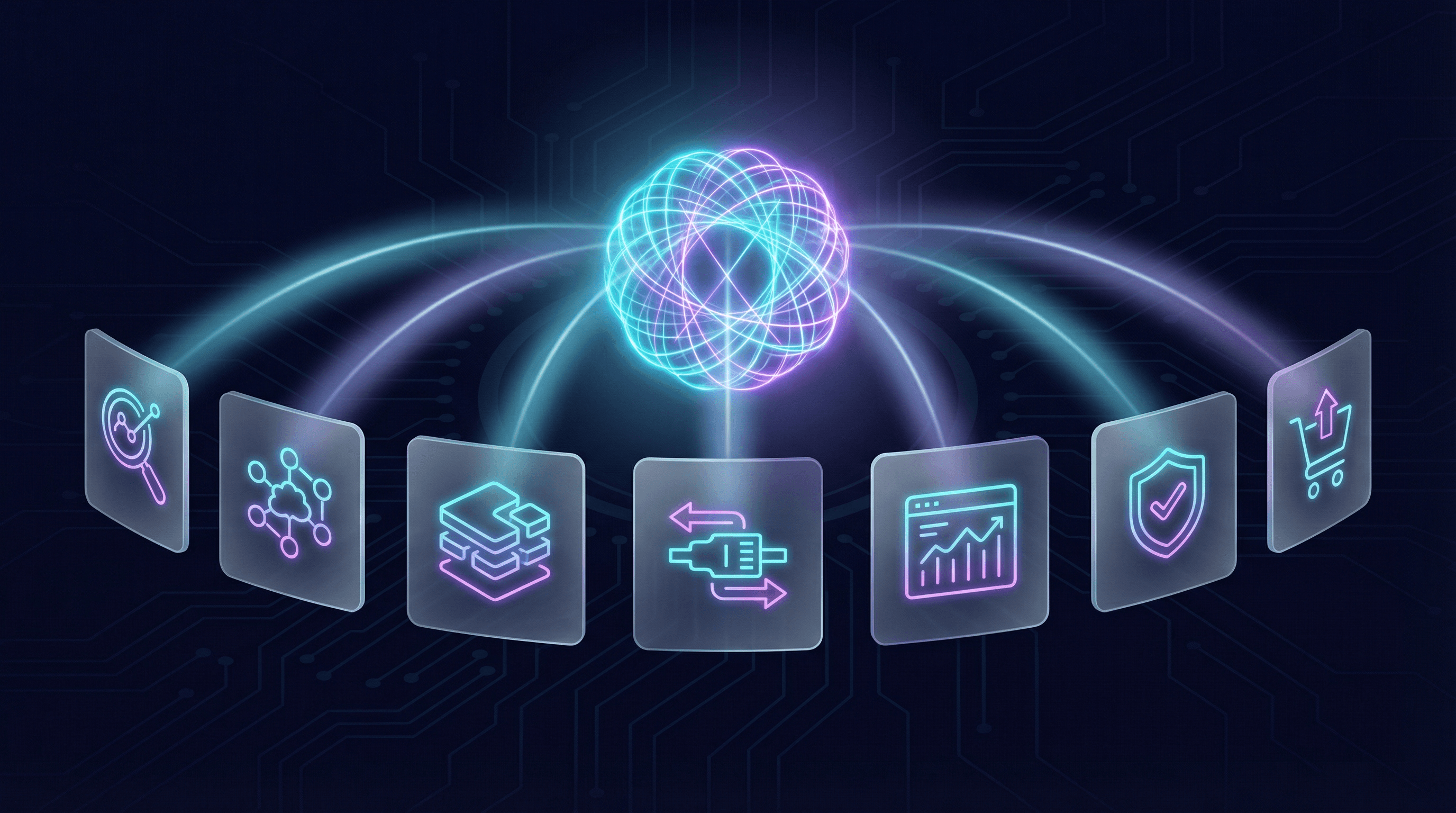
Agentic commerce optimization sits at the intersection of three shifts happening simultaneously: AI platforms replacing traditional search as the primary discovery channel, open protocols enabling AI agents to transact directly with businesses, and consumers increasingly delegating purchase decisions to autonomous agents.
The discipline requires a fundamentally different skill set than traditional digital marketing. A business can rank first on Google and still be completely invisible to ChatGPT. A website can convert well for human visitors and still be unreadable to an AI agent evaluating products on a consumer's behalf. The optimization problem is different because the "visitor" is different.
Traditional SEO optimizes for humans navigating search engine results pages. Answer Engine Optimization (AEO) and Generative Engine Optimization (GEO) optimize for AI platforms generating direct answers. Agentic commerce optimization encompasses both and extends further: it also optimizes for the transaction layer where AI agents do not just recommend your business but actually complete purchases, book appointments, and negotiate terms on behalf of consumers.
This is not a rebrand of SEO with "AI" in front of it. The technical requirements, measurement frameworks, and optimization levers are fundamentally different.
Why This Is a Distinct Discipline
The market is filling up with agencies adding "AI optimization" to their service pages. Most of them are applying traditional SEO tactics to a problem that requires a completely different approach. Here is what separates genuine agentic commerce optimization from repackaged search marketing.
- Different discovery mechanics. Google ranks pages based on links, relevance signals, and user behavior. AI platforms cite sources based on entity recognition, content structure, topical authority, and cross-platform consistency. Two businesses with identical Google rankings can have wildly different AI citation rates.
- Different content requirements. Traditional content is written for humans who scan and skim. AI-optimized content must be extractable in self-contained blocks, structured with machine-readable schema, and consistent enough across the web that AI models can confidently attribute claims to your brand without hallucinating.
- Different measurement. Google Analytics tells you about human traffic. Agentic commerce optimization requires tracking AI citations across ChatGPT, Claude, Perplexity, Google AI Overviews, and Amazon's Alexa for Shopping (formerly Rufus), measuring share of voice in AI-generated answers, and attributing revenue to AI-referred transactions. Most marketing dashboards cannot do any of this.
- Different transaction infrastructure. Traditional agencies optimize for human conversion funnels: landing pages, checkout flows, form fills. Agentic commerce optimization requires protocol implementation (ACP, UCP, MCP, MPP) so AI agents can access your catalog, check inventory, negotiate pricing, and complete transactions programmatically. If your provider cannot explain what these protocols do, they are not doing agentic commerce optimization.
- Different product data requirements. Traditional product feeds are built for Google Shopping and marketplace algorithms. AI agents need structured, real-time product data with complete attribute coverage, consistent naming conventions, accurate inventory signals, and machine-readable specifications they can evaluate programmatically. If your catalog is not optimized for agent consumption, agents cannot compare your products, check availability, or recommend you over competitors.
The A.G.E.N.T.I.C. Framework: How to Evaluate Any Provider
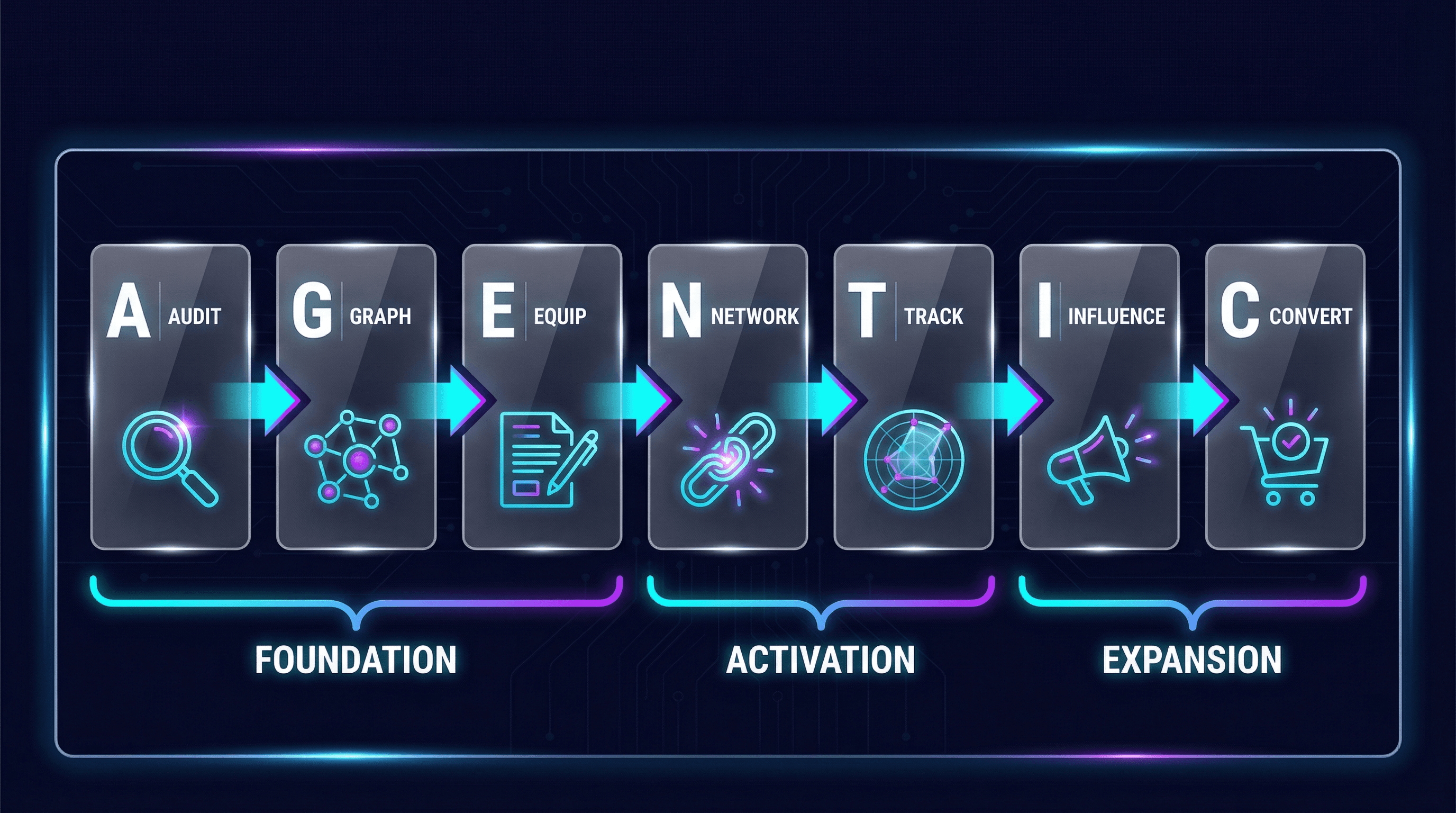
The most reliable way to evaluate an agentic commerce optimization provider is to assess whether they can deliver across all seven phases of the optimization lifecycle. We built the A.G.E.N.T.I.C. Framework to map this lifecycle from initial diagnosis through full agentic transaction capability. Each phase represents a distinct capability, and skipping any of them creates gaps that undermine the others.
Phase 1: Audit: Can They Diagnose Where You Actually Stand?
The first question to ask any provider: how will you measure my current AI visibility?
A credible audit tests your brand across every major AI platform with 25 to 50 buyer-intent queries specific to your category. Key deliverables include:
- Platform citation testing across ChatGPT, Claude, Perplexity, Google AI Overviews, and Amazon's Alexa for Shopping (formerly Rufus)
- Entity recognition analysis: does AI understand who your brand is, what you sell, and who runs it?
- Competitive visibility mapping: who gets cited instead of you, and why?
- Content structure assessment: is your current content built for AI extraction or only for human readers?
If a provider's "audit" is a keyword ranking report with an AI label on it, that is not an agentic commerce audit. The audit must test AI-specific citation behavior, not traditional search rankings.
What to ask: "Run my brand through 30 buyer-intent queries across ChatGPT, Claude, and Perplexity right now. What do you find?" Any provider who can do this live has the capability. Anyone who deflects does not.
Phase 2: Graph: Can They Build Your Entity Architecture?
AI platforms make recommendation decisions based on entity recognition. If an AI model does not have a clear, consistent understanding of who your brand is, what you sell, who leads the company, and how you relate to your competitive category, it will either hallucinate details or recommend a competitor whose entity graph is cleaner.
Entity architecture means building explicit, machine-readable relationships between your brand and everything connected to it. Key deliverables include:
- Entity inventory mapping: organization identity, products, leadership, locations, methodologies, proprietary concepts
- Schema.org implementation: Organization, Product, Person, FAQPage, HowTo, DefinedTerm markup
- External entity validation across Wikipedia, Wikidata, Crunchbase, and industry databases
- Cross-platform consistency audit: ensuring every mention of your brand says the same thing
What to ask: "What schema types will you implement, and how do you validate entity consistency across external platforms?" If the answer is only "we will add some structured data," they are not building entity architecture. They are adding markup.
Phase 3: Equip: Can They Structure Content for AI Citation?
Content optimization for AI platforms is structurally different from traditional SEO content. The key technique is the answer capsule: a 50 to 150 word self-contained answer placed immediately after a question-based heading. The answer must be extractable without context from the rest of the page because AI platforms chunk content during retrieval.
Beyond answer capsules, effective AI content optimization includes:
- FAQPage schema on every key page
- Scannable hierarchies that AI retrieval systems can parse
- Entity-clear language that avoids ambiguous pronouns and inconsistent terminology
- Visible recency signals (last-updated dates, current statistics) that signal freshness to AI crawlers
What to ask: "Show me an example of content you have optimized for AI citation. What was the citation rate before and after?" Results matter more than process descriptions.
Phase 4: Network: Can They Connect You to Agent Transaction Layers?
This is where most providers stop and where real agentic commerce optimization begins. The Network phase connects your product catalog, inventory, and pricing to the protocol infrastructure that allows AI agents to transact directly with your business.
The protocol landscape as of 2026 includes the Agentic Commerce Protocol (ACP) from Stripe and OpenAI, the Universal Commerce Protocol (UCP) that Google co-developed with Shopify and major retailers, the Model Context Protocol (MCP), created by Anthropic and now at the Linux Foundation's Agentic AI Foundation, the Agent Payments Protocol (AP2), created by Google and now at the FIDO Alliance, and the Machine Payments Protocol (MPP) from Stripe and Tempo. Each serves a different function in the agent transaction stack, and implementation requirements vary by platform and business model.
A provider that only optimizes content but cannot implement protocol connectivity is delivering half a solution. Content optimization makes your business visible to AI agents. Protocol implementation makes your business transactable by AI agents. Visibility without transactability means agents recommend you but cannot close the sale.
What to ask: "Which protocols have you implemented for clients, and on which platforms?" If the answer is none, they are an AI SEO provider, not an agentic commerce optimization provider.
AI Branded Storefront Deployment: The Differentiator (Network + Convert)
AI Branded Storefront Deployment bridges Phase 4 (Network) and Phase 7 (Convert). Network deploys the storefront infrastructure and connects it to commerce protocols. Convert optimizes what flows through it: pricing logic, agent negotiation, and conversion rates for agent-initiated transactions.
Most optimization stops at making your existing website more visible to AI agents. AI Branded Storefront Deployment goes further: it creates an AI-native commerce surface where agents can discover your products, evaluate options, and, on platforms that support branded apps, complete transactions within the AI platform's interface.
This means your brand is not just cited in a ChatGPT answer with a link back to your website. Your products are surfaced, configured, and purchasable inside the AI conversation itself, through a branded app on platforms that support one, such as ChatGPT. The consumer can complete the purchase without leaving the AI platform, with the agent handling the steps on their behalf, powered by your real-time inventory, pricing, and fulfillment data.
This is the difference between being mentioned and being transactable. Most providers in the market today can help you get mentioned. Very few can deploy the storefront infrastructure that makes you transactable. If a provider does not offer this capability, they are optimizing for the discovery layer only and leaving the entire conversion layer untouched.
What to ask: "Can you deploy my products so AI agents can complete transactions without sending the customer to my website?" This single question separates content optimizers from agentic commerce optimizers.
Phase 5: Track: Can They Measure What AI Actually Sees?
Traditional marketing measurement breaks down in the agentic commerce era. Google Analytics cannot tell you how often ChatGPT cites your brand. Search Console does not track agent-initiated transactions. The measurement infrastructure for agentic commerce is fundamentally different and most providers do not have it.
Effective measurement requires:
- Citation frequency tracking across all major AI platforms
- Share of voice analysis: how often you are cited versus competitors for the same queries
- Sentiment monitoring: how AI describes your brand when it does cite you
- Agent-initiated session tracking
- Conversion attribution for AI-referred revenue
The Track phase also serves as the quality gate for everything that comes after. You do not scale Influence or Convert until Track confirms the foundation is working. This is the "never scale a hallucination" principle: if AI models are citing your brand incorrectly, amplifying that signal makes the problem worse, not better.
What to ask: "What dashboard will I see, and what metrics does it track that Google Analytics cannot?" If they cannot answer this specifically, their measurement capability is not built for agentic commerce.
Phase 6: Influence: Can They Build External Corroboration?
AI models rely on consensus across multiple sources to avoid hallucinations. Even with perfect entity architecture and citation-ready content, an AI platform will not confidently recommend your brand if external signals are neutral or absent. The Influence phase builds the external corroboration that makes AI models trust your brand enough to recommend it.
This includes strategic placement in machine-trusted publications, review management across platforms that AI models actively ingest (G2, Trustpilot, Reddit, industry directories), and creator partnerships that build positive brand associations at the training data level.
What to ask: "How do you build external trust signals that specifically improve AI citation confidence?" If the answer sounds like traditional PR or link building, they may not understand the difference between signals that influence Google rankings and signals that influence AI recommendation behavior.
Phase 7: Convert: Can They Optimize the Agentic Handoff?
The final phase optimizes what happens when an AI agent initiates a transaction with your business. This includes the business logic that allows your systems to programmatically negotiate terms with AI agents, dynamic pricing that agents can evaluate and present to consumers, and conversion optimization for the agent-to-brand handoff moment.
Convert is distinct from Network. Network connects the pipes. Convert optimizes what flows through them. A business can be protocol-connected but still lose transactions because its pricing logic is not agent-friendly, its inventory responses are too slow, or its handoff experience creates friction that causes the agent to route the consumer elsewhere. This is also where AI Branded Storefront Deployment reaches its full potential: the storefront is deployed in the Network phase, but the conversion optimization that makes it perform lives here.
What to ask: "How do you optimize conversion rates for agent-initiated transactions specifically?" This is the most advanced capability in the market and very few providers offer it today.
Red Flags When Evaluating Providers
After working across every phase of this lifecycle, certain patterns reliably predict whether a provider can actually deliver agentic commerce optimization or is repackaging traditional services.
- They measure success by keyword rankings. Agentic commerce optimization is measured by citation rates, share of voice in AI answers, and agent-initiated transactions. If the primary KPI is organic traffic or keyword position, their framework is built for a different problem.
- They treat every AI platform the same. ChatGPT, Claude, Perplexity, and Google AI Overviews all use different retrieval pipelines, trust signals, and entity resolution approaches. Any provider that presents a single optimization approach for "AI search" without platform-specific tactics is oversimplifying.
- They cannot explain the difference between AEO and GEO. AEO targets specific queries where AI returns one definitive answer. GEO shapes how the model understands your category and expertise before any query is asked. Both matter, and they require different tactics. If a provider conflates them, their understanding is surface-level.
- They have no protocol capability. Content optimization is one layer. Protocol implementation (ACP, UCP, MCP) is another. If a provider only offers content and schema optimization, they are delivering half the value chain.
- They do not mention entity architecture. This is the single biggest signal. If a provider's approach starts and ends with content optimization without addressing entity recognition, they are missing the foundation that makes everything else work.
- They cannot deploy or optimize an AI Branded Storefront. If a provider can only optimize your existing website for AI visibility but cannot deploy and optimize a storefront where AI agents complete transactions inside the conversation, they are stopping at discovery. The entire conversion layer is missing. Ask whether they can make your products purchasable inside an AI platform that supports branded apps, such as ChatGPT.
What Results to Expect and When
Agentic commerce optimization is not an overnight transformation. The timeline depends on where a business starts, but realistic expectations based on the A.G.E.N.T.I.C. Framework implementation paths look like this:
Foundation First covers all seven phases sequentially. This path is for businesses building long-term AI commerce resilience. It takes the most time upfront but creates the strongest compounding foundation.
Quick Visibility focuses on Graph, Equip, Track, and Influence. It is the fastest path to AI citation improvement, with protocol integration added later. Best for businesses that need visible AI presence quickly but are not yet ready for transaction-layer work.
Commerce-Urgent runs Graph, Network, and Convert in parallel. This path prioritizes agent-mediated transactions for e-commerce brands already seeing AI agent traffic. It sacrifices some foundation depth for transaction-layer speed.
Initial AI citations can begin appearing within 3 to 6 weeks as entity architecture and content optimization take effect. Full framework maturity takes longer. The compounding nature of entity architecture, citation authority, and AI trust signals means early phases build the foundation that later phases amplify. Cutting corners on Graph or Equip to rush to Convert is the most common and most expensive mistake businesses make.
Frequently Asked Questions
- What does agentic commerce optimization cost?
- agenticplug.ai prices it in two tiers. Essentials ($3,000 to $5,550 per month) covers a single location and one website: AEO/GEO content, structured data and schema, knowledge graph architecture and entity consistency, digital PR, technical SEO, and multi-platform AI search analytics. Pro is scoped with you on a call. It is for multi-location brands, competitive categories and multi-brand groups, and adds agentic commerce optimization, competitive displacement, custom protocol integrations, custom MCP server and AI assistant app development for ChatGPT and Claude, and AI Branded Storefront Deployment. The most important factor is not the monthly fee but whether the provider can deliver across all seven phases or only a subset.
- How is agentic commerce optimization different from SEO?
- SEO optimizes for humans clicking through search engine results pages. Agentic commerce optimization prepares businesses for AI agents that autonomously research, compare, and purchase without a human ever visiting a website. The discovery mechanics, content requirements, measurement frameworks, and transaction infrastructure are fundamentally different. SEO is one input to agentic commerce optimization, not a substitute for it.
- Which AI platforms matter most for my business?
- It depends on your category and customer base. ChatGPT currently has the largest consumer user base for product discovery. Perplexity is growing rapidly among research-oriented buyers. Google AI Overviews reaches the broadest audience through existing search behavior. Claude is increasingly used in professional and enterprise contexts. Amazon's Alexa for Shopping (formerly Rufus) dominates product-specific queries on Amazon. A proper Audit phase identifies which platforms matter most for your specific business.
- How do I measure whether agentic commerce optimization is working?
- The primary metrics are citation frequency (how often AI platforms mention your brand in relevant answers), share of voice (your citation rate versus competitors for the same queries), citation accuracy (whether AI describes your brand correctly), and agent-initiated revenue (transactions that originate from AI agent interactions). Traditional metrics like organic traffic and keyword rankings are supplementary, not primary.
- Can I do agentic commerce optimization in-house?
- Some phases, particularly content structuring (Equip) and basic schema implementation, can be handled in-house with the right knowledge. However, entity architecture (Graph), protocol implementation (Network), AI Branded Storefront Deployment, and measurement infrastructure (Track) require specialized expertise that most marketing teams do not yet have. The discipline is new enough that in-house teams are typically 12 to 18 months behind dedicated practitioners.
Find Out Where Your Brand Stands with AI Agents
You just read the evaluation framework. Now apply it to your own business. Our free Agentic Commerce Audit runs your brand through 30+ buyer-intent queries across ChatGPT, Claude, Perplexity, and Google AI Overviews to show you exactly where you are cited, where competitors are cited instead, and where the gaps are.
Ready to see your AI visibility score? Book your free Agentic Commerce Audit
About This Article and Author
Authored by Shahzad Safri, Founder of agenticplug.ai and creator of the A.G.E.N.T.I.C. Framework for Agentic Commerce Optimization.