What Is Agentic Commerce?

 Add as a preferred source on Google
Key Takeaways
- Agentic Commerce is the $1 trillion shift from traditional search-and-click to autonomous AI agents independently searching, comparing, and purchasing on behalf of consumers.
- As of August 2026, the protocol stack has outgrown its founders. MCP and A2A are now governed by the Linux Foundation's Agentic AI Foundation, AP2 by the FIDO Alliance, and x402 by its own Linux Foundation body. Those four began as single-vendor projects and are now community-governed standards.
- Agent payments have moved from pilot to production. Worldline, ING, and Mastercard completed Europe's first end-to-end agentic payment in production in June 2026, and AWS made agent payments generally available in Amazon Bedrock AgentCore in August 2026.
- The demand signal is measurable. Adobe Analytics reports AI-sourced traffic to US retail sites grew 393% year-over-year in Q1 2026, and that traffic now converts 42% better than non-AI channels such as paid search and email.
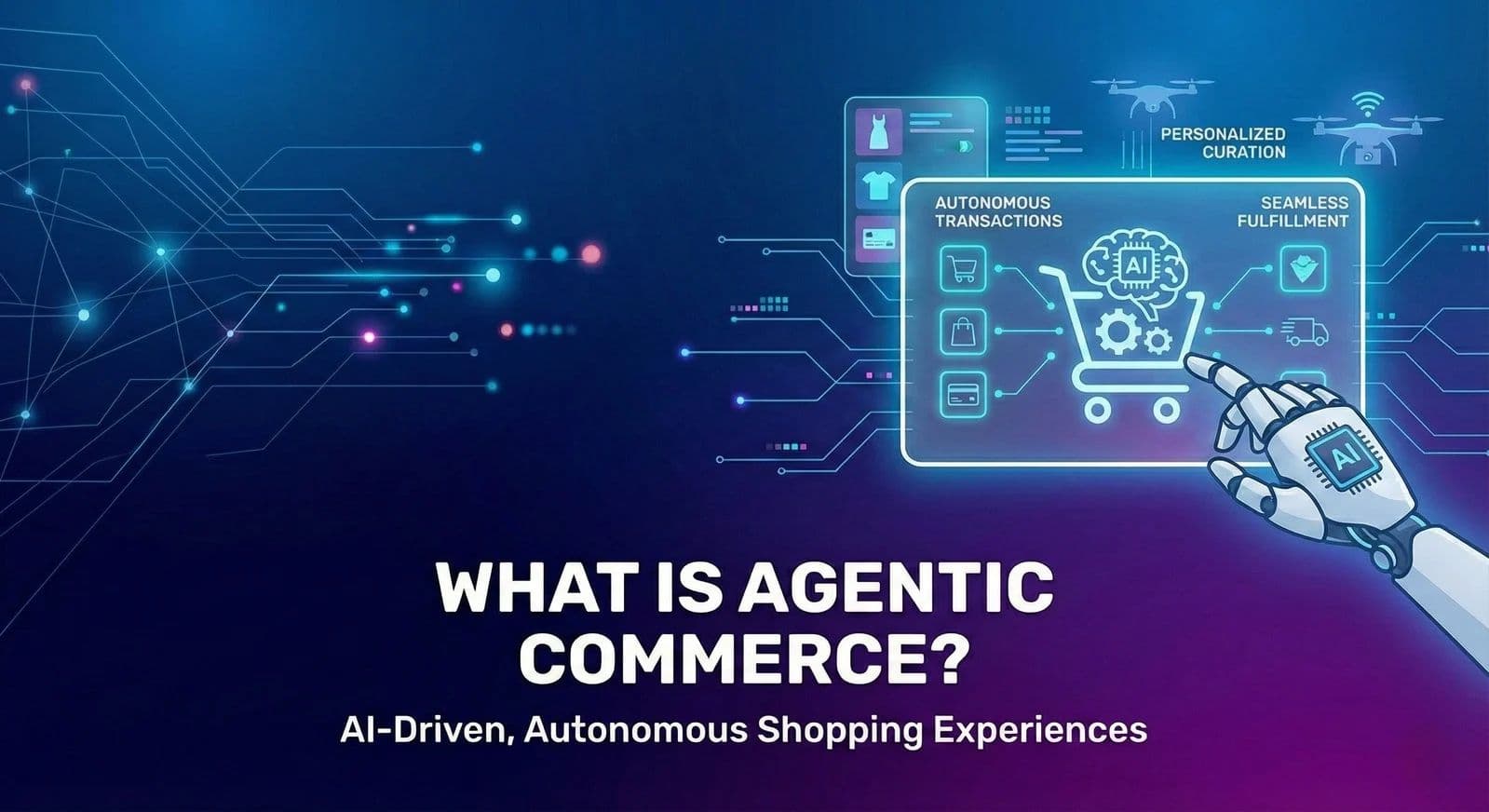
Quick Answer: Agentic commerce is AI-powered autonomous shopping where AI agents independently search, compare, and complete purchases on your behalf. McKinsey projects agentic commerce will capture up to $1 trillion in orchestrated US retail revenue by 2030. As of August 2026 the transaction layer is not only live but independently governed: the Model Context Protocol and Agent2Agent sit under the Linux Foundation's Agentic AI Foundation, the Agent Payments Protocol under the FIDO Alliance, and x402 under its own Linux Foundation body. Agent-initiated payments have moved from pilot to production, with Worldline, ING, and Mastercard completing Europe's first end-to-end agentic payment in production in June 2026. Source: McKinsey
Last Updated: October 8, 2026 • Reading Time: 15 minutes
What Is Agentic Commerce?
Agentic commerce is shopping powered by AI agents that autonomously execute complete transactions, from discovery through checkout with minimal human intervention.
The 3 Core Capabilities
- Delegated Authority: You transfer decision-making power to AI agents for specific shopping tasks. Mastercard (2025) defines it as shopping "in which an AI agent “closes the loop” or completes tasks for a user — such as searching for items, comparing options and making a purchase — with limited or no manual inputs needed from that user."
- Preference Architecture: AI systems capture and apply your preferences across all interactions, learning from each purchase to improve future recommendations.
- Autonomous Execution: AI agents navigate marketplaces, negotiate prices, and complete transactions independently within parameters you set.
The Technical Infrastructure
Agentic commerce relies on emerging protocols that allow different AI systems to communicate and execute transactions securely.
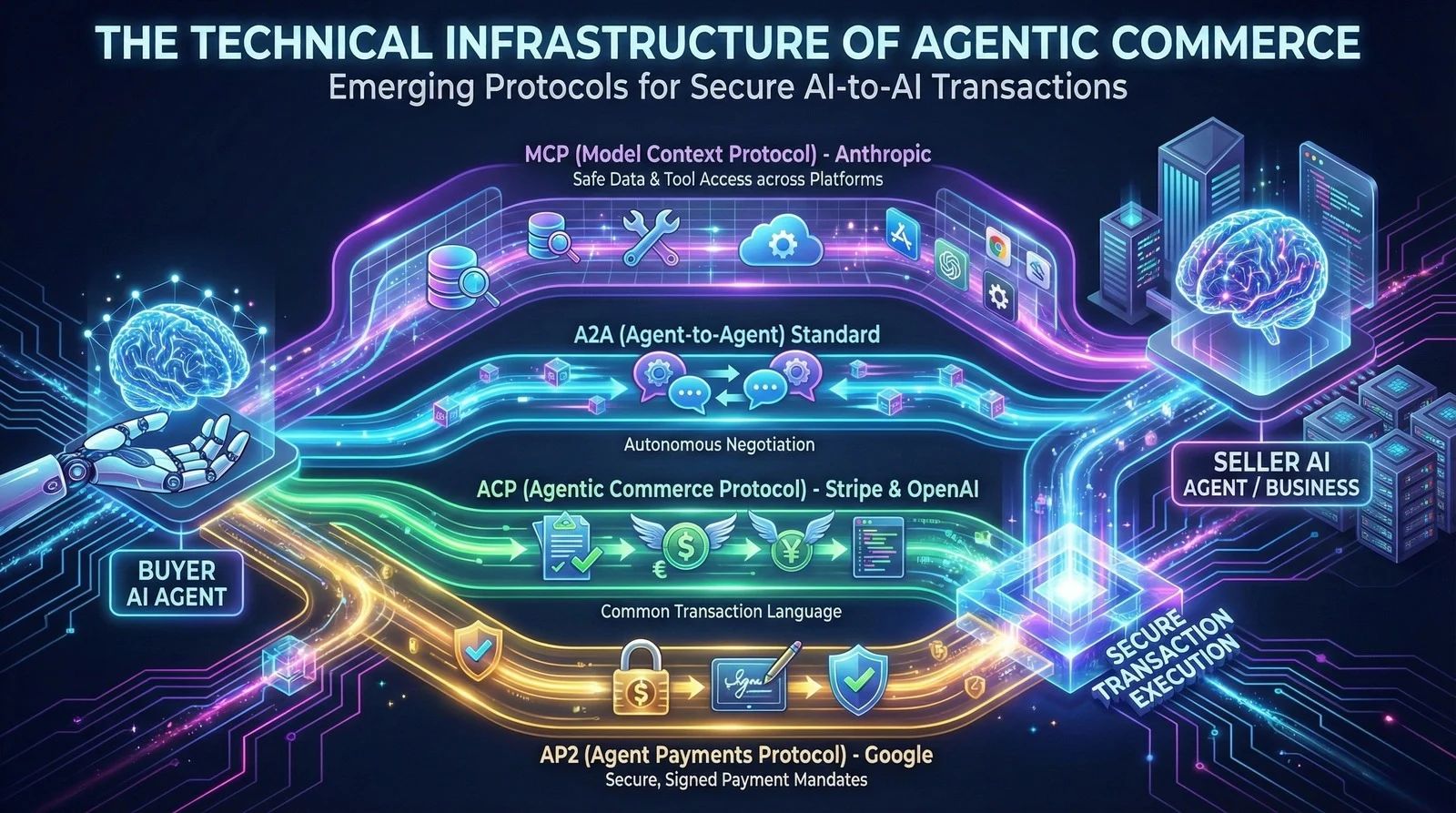
A note on who owns these standards, because it changed in 2026 and it matters more than it sounds. Every protocol below started as a single company's project. Most no longer are. Through 2026 the founding vendors handed stewardship to neutral foundations, which is the difference between betting on a company's roadmap and building on infrastructure. If you are choosing what to integrate, governance is now a real selection criterion.
- Agentic Commerce Protocol (ACP): Developed by Stripe and OpenAI to define a common language for how agents and businesses transact. Launched September 2025 under Apache 2.0 as the protocol behind ChatGPT's Instant Checkout. On March 24, 2026, OpenAI announced that it is expanding ACP to product discovery and letting merchants use their own checkout experiences, and merchants now use ACP to share product feeds and promotions with ChatGPT. Source: Stripe, Source: OpenAI
- Model Context Protocol (MCP): The open standard, originally from Anthropic, that lets AI models safely access data and tools across platforms. Anthropic donated MCP to the Linux Foundation's Agentic AI Foundation in December 2025. Its 2026-07-28 specification is the largest revision since launch, replacing the bidirectional stateful protocol with a stateless request/response core that is far simpler to run serverless or horizontally scaled.
- Agent Payments Protocol (AP2): The framework for cryptographically signed payment mandates. Google transferred AP2 to the FIDO Alliance in April 2026 and shipped v0.2 with Human-Not-Present support for pre-authorized autonomous transactions. The FIDO Alliance has since formed an Agentic Authentication Working Group around it.
- Agent2Agent (A2A): The standard for direct communication and negotiation between a buyer's agent and a seller's agent. Originally Google's, A2A reached v1.0 in March 2026 and became a hosted project of the Agentic AI Foundation in August 2026, placing the agent-to-agent layer under the same neutral governance as MCP's agent-to-tool layer.
- Universal Commerce Protocol (UCP): An open standard for agent interoperability covering discovery of merchant capabilities, cart, catalog, identity linking, and cross-platform transaction negotiation. Google, Shopify, Etsy, Wayfair, Target, and Walmart are among its developers, and it has expanded beyond retail into dedicated food and lodging technical councils. Source: Google
- Machine Payments Protocol (MPP): Launched March 2026 by Stripe and Tempo as an open standard for machine-to-machine agent payments, letting agents pay programmatically using stablecoins, cards, or buy-now-pay-later through Stripe's existing PaymentIntents API. Visa has since published a card-based MPP specification and SDK extending it to card rails.
- x402: The protocol that revives HTTP's long-dormant 402 "Payment Required" status code so an agent can pay for a resource inline, with no prior account: the payment is the credential. Contributed by Coinbase, x402 now runs under its own Linux Foundation body, the x402 Foundation, launched July 2026 with 40 members including Adyen, AWS, American Express, Cloudflare, Google, Mastercard, Shopify, Stripe, and Visa. Cloudflare's Monetization Gateway uses it to let any site charge agents for pages, datasets, APIs, or MCP tools.
How Agentic Commerce Works
Quick Answer: Agentic commerce works through five steps: (1) understanding your intent through natural language, (2) searching across multiple merchants simultaneously, (3) comparing options using AI analysis, (4) negotiating capabilities and terms with merchant systems, and (5) completing checkout over a payment protocol that proves the agent was authorized to spend.
The 5-Step Process
- 1. Intent Recognition: You state what you want in natural language: "Order organic dog food under $50, grain-free, with free shipping." The agent resolves that sentence into a structured set of constraints, such as a budget ceiling, required product attributes, and shipping terms, that it can actually act on.
- 2. Multi-Merchant Search: The agent queries many merchants in parallel rather than working through one storefront at a time, checking inventory, pricing, shipping options, and reviews at once. Where a merchant exposes its catalog through UCP or an MCP server, the agent reads live structured data instead of scraping a page built for human eyes.
- 3. Intelligent Comparison: The agent evaluates far more options than the handful a shopper realistically compares, and ranks them on total landed cost, delivery date, return terms, and review quality rather than on whichever listing happened to rank first.
- 4. Capability and Terms Negotiation: Before committing to a cart, the agent discovers what the merchant actually supports, including accepted payment methods, fulfillment options, and any promotions or loyalty benefits that apply, then settles the terms of the session. This is the step UCP was designed to standardize.
- 5. Secure Checkout: The agent completes the transaction over a payment protocol that proves authorization: an AP2 cryptographically signed mandate, a machine payment over MPP or x402, or a tokenized single-use credential from a card network. The merchant receives proof the agent was authorized to spend before any money moves.
Agentic vs Traditional vs Conversational Commerce
Traditional e-commerce requires continuous human involvement, conversational commerce adds AI chat assistance while humans decide, and agentic commerce enables AI to autonomously execute complete transactions based on your parameters.
| Feature | Traditional Commerce | Conversational Commerce | Agentic Commerce |
|---|---|---|---|
| Role of AI | None/Passive (Recommendations) | Active Assistant (Chatbots/Voice) | Autonomous Agent (Independent Buyer) |
| User Involvement | Continuous (Search, Click, Checkout) | Interactive (Guidance & Confirmation) | Minimal (Set Parameters & Delegated) |
| Core Technology | Web Browsers & Shopping Carts | Natural Language Processing (NLP) | Agent protocols (ACP, UCP, MCP, AP2, MPP, x402) |
| Primary Goal | Manual Product Discovery | Assisted Decision Making | Autonomous Task Execution |
| Decision Maker | The Human | Human (informed by AI) | AI Agent (within authority) |
When to Use Each Approach
Choose Traditional E-Commerce for:
- High-involvement purchases (luxury goods, home decor).
- Complex customization needs.
- Products requiring visual exploration.
Choose Conversational Commerce for:
- Complex product questions.
- Guided selling processes (insurance, financial products).
- Customer support integration.
Choose Agentic Commerce for:
- Repetitive routine purchases (groceries, household staples).
- Multi-vendor price optimization.
- Time-sensitive procurement.
- B2B repetitive ordering.
Real Results: Mediq automated 91% of order-related tasks using agentic AI, eliminating 90% of processing time (Go Autonomous, 2024).
The $1 Trillion Market Opportunity
The agentic AI in retail and e-commerce market was valued at $46.74 billion in 2025 and is projected to reach $218.37 billion by 2031 (29.29% CAGR over 2026-2031), with US B2C agentic commerce potentially capturing up to $1 trillion by 2030 according to McKinsey.
Market Size & Growth Projections
- 2025: $46.74B — agentic AI in retail/e-commerce, rising to an estimated $60.43B in 2026 (Mordor Intelligence)
- 2031 projection: $218.37B at a 29.29% CAGR over 2026-2031 (Mordor Intelligence)
- Market US Potential: Up to $1T - US B2C agentic commerce (2030) (McKinsey)
Proven ROI Metrics
Google Cloud's second annual ROI of AI study surveyed 3,466 senior leaders across 24 countries. It identifies a cohort it calls "agentic AI early adopters" — 13% of respondents, whose organizations dedicate at least half their future AI budget to agents and already run them across operations. The gap between that cohort and everyone else is the useful number:
- 88% of agentic AI early adopters report seeing ROI from generative AI on at least one use case, against a 74% average across all organizations (Google Cloud, September 2025).
- Early adopters are consistently likelier to report ROI on specific agentic use cases: customer service and experience (43% vs 36%), marketing effectiveness (41% vs 33%), security operations (40% vs 30%), and software development (37% vs 27%).
- 52% of executives say their organization is actively using AI agents, and 39% have launched more than ten.
Real-World Results
B2B Success Stories
Danfoss: order processing time reduced by 90% and over 80% of orders automated, achieved without increasing headcount, with lower error rates reported as an outcome. (Go Autonomous)
Mediq (healthcare distributor): 91% of order-related tasks handled autonomously across Sweden, Norway, Denmark, and Finland. (Go Autonomous)
Consumer-Facing Results
Adobe Analytics: AI-sourced traffic to US retail sites grew 393% year over year in Q1 2026. More importantly, it stopped being low-quality traffic: in March 2026 AI-driven visits converted 42% better than non-AI channels such as paid search and email, a reversal from March 2025 when the same traffic converted 38% worse. Adobe's accompanying survey found 39% of consumers had used AI for online shopping, and 85% of those said it improved the experience. Source: Adobe
Shopify: AI searches powered by the Shopify Catalog API convert at 2x the rate of searches run against scraped data — a direct measure of what structured, agent-readable product data is worth. Source: Shopify
Salesforce: Its 2026 Agentic Enterprise Index, drawn from aggregated Agentforce usage between February 2025 and April 2026, found that organizations deploying agents saw 4x higher retail online sales growth. Separately, Salesforce reported that agentic search, meaning purchase journeys that begin inside an AI chat assistant rather than on-site search, grew 200% year over year. Source: Salesforce, Source: Salesforce
Where Agentic Commerce Stands in August 2026
Quick Answer: The defining changes of 2026 were not new protocol launches. Three shifts happened instead: the protocols left their founders (AP2 to the FIDO Alliance, x402 and A2A to the Linux Foundation), the payments left the lab (Europe's first production agentic payment in June, AWS agent payments generally available in August), and the distribution left the browser (Shopify and Square enrolling millions of merchants into AI assistants automatically).
When this article was first published in December 2025, agentic commerce was a prediction backed by research from McKinsey and BCG. By April 2026 it was operational infrastructure with live protocols. Eight months on, the story has changed shape again.
Shift One: The Protocols Left Their Founders
Between December 2025 and August 2026, one foundational protocol after another was handed to a neutral standards body:
| Protocol | Originally Built By | Now Governed By | Transferred |
|---|---|---|---|
| MCP | Anthropic | Linux Foundation (Agentic AI Foundation) | December 2025 |
| AP2 | FIDO Alliance | April 2026 | |
| x402 | Coinbase | Linux Foundation (x402 Foundation) | July 2026 |
| A2A | Linux Foundation (Agentic AI Foundation) | August 2026 | |
| ACP | Stripe & OpenAI | Not transferred — Apache 2.0 | — |
| UCP | Google-led consortium | Not transferred — Apache 2.0 | — |
Why this matters: a year ago, adopting the agentic stack meant betting a few companies would keep their protocols open. That is no longer the bet. The infrastructure layer is now governed the way TCP/IP and HTTP are governed — the condition under which conservative enterprises start building. Source: Google, Source: AAIF, Source: Linux Foundation
The Agentic AI Foundation itself reached 247 member organizations in August 2026, adding 57 in a single quarter, with Visa, Wells Fargo, and Alibaba joining at Gold tier. Source: Linux Foundation
Shift Two: The Payments Left the Lab
In April 2026 the honest description of agent payments was "impressive pilots." That is no longer accurate:
- Europe's first production agentic payment (June 2, 2026): At Money20/20 Europe, Worldline and ING, with Mastercard, completed a live end-to-end agentic payment in production. A real ING cardholder searched for a wedding anniversary gift; a merchant's AI agent identified concert tickets within the defined budget, presented a curated selection, and completed the transaction only after the consumer gave explicit approval. Note where the human stayed in the loop: at approval, not at discovery. Source: Worldline
- Stripe Link Agent Wallet (April 2026): Gives AI shopping agents access to Link's 200M+ consumer base through one-time-use cards or shared payment tokens, with spend requests routed back to the human for approval. Source: Stripe
- Visa and OpenAI partnership (June 2026): Followed by Agent Score and an Agentic Registry, letting merchants assess whether an inbound agent is trustworthy. Source: Visa
- Mastercard Agent Pay for Machines (June 2026): Always-on machine payments for agents operating without a human present.
- AWS AgentCore payments, generally available (August 18, 2026): Agents can autonomously discover, access, and pay for paid APIs, MCP servers, and content in a few lines of code, with configurable spend limits enforced at the infrastructure layer, plus MPP and x402 support. Source: AWS
Why this matters: when a hyperscaler ships agent payments as a generally available primitive rather than a preview, the capability has stopped being a differentiator and started being plumbing.
Shift Three: The Distribution Left the Browser
The most consequential change for merchants is where the transaction now begins:
- Shopify Spring '26 Edition (June 2026): Made agentic commerce the default rather than an opt-in. Catalog API access takes just an API key with no approval needed, and ChatGPT, Microsoft Copilot, and the Shop App are the most visible surfaces consuming that product data today. Source: Shopify, Source: Shopify Editions
- Square ChatGPT app and Claude plugin (July 2026): Auto-enrolls eligible sellers from a base of more than 4.5 million, so customers can browse menus and order without the seller writing a line of code. Source: Square
- Gemini in Chrome auto browse (August 2026): Shipped to all US Android users, putting an agent that completes multi-step transactional tasks on the live web into consumer hands at mobile scale. Source: Google
Why this matters: merchants are being enrolled into agentic channels by their platforms, often automatically. The competitive question is no longer whether your products appear in an AI assistant, but whether the data behind them is good enough to win the comparison once they do.
The Demand Data
Quick Answer: AI-sourced retail traffic grew 393% year over year in Q1 2026 and now converts 42% better than non-AI channels, having converted 38% worse twelve months earlier. That crossover is the single most important number in agentic commerce.
- 393% year-over-year growth in AI-sourced traffic to US retail sites in Q1 2026 (Adobe Analytics).
- 42% better conversion than non-AI channels such as paid search and email in March 2026, reversed from 38% worse in March 2025 (Adobe Analytics).
- 39% of consumers have used AI for online shopping, and 85% of those say it improved the experience (Adobe Analytics).
- 200% year-over-year growth in agentic search — purchase journeys that begin inside an AI chat assistant rather than on-site search (Salesforce).
- 30% to 40% of Amazon app sessions used the Rufus assistant through November 2025, peaking at 40% on Black Friday and settling at 38% by month end, with Rufus-assisted purchases growing faster than unassisted ones (Sensor Tower).
- $190 billion to $385 billion in US e-commerce spending from agentic shoppers by 2030, or 10% to 20% of online retail (Morgan Stanley Research).
The forecasts made in late 2025, which put mainstream agentic commerce somewhere between 2028 and 2030, now look conservative on infrastructure and roughly right on consumer habit. The protocols are governed, the payment rails are in production, and the platforms have enrolled their merchants. What has not yet arrived at scale is the consumer behavior change — and that is the gap businesses still have time to prepare for.
How to Prepare Your Business for Agentic Commerce
The brands capturing agentic commerce revenue today started preparing before the protocols were finalized. Readiness requires work across three layers: making your business discoverable by AI agents, structuring your data so agents can evaluate your products, and connecting to the transaction protocols that let agents buy.
1. Make Your Business Visible to AI Systems
AI agents do not browse websites the way humans do. They extract structured data from schema markup, answer capsules, and machine-readable content. If your product data is locked inside images, PDFs, or unstructured HTML, agents cannot find you. Start with Organization, Product, and FAQPage schema. Write answer capsules (50 to 150 word self-contained answers) for every key product and service question.
2. Build Your Entity Architecture
AI platforms make citation decisions based on entity recognition. If the AI does not understand who your brand is, what you sell, and how you relate to your category, it will recommend a competitor whose entity graph is clearer. Map your brand relationships explicitly: products, leadership, locations, proprietary methodology, and differentiators. This is the semantic foundation that reduces hallucinations and increases citation confidence.
3. Connect to Agent Transaction Layers
The protocol stack (ACP, UCP, MCP, AP2, MPP, x402) is live, independently governed, and growing. Businesses that expose their catalog, inventory, and pricing through these protocols give AI agents a direct path to transact. Those that do not are invisible to the fastest-growing commerce channel. Check what your platform already does for you first: as of Shopify's Spring '26 Edition, catalog API access needs only an API key and products are auto-syndicated into AI channels, so the work may be configuration rather than engineering. For custom implementations, standing up an MCP server exposes your catalog to any agent that supports the standard, and x402 lets you charge agents for API or content access inline, with no account setup on their side.
4. Measure What AI Sees
Traditional analytics measure human traffic. Agentic commerce requires tracking AI citations, agent-initiated sessions, and share of voice across ChatGPT, Perplexity, Google AI Overviews, and Claude. You cannot optimize what you do not measure.
The A.G.E.N.T.I.C. Framework maps this entire lifecycle from audit through conversion. Businesses that follow a structured approach move faster and avoid the expensive mistake of optimizing the wrong layer first.
To track which protocols are live, which platforms support agent transactions, and how the ecosystem is evolving in real time, see our State of Agentic Commerce tracker.
What Industry Experts Say
"Agentic commerce flips the customer journey on its head. You're not just automating what you already do—you're redesigning what shopping means."
"Without intervention, retailers risk being reduced to background utilities in agent-controlled marketplaces."
"AI agents are becoming first-class participants in digital commerce, and they need a payments layer as open and interoperable as the internet itself."
Key Takeaways for Brands
The data is clear:
- $1 trillion US market potential by 2030 (McKinsey).
- AI-sourced retail traffic up 393% year over year in Q1 2026, now converting 42% better than non-AI channels (Adobe Analytics).
- 88% of "agentic AI early adopters" report ROI from generative AI on at least one use case, against a 74% average across all organizations (Google Cloud).
- The protocol stack is no longer vendor-controlled: MCP and A2A at the Linux Foundation, AP2 at the FIDO Alliance, x402 at its own foundation.
Success requires:
- Structured, machine-readable product data.
- API-first infrastructure for real-time queries.
- Integration with major AI platforms.
- Consumer trust through transparency and control.
- Strategic approach vs technology-only mindset.
The window is narrowing. Organizations moving decisively now will shape industry standards and capture disproportionate value. Those who wait risk invisibility to AI agents increasingly mediating consumer choice.
How Agentic Commerce Works
A 5-step process showing how AI agents autonomously complete shopping transactions from intent recognition to secure checkout.
Intent Recognition
State what you want in natural language, such as 'Order organic dog food under $50, grain-free, with free shipping.' The agent resolves that sentence into a structured set of constraints it can act on: a budget ceiling, required product attributes, and shipping terms.
Multi-Merchant Search
The agent queries many merchants in parallel rather than working through one storefront at a time, checking inventory, pricing, shipping options, and reviews at once. Where a merchant exposes its catalog through UCP or an MCP server, the agent reads live structured data instead of scraping a page built for human eyes.
Intelligent Comparison
The agent evaluates far more options than the handful a shopper realistically compares, ranking them on total landed cost, delivery date, return terms, and review quality rather than on whichever listing happened to rank first.
Capability and Terms Negotiation
Before committing to a cart, the agent discovers what the merchant actually supports, including accepted payment methods, fulfillment options, and any promotions or loyalty benefits that apply, then settles the terms of the session. This is the step the Universal Commerce Protocol was designed to standardize.
Secure Checkout
The agent completes the transaction over a payment protocol that proves authorization: an AP2 cryptographically signed mandate, a machine payment over MPP or x402, or a tokenized single-use credential from a card network. The merchant receives proof the agent was authorized to spend before any money moves.
Frequently Asked Questions
- What's the difference between agentic and conversational commerce?
- Conversational commerce gives you AI chat assistance while you make the decision: the AI advises, you decide. Agentic commerce lets the AI autonomously execute a complete purchase, from research through checkout, within parameters you set. The AI decides and acts inside your boundaries, rather than handing options back to you.
- How do autonomous payments work securely?
- Agentic payments use protocols that prove an agent was authorized before money moves. AP2, now governed by the FIDO Alliance, uses cryptographically signed mandates. MPP and x402 handle machine-to-machine payments over HTTP. Card networks add tokenized single-use credentials. This is production infrastructure: Worldline, ING and Mastercard completed Europe's first end-to-end agentic payment in June 2026.
- Which products are best for agentic commerce?
- Commoditized and repeat-purchase categories deliver the highest return: groceries, household staples, office supplies, B2B procurement, and routine replenishment. Morgan Stanley found groceries and consumer packaged goods lead AI-driven purchases today. Luxury goods, home decor, and experiential purchases remain better suited to human-driven exploration, where visual browsing and considered choice still matter.
- When will agentic commerce become mainstream?
- The infrastructure is already mainstream; consumer habit is not. As of August 2026 the protocols are live and independently governed, agent payments run in production, and platforms have enrolled millions of merchants automatically. The commonly cited 2028-2030 window marks when shopper behavior catches up, not when the technology arrives.
- What does it cost to get ready for agentic commerce?
- It depends on your starting point, and the first tier is often free. Platform configuration comes first: Shopify Catalog access needs only an API key. Structured data and entity work is the second tier, a content and markup project. Custom protocol integration, such as running your own MCP server, is the only tier requiring real engineering.
- How do I prepare my business for the agentic era?
- Work in three layers. First, make yourself readable: convert product catalogs to JSON-LD and build real-time inventory and pricing APIs. Second, check what your commerce platform already does for you, since major platforms now expose merchant catalogs to AI assistants by default. Third, measure what agents see: citations, agent-initiated sessions, and share of voice across ChatGPT, Perplexity, and Claude.
- Who controls the agentic commerce protocols?
- No single company, which is the biggest change of 2026. MCP and A2A are hosted projects of the Linux Foundation's Agentic AI Foundation. Google transferred AP2 to the FIDO Alliance in April 2026, and Coinbase contributed x402 to its own Linux Foundation body in July. ACP and UCP remain consortium-developed under Apache 2.0, not transferred.