Amazon Ads MCP Server: What Brands Need to Know About Amazon's Two-Track Agentic Commerce Strategy

 Add as a preferred source on Google
Key Takeaways
- Amazon Ads MCP Server entered open beta on February 2, 2026, announced by Paula Despins (VP of Ads Measurement), available globally to partners with active API credentials.
- Any MCP-compatible AI agent can now manage Amazon ad campaigns: Claude, ChatGPT, Gemini, and custom-built agents can create campaigns, pull reports, manage billing, and expand to new markets through natural language prompts.
- The MCP Server solves the orchestration problem: traditional APIs expose capabilities one at a time, so agents had to piece together how individual steps fit together. MCP tools act as an instruction manual, turning multi-step workflows into single prompts.
- Amazon is NOT open at the commerce layer: Rufus, Buy for Me, and Alexa+ keep product discovery proprietary. Amazon has not joined ACP or UCP, building a walled garden for shopping while opening advertising infrastructure. (Editor's note, October 9, 2026: Amazon joined UCP's Tech Council on April 24, 2026.)
- Brands need two separate optimization strategies: one for agent-managed advertising (open, protocol-based) and one for AI-powered product discovery on Amazon (proprietary, content-driven).
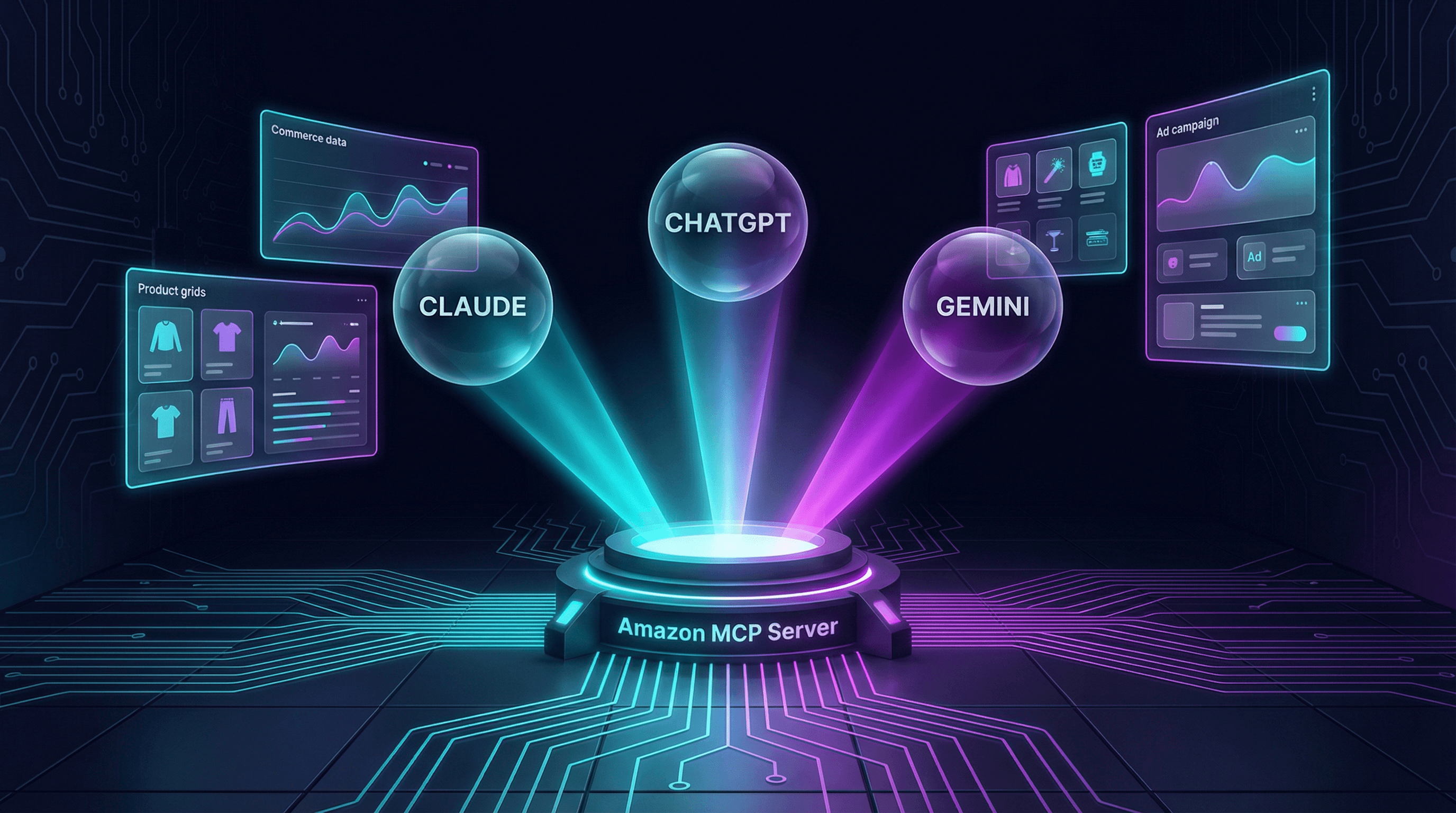
Amazon launched the Ads MCP Server in open beta, opening its advertising infrastructure to any AI agent via the Model Context Protocol. But Amazon is running two parallel strategies: an open ad layer (MCP) and a proprietary commerce layer (Rufus, Buy for Me, Alexa+). Amazon has not joined ACP or UCP. Brands need separate optimization strategies for each surface.
Sources: Amazon Ads, About Amazon, Google
Last Updated: March 2, 2026 • Reading Time: 16 min read
Editor's note (October 9, 2026): This post describes Amazon as of March 2, 2026. Two things have changed since. On April 24, 2026, Amazon joined the Universal Commerce Protocol's Tech Council, the protocol's technical governing body, so the post's statements that Amazon has not joined UCP no longer hold. Amazon is still not among ACP's maintainers. And on May 13, 2026, Amazon renamed Rufus to Alexa for Shopping. Sources: UCP, ACP maintainers, About Amazon
What Is the Amazon Ads MCP Server?
The Amazon Ads MCP Server is an open beta infrastructure layer that connects external AI agents to Amazon's advertising APIs through the Model Context Protocol (MCP), an open standard originally developed by Anthropic. Announced on February 2, 2026 by Paula Despins, VP of Ads Measurement, the server enables any MCP-compatible AI agent to create campaigns, run performance reports, manage accounts, access billing data, and expand campaigns internationally through natural language prompts. It is available globally to Amazon Ads partners with active API credentials.
The MCP Server did not appear in isolation. It represents the second chapter of Amazon's agentic advertising strategy. At the unBoxed 2025 advertiser event, Amazon introduced the Ads Agent, a console-based conversational experience that let advertisers run complex workflows inside Amazon's own UI. The MCP Server extends those capabilities outside Amazon's console entirely, making them available to Claude (Anthropic), ChatGPT (OpenAI), Gemini (Google), and any custom-built agent.
Amazon first introduced the MCP Server to its partners at unBoxed 2025 in November, then opened the beta on February 2, 2026 to every Amazon Ads partner with active API credentials. The progression from a partner introduction to an open beta signals Amazon's confidence in the protocol and its commitment to interoperability at the advertising layer.
Sources: Amazon Ads, Amazon Ads (unBoxed 2025 recap)
What Problem Does the Amazon Ads MCP Server Solve?
The Amazon Ads MCP Server solves the orchestration problem that trips up AI agents trying to work with traditional APIs. Amazon says those APIs "were designed to expose specific capabilities one at a time, not to coordinate the kind of complete, autonomous workflows that AI agents now need to manage," and that without guidance, "agents must piece together how individual steps fit together, and they don't reliably produce the best results." MCP addresses this by providing agents with pre-built tools that bundle multi-step workflows into single executable prompts.
Amazon is explicit that connectivity alone is not enough: even "straightforward tasks like launching a campaign in a new country can involve dozens of manual steps." The server's tools fix this by acting as what Amazon calls "an instruction manual," turning complex advertising operations into simple actions an agent can execute.
The difference is architectural. Traditional APIs expose capabilities one at a time, requiring agents to chain multiple calls, handle error states, and manage sequencing logic. MCP tools package common multi-step workflows into single operations. Creating an end-to-end Sponsored Products campaign, which normally requires three or more operations (creating the campaign, setting up ad groups, and creating ads), now happens in a single prompt, and the result is a ready-to-launch campaign that only needs review and approval. Another tool expands a campaign already running in the U.S. and Canada to another country with a single prompt.
The result, in Amazon's words: advertisers and partners "can focus on their unique use cases and what differentiates them."
Source: Amazon Ads
What Can AI Agents Do With the Amazon Ads MCP Server?
AI agents connected to the Amazon Ads MCP Server can run full advertising workflows from a natural language prompt. Capabilities include creating, updating, and deleting campaigns, creating end-to-end Sponsored Products campaigns in a single workflow, running performance and reporting queries, managing account-level settings, accessing billing and financial data, and expanding campaigns to new countries.
Campaign Management
The most significant capability is not any individual action but the bundling of multi-step workflows into single prompts. An advertiser can ask an agent to create an end-to-end Sponsored Products campaign, and the tool creates the campaign, sets up its ad groups, and creates its ads in one coordinated workflow, leaving a ready-to-launch campaign for the advertiser to review and approve.
Reporting and Analytics
Agents can run performance and reporting queries and generate reports from a single natural language prompt.
Account and Billing Operations
Administrative tasks like account settings management and billing data access are available through the same integration, eliminating the need for separate tools or manual console access for operational workflows.
Source: Amazon Ads
How Does Amazon's MCP Strategy Compare to ACP and UCP?
Amazon's MCP Server operates exclusively at the advertising automation layer, while ACP (Agentic Commerce Protocol) and UCP (Universal Commerce Protocol) govern the commerce and transaction layer. These are fundamentally different surfaces. Amazon has opened its advertising infrastructure to external AI agents via MCP while keeping its commerce layer proprietary. Neither UCP nor ACP covers advertising automation. At the ad layer, Google released its own open-source Google Ads API MCP Server on October 7, 2025, with an initial release that is read-only, for reporting and diagnostics; Amazon's server also lets agents create, update, and delete campaigns.
Agentic Commerce Protocol Comparison
| Attribute | Amazon Ads MCP Server | UCP (Google + Shopify) | ACP (OpenAI + Stripe) |
|---|---|---|---|
| Layer | Advertising automation | Full commerce lifecycle | Checkout and transactions |
| Protocol | MCP (Anthropic) | REST, A2A, MCP-compatible | REST (Stripe infrastructure) |
| Open or Proprietary | Open (any MCP agent) | Open standard | Open-source (Apache 2.0) |
| Who Can Connect | Any AI agent with API credentials | Any AI surface or merchant | Any AI assistant or payment provider |
| Commerce Layer Access | Ads only, not shopping | Discovery through post-purchase | Checkout and payment flows |
| Amazon Participation | Creator and operator | Not joined | Not joined |
| Current Status | Open beta (Feb 2, 2026) | Live (Jan 2026) | Live (Sep 2025) |
| Key Partners | Claude, ChatGPT, Gemini | Visa, Mastercard, Shopify, Target | Stripe, commercetools, Etsy |
The AdCP Connection
The Ad Context Protocol (AdCP) is an emerging open standard for advertising automation whose agents communicate over MCP and A2A. Published at adcontextprotocol.org and on GitHub, AdCP aims to let AI agents discover, plan, buy, sell, and measure media across advertising platforms. Amazon's MCP Server is a separate, Amazon-specific effort, but both point the same way: the advertising industry is moving toward protocol-based AI automation broadly, not just at Amazon.
Sources: Amazon Ads, AdCP, AdCP on GitHub
What Is Amazon's Agentic Commerce Strategy?
Amazon is running two completely separate agentic strategies that operate on opposite principles: openness at the advertising layer and proprietary control at the commerce layer. Understanding this split is the single most important strategic insight for brands operating on Amazon.
Track 1: Advertising (Open via MCP)
The Amazon Ads MCP Server opens Amazon's advertising infrastructure to any external AI agent through a standardized protocol. Claude, ChatGPT, Gemini, and custom agents can all manage Amazon ad campaigns. The philosophy here is interoperability: Amazon wants as many agents as possible managing ad spend on its platform because more ad automation means more ad revenue.
This makes strategic sense. Amazon's ad business generated $17.7 billion in Q3 2025 alone, growing 24% year over year (Amazon Q3 2025 results). Every AI agent that can easily manage Amazon campaigns represents more potential ad dollars flowing into the platform.
Track 2: Commerce and Shopping (Proprietary Walled Garden)
At the shopping and product discovery layer, Amazon's strategy is the exact opposite. Amazon is building proprietary AI shopping agents that keep consumers inside Amazon's ecosystem:
- Rufus: AI shopping assistant embedded directly in the Amazon app, guiding product discovery and purchase decisions.
- Buy for Me: Agentic AI that purchases products from external brand websites without leaving the Amazon app, launched in beta in April 2025.
- Alexa+: Upgraded voice assistant with agentic AI capabilities for e-commerce.
Amazon has not joined ACP or UCP. Amazon is not among the co-developers or endorsers Google named when it launched UCP in January 2026, nor among ACP's maintainers. Instead, Amazon is building its own proprietary AI shopping agents within its own ecosystem.
Sources: About Amazon (Rufus), About Amazon (Buy for Me), About Amazon (Alexa+), Google (UCP launch partners), ACP maintainers
Why the Split Matters
The strategic logic is straightforward. Amazon profits from advertising through volume: more agents managing campaigns means more ad spend. But Amazon profits from commerce through control: keeping consumers inside the Amazon ecosystem means controlling the entire transaction, from discovery to delivery.
This creates a critical asymmetry for brands. Getting your ads managed by any AI agent is now easy and standardized. Getting your products discovered by AI shopping agents on Amazon is still Amazon's proprietary game. These are two completely different surfaces with completely different optimization requirements.
CEO Andy Jassy spoke about the commerce side on Amazon's Q3 2025 earnings call. He said agentic commerce has a chance to be really good for e-commerce and will expand the amount of shopping that happens online, pointed to Rufus and Buy for Me as Amazon's own efforts, and said Amazon expects over time to partner with third-party agents, once it finds a way to make the customer experience better and to get the right exchange of value: today, he said, those agents offer no personalization or shopping history and often get prices and delivery estimates wrong. Openness at the advertising layer and control at the commerce layer can coexist, and that appears to be exactly what Amazon is doing.
What Does This Mean for Brands Advertising on Amazon?
For brands running Amazon ad campaigns, the MCP Server is an immediate operational upgrade. Any AI agent can now manage Amazon advertising through a single standardized integration, eliminating custom API work and reducing the engineering burden of campaign automation. The brands and agencies that adopt agent-managed advertising earliest will gain efficiency advantages that compound over time.
The Operational Shift
Before the MCP Server, automating Amazon advertising required building custom integrations for every workflow. Each API update could break those integrations. Agencies maintained dedicated engineering teams just to keep Amazon ad automation running. The MCP Server replaces all of that with a single protocol-based connection that any MCP-compatible agent can use.
What Changes for Advertisers
Campaign creation, optimization, reporting, and international expansion all become conversational workflows. An advertiser can instruct an AI agent to analyze campaign performance, identify underperforming ad groups, reallocate budget, and expand top performers to new markets, all in a single session. The agent handles the API complexity.
The Competitive Timeline
The open beta is live now. Brands and agencies that get into the beta, learn how agents interact with their campaigns, and optimize their product data for agent consumption will have structural advantages when agent-managed advertising becomes standard. This mirrors the early days of programmatic advertising: the first movers who understood the mechanics gained advantages that late adopters spent years trying to close.
What Does This Mean for Brands Selling Products on Amazon?
For brands focused on product discovery and sales on Amazon, the MCP Server is important context but not the direct lever. The discovery layer on Amazon is controlled by Amazon's proprietary AI agents: Rufus, Buy for Me, and Alexa+. External AI shopping agents do not have standardized access to Amazon's product catalog for discovery and purchase flows. This means brands need a different optimization strategy for each surface.
Agent-Managed Advertising vs. AI-Powered Discovery
When an AI agent creates or optimizes a Sponsored Products campaign via the MCP Server, it makes decisions about which products to feature, which targeting parameters to set, and which bids to place based on available product data. The quality of product titles, descriptions, categorization, and pricing directly determines how well agents manage your advertising.
But product discovery on Amazon is a separate surface. When a consumer asks Rufus for a product recommendation, Rufus is making that recommendation using Amazon's proprietary algorithms and product data, not through an open protocol that external agents can influence.
Two Optimization Strategies
For agent-managed advertising (open, protocol-based):
- Clean product data with structured attributes for agent consumption.
- Complete and accurate campaign metadata.
- Clear performance tracking for agent-driven optimization.
For AI-powered product discovery (proprietary, content-driven):
- Product listings optimized for Amazon's own AI models (Rufus, Alexa+).
- Rich product content including A+ Content, videos, and enhanced brand content.
- Customer review quality and volume (signals Amazon's AI uses for recommendations).
- Entity clarity and consistent naming across the Amazon ecosystem.
What Should Brands Do Right Now?
Brands need to act on both tracks of Amazon's agentic strategy simultaneously. The A.G.E.N.T.I.C. Framework provides the structure for this, with specific phases mapping directly to the actions required.
1. Audit Your Amazon Product Data for Agent Readiness (A.G.E.N.T.I.C. Phase 1: Audit)
Review product titles, descriptions, backend keywords, and category assignments for clarity and completeness. AI agents reason from product data. Ambiguous titles and thin descriptions lead to poor agent decisions about your inventory, whether those agents are managing your ads or recommending your products.
2. Get API Credentials for the Amazon Ads MCP Server (A.G.E.N.T.I.C. Phase 4: Network)
If you advertise on Amazon, get your team or agency into the open beta now. The learning curve for agent-led advertising is real. Understanding how AI agents interact with your campaigns during beta gives you structural advantages when agent-managed advertising becomes standard.
3. Optimize Your Product Listings for Rufus (A.G.E.N.T.I.C. Phase 3: Equip)
Rufus uses Amazon's own algorithms and product data to make recommendations, and it cannot be influenced through open protocols. The lever brands have there is the quality of their Amazon-native content: complete product titles and descriptions, accurate categorization, A+ Content, brand story pages, and customer review volume and recency. Thin listings and missing attributes give Rufus less to work with than competitors' richer data, so audit your top 20 SKUs for completeness. Buy for Me works differently: it surfaces select products Amazon does not sell and buys them from the brands' own sites, and brands choose whether to participate (About Amazon).
4. Structure Brand Content for AI Citation (A.G.E.N.T.I.C. Phase 3: Equip)
The brands AI agents trust when making recommendations are the brands that appear consistently and authoritatively in AI-generated answers. This requires answer-capsule content architecture, FAQPage schema, strong E-E-A-T signals, and regular content freshness updates across ChatGPT, Perplexity, Google AI Overviews, and Claude.
5. Track Your AI Share of Voice (A.G.E.N.T.I.C. Phase 5: Track)
Before investing in any paid AI advertising or agentic commerce integration, establish your baseline AI visibility. Run your 20 most important category queries across ChatGPT, Perplexity, Google AI Overviews, and Claude. Record who appears. If it is not you, you are funding a funnel with a broken top. Never scale a hallucination.
6. Prepare for Protocol Pluralism
Amazon's two-track strategy confirms what the broader ecosystem is showing: there will not be one protocol to rule them all. Brands need advertising automation via MCP, commerce integration via ACP and UCP, and proprietary optimization for each platform's own AI agents. The winners will be brands that build adaptive infrastructure across all surfaces rather than betting on a single ecosystem.
Source: agenticplug.ai
Frequently Asked Questions
- What is the Amazon Ads MCP Server?
- The Amazon Ads MCP Server is an open beta infrastructure layer that connects AI agents to Amazon's advertising APIs through the Model Context Protocol, an open standard developed by Anthropic. Once integrated, agents can create and manage campaigns, run performance reports, manage accounts, access billing data, and execute complex advertising workflows using natural language prompts. It launched on February 2, 2026 and is available globally to Amazon Ads partners with active API credentials.
- Which AI agents work with Amazon's MCP Server?
- Any AI agent built on the Model Context Protocol can connect to the Amazon Ads MCP Server. Amazon explicitly confirmed compatibility with Claude (Anthropic), ChatGPT (OpenAI), and Gemini (Google), as well as custom-built agents developed by advertisers or agency partners. The protocol-based approach means any future MCP-compatible agent will also work without additional integration.
- Does Amazon support ACP or UCP for shopping agents?
- No. Amazon has not joined the Agentic Commerce Protocol (ACP) or the Universal Commerce Protocol (UCP). Amazon is building proprietary AI shopping agents, including Rufus, Buy for Me, and Alexa+, within its own ecosystem rather than opening its commerce layer to external AI agents. In its own store, Amazon's openness to outside agents is limited to the advertising layer through the MCP Server. Editor's note (October 9, 2026): this answer reflects March 2026. On April 24, 2026, Amazon joined UCP's Tech Council, the protocol's technical governing body. Amazon is still not among ACP's maintainers.
- How is the Amazon Ads MCP Server different from the Amazon Ads API?
- The Amazon Ads API exposes individual capabilities one action at a time and requires custom integrations for every workflow. The MCP Server bundles common multi-step workflows into pre-built tools that AI agents can execute through single natural language prompts. Creating a full Sponsored Products campaign, which required three or more separate API operations, now happens in one prompt. The MCP Server is designed for AI agents, not for direct programmatic access.
- Should I optimize differently for Amazon Rufus vs. external AI shopping agents?
- Yes. Rufus is Amazon's proprietary AI shopping assistant and uses Amazon's own algorithms, product data, and ranking signals. External AI shopping agents cannot access Amazon's product catalog through standardized protocols for purchase flows. Optimizing for Rufus requires strong Amazon-native content: complete product listings, A+ Content, customer reviews, and accurate categorization. Optimizing for external AI agents requires broader AEO/GEO strategy: entity clarity, schema markup, answer-capsule content, and presence across AI citation surfaces.
- What does Amazon's MCP Server mean for my agentic commerce strategy?
- Amazon's MCP Server confirms that agent-managed advertising is becoming standard infrastructure. But it also reveals that advertising and commerce are splitting into two separate agentic surfaces with different access models. Your strategy needs both: protocol-based integration (Amazon's MCP Server for advertising automation, ACP and UCP for commerce on the platforms that support them) and proprietary optimization for product discovery on platforms like Amazon that have not opened their commerce layer. The A.G.E.N.T.I.C. Framework provides the structure for building across both surfaces simultaneously.
Get Your Brand Ready for Agentic Commerce
Amazon's MCP Server is live and Rufus is already shaping product discovery. The infrastructure has arrived ahead of the timeline most brands assumed. The audit is the right first step to understand where you stand.
Ready to become agent-ready? Book your free Agentic Commerce audit
About This Article and Author
Authored by Shahzad Safri, Founder and Agentic Web expert at agenticplug.ai, combining insights from Amazon Ads, About Amazon, Amazon Investor Relations, Google, AdCP, and ACP.