What Visa Intelligent Commerce Connect Means for Merchants

 Add as a preferred source on Google
Direct Answer
Visa Intelligent Commerce Connect is Visa's merchant-facing integration layer for AI-powered commerce. Launched April 8, 2026, it is available through a single integration via the Visa Acceptance Platform, helping businesses support agent-led shopping flows across multiple protocols, payment environments, and token systems without building the entire stack themselves.
Key Takeaways
- Visa Intelligent Commerce Connect is a business on-ramp to agentic commerce positioned as a single integration through the Visa Acceptance Platform.
- Visa is framing the market problem as integration complexity across networks, protocols, token vaults, merchant systems, and AI shopping surfaces.
- This matters to merchants because AI commerce starts before checkout with catalog discoverability, product data accessibility, and transaction readiness.
- Visa is signaling interoperability matters by naming support for Trusted Agent Protocol, Machine Payments Protocol, Agentic Commerce Protocol, and Universal Commerce Protocol.
- The storefront-retention angle is one of the most important parts of the launch because Visa is telling merchants they can participate in AI commerce without giving up the customer relationship entirely.
What Is Visa Intelligent Commerce Connect?
Visa Intelligent Commerce Connect is Visa's new business-facing integration layer for AI-powered commerce. In plain English, Visa is trying to make it easier for businesses to participate in agent-driven shopping and payment flows without forcing every merchant, platform, or enabler to stitch together a fragmented stack on their own.
Visa describes Intelligent Commerce Connect as a network, protocol, and token vault-agnostic on-ramp to agentic commerce available through a single integration via Visa Acceptance Platform. The company says it is built for agent builders, merchants, and enablers, which is important because it shows Visa is not treating this as a niche developer experiment. It is positioning Connect as shared infrastructure for the businesses and platforms that want to support AI-driven buying. Sources: Visa Press Release, April 8 2026, Visa Intelligent Commerce Connect Product Page
That distinction matters. Visa Intelligent Commerce is the broader portfolio. Intelligent Commerce Connect is the part of that portfolio designed to help businesses integrate into the new commerce flow. If Intelligent Commerce is Visa's umbrella story about AI shopping, Connect is the merchant and platform entry point.
What Market Problem Is Visa Intelligent Commerce Connect Trying to Solve?
Visa Intelligent Commerce Connect is trying to solve the infrastructure gap between AI shopping experiences and the merchant systems needed to fulfill them. That is the deeper story inside the launch.
The market has already produced plenty of proof that AI-assisted shopping is real. What it has not produced yet is a clean, widely adopted path that lets businesses connect product discovery, agent interaction, secure payment initiation, authentication, and merchant checkout across a fragmented ecosystem. That is where launches like this become strategically important.
Visa's wording points directly at that problem. The company says Connect is meant to make it easier for businesses to connect to and participate in AI-powered commerce. That framing matters because it implies the barrier is not awareness. The barrier is operational participation. Businesses may understand that AI shopping is coming, but understanding the trend is not the same thing as being wired into it.
The complexity is stacked in layers:
- multiple emerging protocols
- multiple payment and token environments
- different merchant platforms and integration models
- AI interfaces that increasingly shape discovery before a customer ever reaches a storefront
- security and authentication requirements that are harder in agent-led flows than in traditional checkout
That is why the launch reads like infrastructure, not just product marketing. Visa is trying to reduce the number of moving parts a business has to solve independently before it can participate in agentic commerce in a credible way. Sources: Visa Press Release, April 8 2026, Visa Intelligent Commerce Connect Product Page, Visa Acceptance Platform
Why Did Visa Launch Intelligent Commerce Connect Now?
Visa launched Connect because AI shopping is moving from a concept problem to an infrastructure problem. The market no longer just needs demos showing that an AI agent can help a consumer shop. It needs connective tissue that helps merchants, platforms, and payment systems actually support those flows.
Visa's own framing makes that clear. The company says businesses need a simpler way to connect to and participate in AI-powered commerce. That implies the current environment is too fragmented to scale cleanly. Different protocols, different payment rails, different token environments, and different merchant systems create too much operational complexity for broad participation.
That is exactly the kind of market moment where a payments network like Visa becomes strategically important. Visa is not just adding another AI feature. Based on how the company frames Connect, it is positioning itself as a connective layer in a market where the friction is no longer only at checkout. The friction now lives across discovery, authorization, orchestration, and merchant integration.
That timing is what makes the launch worth paying attention to. A reasonable reading of this move is that the category is shifting from early experimentation toward ecosystem formation, with infrastructure providers now trying to reduce the participation burden for businesses. Sources: Visa Press Release, April 8 2026, Visa Intelligent Commerce Connect Product Page
What Does Visa Intelligent Commerce Connect Actually Enable for Businesses?
Visa says Intelligent Commerce Connect helps businesses connect to AI-powered commerce through one integration. That alone is the headline business claim, but the underlying capabilities are what make the launch meaningful.
According to Visa, Connect enables businesses to support:
- secure payment initiation
- tokenization
- spend controls
- authentication
- Visa Intelligent Commerce APIs
- other networks' APIs
- compatibility across different token providers
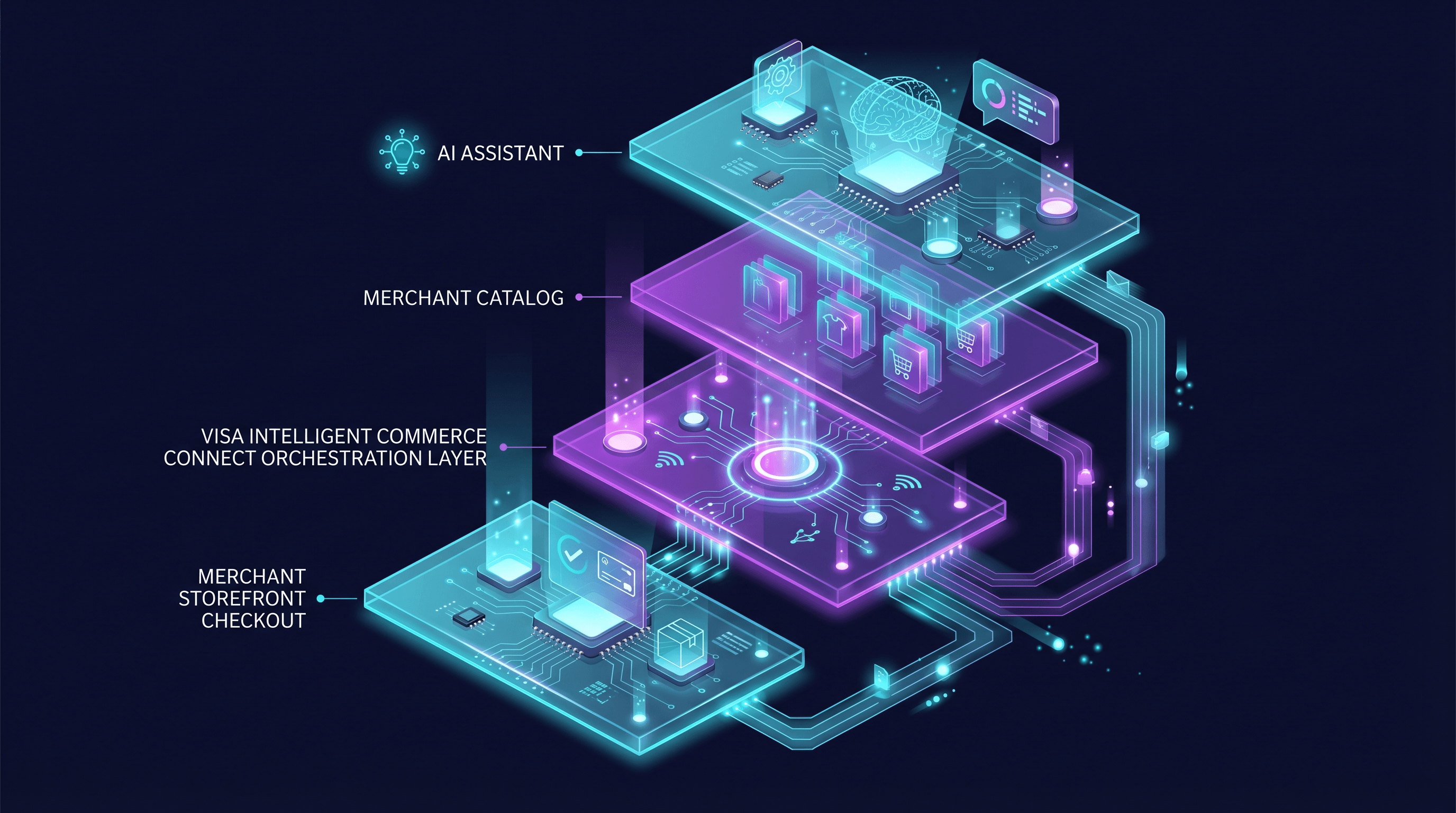
- orchestration support through the Visa Acceptance Platform
The press release goes further by saying Connect enables businesses to accept payments initiated via:
- Trusted Agent Protocol
- Machine Payments Protocol (MPP)
- Agentic Commerce Protocol (ACP)
- Universal Commerce Protocol (UCP)
This is one of the most important facts in the whole launch. Visa is explicitly acknowledging that agentic commerce is emerging across multiple protocol paths, and it wants to make participation easier even in a fragmented environment. That is a much more practical business story than pretending one protocol has already won.
Just as important, this is not framed as a narrow Visa-only product. The company is signaling that merchants and enablers will need interoperability across a messy real-world environment where different platforms, networks, and payment approaches coexist. That is a more believable market posture than a winner-takes-all protocol narrative. Sources: Visa Press Release, April 8 2026, Visa Acceptance Platform
| Stakeholder | What Connect changes | Why it matters |
|---|---|---|
| Merchants | Single integration path into AI-powered commerce | Reduces complexity around protocols, tokenization, and payment readiness |
| Agent builders | A more standardized path to merchant acceptance and payment flows | Makes it easier to connect AI shopping experiences to real commerce infrastructure |
| Commerce enablers | Orchestration and platform-level support via Visa Acceptance Platform | Lets intermediaries help many merchants adopt agentic commerce more efficiently |
| Payment teams | Support for tokenization, authentication, and spend controls in agent-led transactions | Frames AI commerce as a controllable payment operation, not just a UX experiment |
| Brands and marketers | Catalog discoverability and product data become part of commerce readiness | Winning AI shopping starts before checkout, at the discovery and selection stage |
Why Does This Matter for Merchants, Not Just Payment Teams?
Visa Intelligent Commerce Connect matters because it shifts the conversation from payment authorization alone to full merchant readiness for AI-driven buying journeys. This is not just about whether an AI agent can submit a payment credential. It is about whether a merchant can be discovered, evaluated, selected, and transacted with inside AI shopping environments.
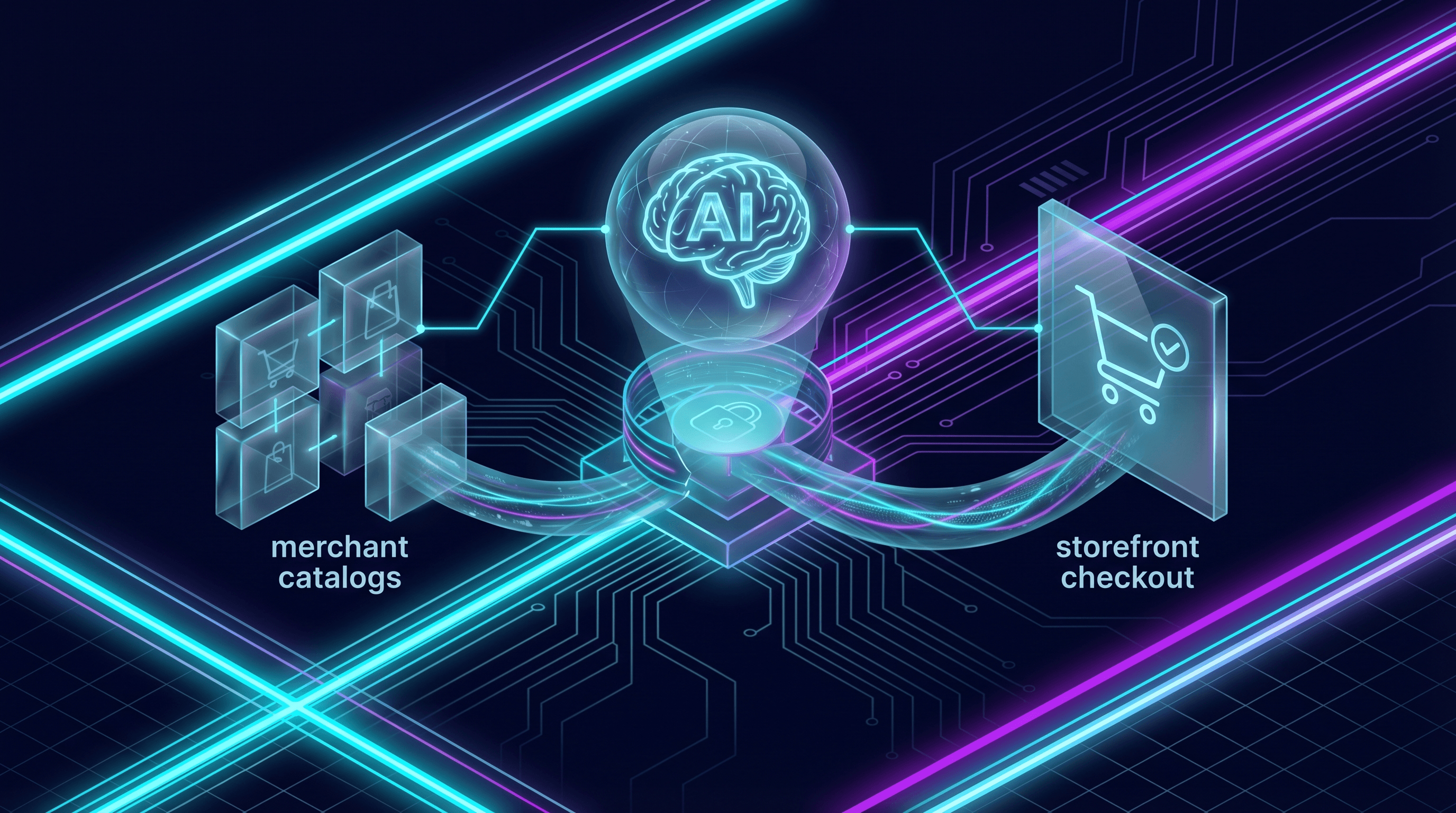
Visa's own product framing makes that clear. The company says businesses can create an AI-ready version of their catalog, connect it to the AI platforms they choose, and still have customers complete purchases on the merchant storefront. That turns the launch into a broader commerce and discoverability story, not just a payments story. Source: Visa Intelligent Commerce Connect Product Page
That matters because merchants are not only worried about payment security. They are worried about disintermediation. If AI assistants become the place where discovery and product selection happen, merchants risk losing customer context, transaction visibility, brand interaction, and the relationship that usually forms around the buying journey. Visa's storefront-completion language reads as an effort to reduce that fear and make participation feel operationally realistic.
- Merchant catalogs matter earlier in the journey because AI shopping starts with discovery and recommendation before checkout ever happens.
- Merchant storefronts still matter at the moment of conversion because Visa is explicitly preserving a path where the final purchase completes on the brand's own surface.
- Merchant data quality matters more because AI systems need product details, availability, and structured information they can interpret cleanly.
- Merchant visibility matters more because a brand cannot be chosen by an AI shopping agent if its products are not machine-discoverable in the first place.
- Merchant control becomes a strategic issue because businesses do not want to become invisible fulfillment endpoints behind someone else's interface.
That is why this launch matters beyond payment operations. If AI commerce begins inside AI interfaces, then merchants need more than payment acceptance. They need infrastructure that helps their catalog, product data, and transaction path become usable inside those environments without collapsing the value of their own storefront.
In A.G.E.N.T.I.C. terms, this is primarily a Network-phase signal, with clear Graph and Equip implications. Network matters because the transaction and protocol layer is being wired up. Graph matters because businesses need a machine-readable entity foundation that helps AI systems understand who they are, what they sell, and how their products and services connect. Equip matters because businesses still need product data, content structure, and AI-readable clarity for AI systems to discover and evaluate them in the first place.
How Is Visa Positioning Connect Differently From a Typical Payments Product?
Visa is positioning Connect less like a conventional payments feature and more like connective commerce infrastructure. That distinction matters because the language of the launch is much broader than authorization, routing, or fraud controls.
A typical payments product usually answers a narrow operational question: how do we approve, secure, or settle a transaction? Visa Intelligent Commerce Connect is framed more broadly. Visa is trying to sit between AI agents, merchants, token providers, protocols, and acceptance infrastructure. That is a larger role than payment processing alone.
The product page and press release both reinforce that broader positioning. Visa is not only talking about authentication and spend controls. It is also talking about catalog discoverability, protocol compatibility, merchant participation, interoperability across token vaults and networks, and a single integration path through the Visa Acceptance Platform. That makes Connect feel less like a checkout enhancement and more like an early bridge layer for agentic commerce. Sources: Visa Press Release, April 8 2026, Visa Intelligent Commerce Connect Product Page, Visa Acceptance Platform
- A typical payments product focuses on transaction execution, while Visa Intelligent Commerce Connect focuses on participation in AI shopping environments.
- A typical payments product starts at checkout, while Connect starts earlier with catalog readiness, discoverability, and merchant connectivity.
- A typical payments product stays inside one payment workflow, while Connect is framed around interoperability across networks, protocols, and token vaults.
- A typical payments product is a merchant tool, while Connect is positioned as a bridge across merchants, AI agents, commerce enablers, and acceptance infrastructure.
- A typical payments product solves a payment problem, while Connect is trying to solve an ecosystem-connection problem.
This is also why Visa's role matters specifically. Payment networks have distribution reach, trust infrastructure, merchant relationships, and integration gravity. When a company in that position starts trying to simplify AI-commerce participation, it can influence how quickly the market moves from isolated pilots to broader operational adoption. That does not mean Visa will control the category, but it does mean Visa has the reach to make the category easier to enter for many businesses.
That positioning matters because the real bottleneck in agentic commerce is not whether one more checkout feature exists. The bottleneck is whether the ecosystem becomes connected enough for AI shopping experiences to reach merchants reliably and securely.
What Are the Limits of Visa Intelligent Commerce Connect Today?
Visa Intelligent Commerce Connect is a meaningful signal, but it should not be read as proof that agentic commerce is fully standardized or broadly mature today. The most credible reading is that Visa is trying to lower barriers to participation in a market that is still taking shape.
Several limits matter. First, Visa positions Connect as an on-ramp, which implies the category still needs onboarding infrastructure rather than universal default behavior. Second, naming protocol support does not automatically mean real-world merchant readiness is uniform across platforms, systems, and implementations. Third, the fact that Visa emphasizes purchases completing on the merchant storefront suggests the market is still in a transitional phase, not a fully native AI-agent transaction environment across every commerce surface. Sources: Visa Intelligent Commerce Connect Product Page, Visa Press Release, April 8 2026
There is also an important business nuance here. Visa can provide connective infrastructure, but it cannot make a merchant's product data clean, complete, or AI-readable by itself. It can reduce integration friction. It cannot replace the foundational work businesses still need to do to become discoverable and trustworthy in AI-mediated buying flows.
The pilot-partner framing matters too. Visa named early partners including Aldar, AWS, Diddo, Highnote, Mesh, Payabli, and Sumvin, while also saying more partners will roll out in 2026. That is consistent with a market that is progressing, but still early. It shows ecosystem movement, not universal adoption. Source: Visa Press Release, April 8 2026
That is why this launch is worth covering carefully. It is a serious infrastructure signal, but not a reason to pretend the market is already settled.
What Does Visa Intelligent Commerce Connect Signal About the Future of Agentic Commerce?
Visa Intelligent Commerce Connect signals that agentic commerce is moving deeper into real acceptance and payment infrastructure. That is the strongest conclusion a business reader should take from this launch.
The significance of the announcement is not that Visa has declared the future or standardized the market overnight. It is that one of the world's largest payment networks is investing in a bridge layer designed to make AI-powered commerce easier for businesses to join. That tells merchants, platforms, and commerce operators something important: this category is now serious enough that infrastructure companies are trying to solve for participation, interoperability, and operational simplicity.
It also suggests the market will not be shaped by discoverability alone or by checkout rails alone. The better reading is that the strongest businesses will be the ones that can be found, understood, selected, and transacted with by AI systems. That is the full pipeline from Graph and Equip through Network and eventually into Convert.
- Agentic commerce is moving closer to production infrastructure because major payment and acceptance players are now building connective layers around it.
- Interoperability is becoming a core business requirement because merchants, agents, token systems, and protocols will need to work together instead of in isolated stacks.
- Partial participation will likely arrive before full autonomy because connective infrastructure is easier to roll out than a universal end-state for AI commerce.
- Merchant readiness will matter as much as protocol readiness because product data, catalog structure, and storefront usability still determine whether AI systems can act effectively.
- The market is shifting from theory to operational preparation because businesses can no longer treat AI shopping as only an experimental edge case.
More specifically, it suggests where maturity may arrive first. Agentic commerce may not become mainstream first as a fully autonomous shopping future across every surface. It may mature first through connective infrastructure that makes partial participation easier for merchants, enablers, and payment systems. That is a more believable path to market than waiting for a single universal standard to solve everything at once.
So the right takeaway is not "agentic commerce is here, everything changes tomorrow." The more useful takeaway is this: the infrastructure layer is getting real, and businesses that wait until standards are perfect will be later than they think. Sources: Visa Press Release, April 8 2026, Visa Intelligent Commerce Connect Product Page, Visa Acceptance Platform
Final Takeaway
Visa Intelligent Commerce Connect matters because it reframes agentic commerce as a practical business integration problem, not just a futuristic payments concept. Visa is trying to reduce the friction between AI shopping experiences and the merchant infrastructure needed to support them.
For merchants, that is the real signal. The market is moving from prototypes toward connective infrastructure. Businesses that prepare early will be better positioned when AI-driven buying becomes a normal part of how customers discover and transact.
That is why this launch belongs in the serious category of agentic commerce news. It does not prove the market is finished. It proves the infrastructure layer is being built by companies large enough to matter.
Where This Fits in the A.G.E.N.T.I.C. Framework
Visa Intelligent Commerce Connect is the kind of launch that rewards businesses with clean product data, AI-readable content, and infrastructure that can support agent-driven buying. If your business cannot be clearly understood, selected, and transacted with by AI systems, protocol readiness alone will not save you. That is the work the A.G.E.N.T.I.C. Framework is built to solve.
Frequently Asked Questions
- What is Visa Intelligent Commerce Connect?
- Visa Intelligent Commerce Connect is a business-facing solution launched by Visa on April 8, 2026 to help businesses connect to AI-powered commerce through a single integration via Visa Acceptance Platform. Visa positions it as a network, protocol, and token vault-agnostic on-ramp to agentic commerce.
- How is Visa Intelligent Commerce Connect different from Visa Intelligent Commerce?
- Visa Intelligent Commerce is the broader portfolio around AI-powered commerce. Visa Intelligent Commerce Connect is the business integration layer within that portfolio, designed to help merchants, enablers, and agent builders participate more easily in AI-driven commerce flows.
- Which protocols does Visa Intelligent Commerce Connect support?
- According to Visa's April 8, 2026 press release, Intelligent Commerce Connect can support payments initiated through Trusted Agent Protocol, Machine Payments Protocol, Agentic Commerce Protocol, and Universal Commerce Protocol.
- Why does Visa Intelligent Commerce Connect matter for merchants?
- It matters because Visa is framing AI commerce as a merchant readiness and integration issue, not just a payment authorization issue. The launch points to a future where discoverability, product data accessibility, protocol compatibility, and transaction readiness all matter together.
- Does Visa Intelligent Commerce Connect mean AI agents can fully buy on behalf of customers now?
- It signals real progress, but it does not mean the market is fully standardized or universally mature today. Visa is presenting Connect as an on-ramp, which suggests adoption and implementation are still developing across the ecosystem.
- Which A.G.E.N.T.I.C. phase does Visa Intelligent Commerce Connect map to?
- Primarily Network (Phase 4), because it is about protocol wiring and agentic commerce enablement. It also maps to Graph (Phase 2) and Equip (Phase 3), because merchants still need clean entity architecture, AI-readable catalogs, structured product information, and machine-accessible content for AI shopping environments to work well.