What Is Agentic Commerce?

Key Takeaways
- Agentic Commerce is the $1 trillion shift from traditional search-and-click to autonomous AI agents independently searching, comparing, and purchasing on behalf of consumers.
- As of April 2026, the protocol stack is live: Stripe's Machine Payments Protocol, Google's Universal Commerce Protocol with Gap Inc. and Shopify building on it, and Visa's Intelligent Commerce platform expanding globally.
- AI agent traffic to retail sites grew 1,300% year-over-year. Shopify reports AI-driven orders up 15x. Amazon Rufus influenced 66% of Black Friday purchases with a 3.5x conversion lift.
- Retailers are seeing 88% positive ROI from initial agentic implementations, with companies like Danfoss and Mediq automating 80-91% of order-related tasks.
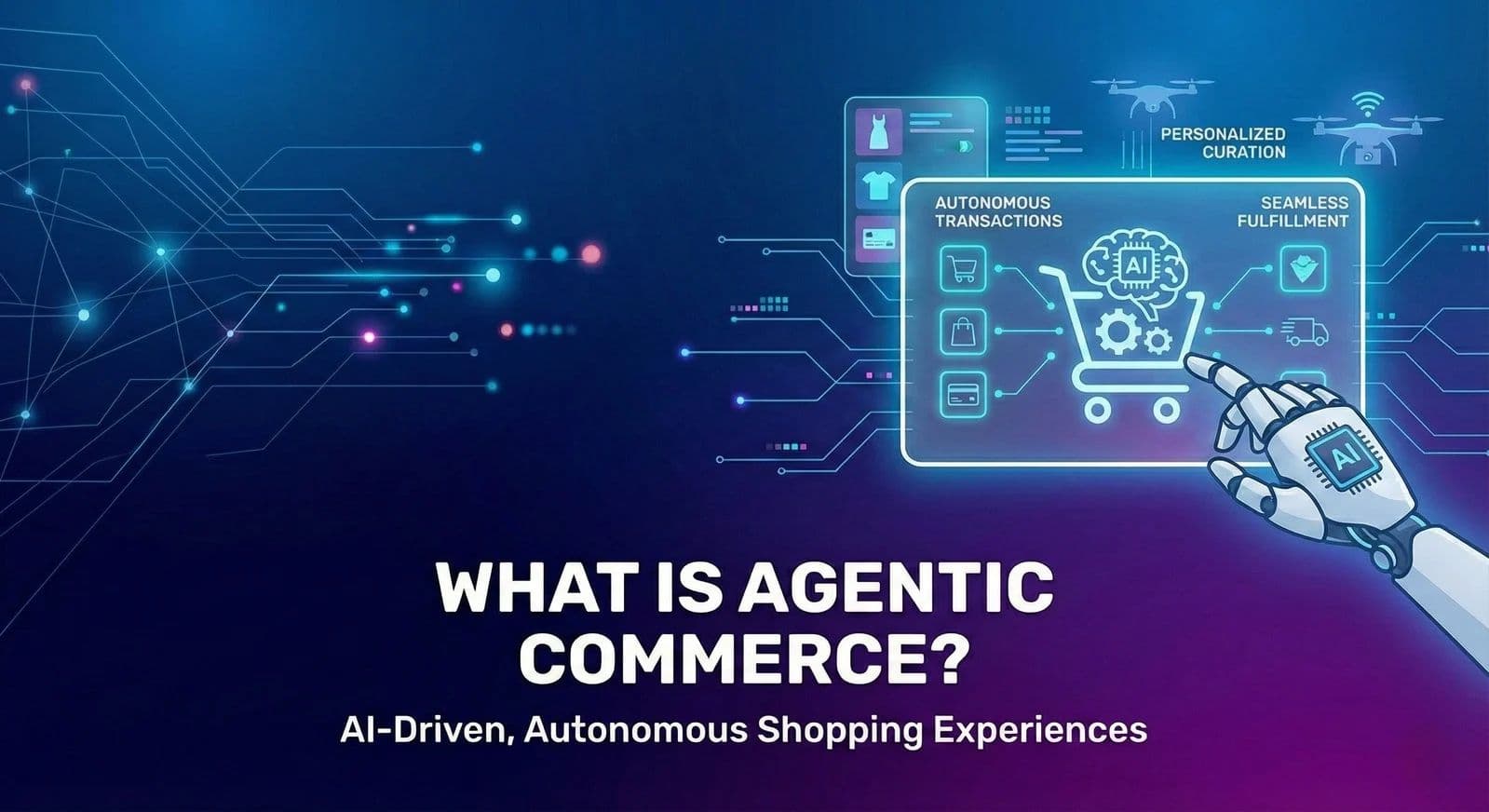
Quick Answer: Agentic commerce is AI-powered autonomous shopping where AI agents independently search, compare, negotiate, and complete purchases on your behalf. McKinsey projects agentic commerce will capture up to $1 trillion in US retail revenue by 2030, representing one-third of all online sales. As of April 2026, the protocol stack is live: Stripe's Machine Payments Protocol, Google's Universal Commerce Protocol, and Anthropic's Model Context Protocol are all in production, with Shopify reporting AI-driven orders up 15x year-over-year. Source: McKinsey
Last Updated: April 2, 2026 • Reading Time: 15 minutes
What Is Agentic Commerce?
Agentic commerce is shopping powered by AI agents that autonomously execute complete transactions, from discovery through checkout with minimal human intervention.
The 3 Core Capabilities
- Delegated Authority: You transfer decision-making power to AI agents for specific shopping tasks. Mastercard (2025) defines it as systems where "an AI agent closes the loop searching for items, comparing options and making a purchase, with limited or no manual inputs needed."
- Preference Architecture: AI systems capture and apply your preferences across all interactions, learning from each purchase to improve future recommendations.
- Autonomous Execution: AI agents navigate marketplaces, negotiate prices, and complete transactions independently within parameters you set.
The Technical Infrastructure
Agentic commerce relies on emerging protocols that allow different AI systems to communicate and execute transactions securely.
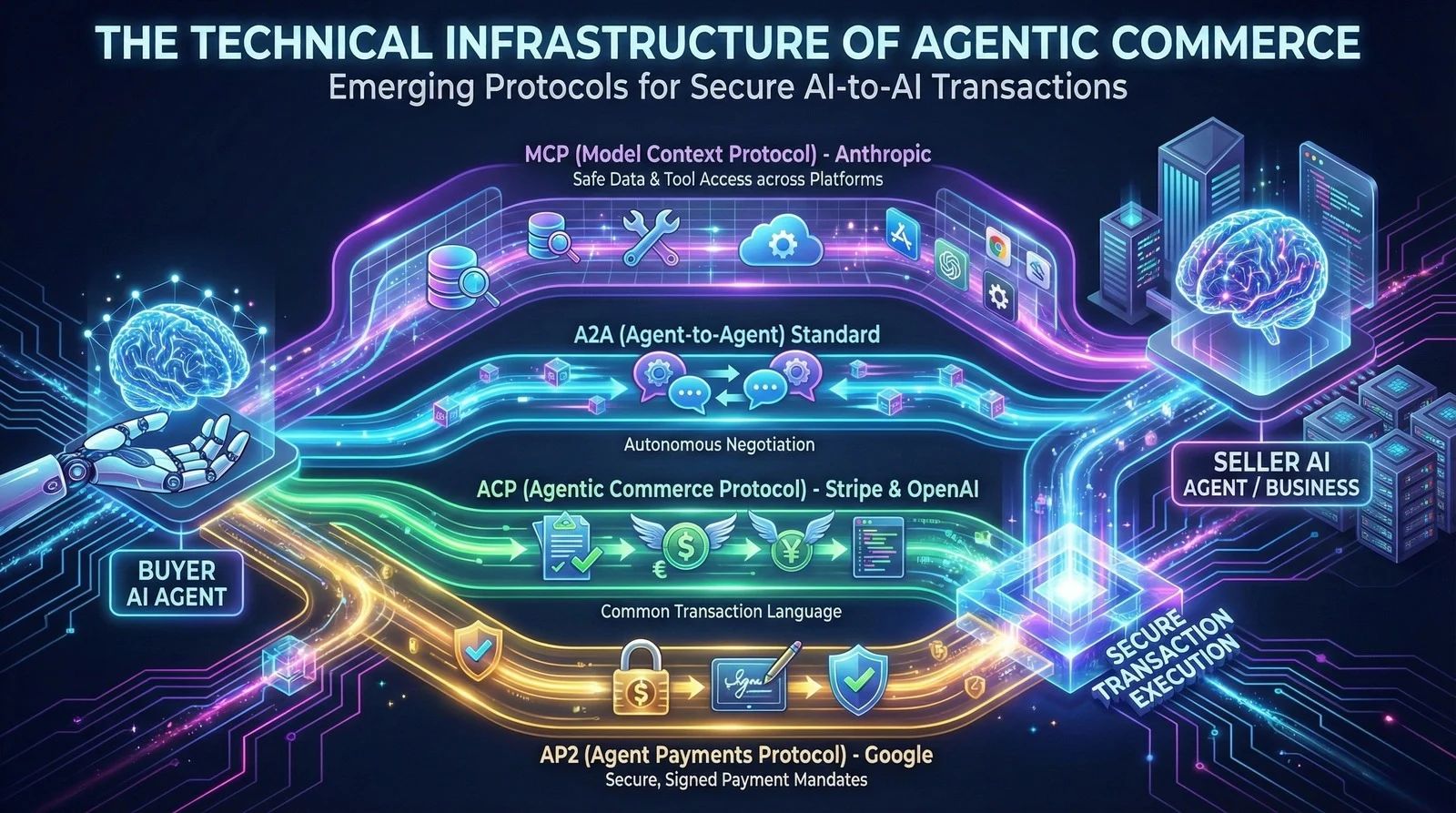
- Agentic Commerce Protocol (ACP): Developed by Stripe and OpenAI to define a common language for how agents and businesses transact.
- Model Context Protocol (MCP): An open standard from Anthropic that enables AI models to safely access data and tools across different platforms.
- Agent Payments Protocol (AP2): Google's framework for secure, cryptographically signed payment mandates.
- A2A (Agent-to-Agent): Developed by Google, this is the standard for autonomous negotiation between a buyer's agent and a seller's agent.
- Universal Commerce Protocol (UCP): An open standard for AI agent interoperability that enables autonomous discovery of merchant capabilities, session management, and cross-platform transaction negotiation. As of March 2026, Gap Inc., Shopify, Best Buy, Commerce Inc., Salesforce, and Stripe are building on UCP. Source: Google
- Machine Payments Protocol (MPP): Launched March 2026 by Stripe and Tempo, MPP is an open standard for AI agent payments. It allows agents to pay for goods and services programmatically using stablecoins, cards, or buy-now-pay-later methods through Stripe's existing PaymentIntents API.
How Agentic Commerce Works
Quick Answer: Agentic commerce works through five steps: (1) understanding your intent through natural language, (2) searching across multiple platforms simultaneously, (3) comparing options using AI analysis, (4) negotiating prices with retailer systems, and (5) completing secure autonomous checkout.
The 5-Step Process
- 1. Intent Recognition: You state what you want in natural language: "Order organic dog food under $50, grain-free, with free shipping." AI agents using large language models understand complex requests with 92% accuracy (industry benchmarks, 2024).
- 2. Multi-Platform Search: AI agents scan 50+ retailers in under 3 seconds—a task requiring 2-3 hours manually (BCG, 2025). The system simultaneously checks inventory, pricing, shipping options, and reviews.
- 3. Intelligent Comparison: AI analyzes 100+ products across price, quality ratings, delivery speed, and total cost. According to DigitalOcean (2025), agents evaluate far more options than the 3-5 products humans typically compare.
- 4. Autonomous Negotiation: Shopping agents communicate with retailer systems to secure bundle discounts, loyalty benefits, and promotional pricing automatically (Edgar Dunn & Company, 2025).
- 5. Secure Checkout: AI completes transactions using protocols like Google's Agent Payments Protocol (AP2) with cryptographically signed mandates. Checkout completes in 5-10 seconds with 99%+ accuracy.
Agentic vs Traditional vs Conversational Commerce
Traditional e-commerce requires continuous human involvement, conversational commerce adds AI chat assistance while humans decide, and agentic commerce enables AI to autonomously execute complete transactions based on your parameters.
| Feature | Traditional Commerce | Conversational Commerce | Agentic Commerce |
|---|---|---|---|
| Role of AI | None/Passive (Recommendations) | Active Assistant (Chatbots/Voice) | Autonomous Agent (Independent Buyer) |
| User Involvement | Continuous (Search, Click, Checkout) | Interactive (Guidance & Confirmation) | Minimal (Set Parameters & Delegated) |
| Core Technology | Web Browsers & Shopping Carts | Natural Language Processing (NLP) | AI Protocols (ACP, MCP, AP2) |
| Primary Goal | Manual Product Discovery | Assisted Decision Making | Autonomous Task Execution |
| Decision Maker | The Human | Human (informed by AI) | AI Agent (within authority) |
When to Use Each Approach
Choose Traditional E-Commerce for:
- High-involvement purchases (luxury goods, home decor).
- Complex customization needs.
- Products requiring visual exploration.
Choose Conversational Commerce for:
- Complex product questions.
- Guided selling processes (insurance, financial products).
- Customer support integration.
Choose Agentic Commerce for:
- Repetitive routine purchases (groceries, household staples).
- Multi-vendor price optimization.
- Time-sensitive procurement.
- B2B repetitive ordering.
Real Results: Mediq automated 91% of order-related tasks using agentic AI, eliminating 90% of processing time (Go Autonomous, 2024).
The $1 Trillion Market Opportunity
The agentic AI in retail market is valued at $46.74 billion in 2025, projected to reach $175.11 billion by 2030 (30.2% CAGR), with US B2C agentic commerce potentially capturing up to $1 trillion by 2030 according to McKinsey.
Market Size & Growth Projections
- Current Market (2025): $46.74B - Agentic AI in retail/e-commerce (Mordor Intelligence)
- Projected Growth (2030): $175.11B - Agentic AI in retail (30.2% CAGR) (Mordor Intelligence)
- Market US Potential: Up to $1T - US B2C agentic commerce (2030) (McKinsey)
Proven ROI Metrics
- 88% report positive ROI from AI agent implementations (Google Cloud, 2025).
- 62% project 100%+ ROI in year one (Google Cloud, 2025).
Real-World Results
B2B Success Stories
Danfoss (Energy Solutions): 90% reduction in order processing time, 80%+ orders fully automated, and 70% reduction in manual errors (Go Autonomous, 2024).
Mediq (Healthcare Distributor): 91% automation of order tasks and 90% faster processing across a 4-country deployment (Go Autonomous, 2024).
Consumer-Facing Results
Rep AI Platform: 12.3% purchase rate with AI vs 3.1% without (4x improvement), with conversion increases up to 427% in specific categories (Rep AI, 2024).
Walmart: 30% reduction in out-of-stock events within 6 months and real-time inventory accuracy >95% through AI reordering (XCube Labs, 2024).
Where Agentic Commerce Stands in April 2026
When this article was first published in December 2025, agentic commerce was a prediction backed by research from McKinsey and BCG. Four months later, it is operational infrastructure with live protocols, real transaction volume, and measurable traffic growth.
Protocol Launches That Changed the Landscape
Stripe's Machine Payments Protocol (MPP) launched in March 2026 as an open standard for AI agent payments. MPP allows agents to pay for goods and services programmatically using stablecoins, cards, and buy-now-pay-later methods, all through a few lines of code on Stripe's existing PaymentIntents API. Businesses like Browserbase, PostalForm, and Prospect Butcher Co. are already processing agent payments in production. Source: Stripe
Google's Universal Commerce Protocol (UCP) expanded from a specification to a live ecosystem. Gap Inc. introduced UCP-powered conversational checkout across Old Navy, Gap, Banana Republic, and Athleta. Shopify, Best Buy, Commerce Inc., Salesforce, and Stripe are all building on UCP, with simplified Merchant Center onboarding rolling out to retailers of all sizes. Source: Gap Inc., Source: Google
Visa's Intelligent Commerce platform expanded to accelerate agentic commerce adoption globally, with pilot programs in Asia Pacific, Europe, and Latin America. The platform enables AI agents to search for, recommend, and complete purchases on behalf of consumers through Visa's secure payment infrastructure. Source: Visa
Mastercard's Verifiable Intent introduced a cryptographic trust layer that lets AI agents prove they are acting on genuine human authorization before completing a transaction. This addresses the core trust problem in agentic commerce: how does a merchant know an agent is authorized to spend real money? Verifiable Intent provides that proof at the protocol level. Source: Mastercard
The Traffic Data Confirms the Shift
Shopify reported AI-driven traffic to its merchant stores increased 8x since January 2025, with AI-driven orders up 15x in the same period. 64% of shoppers surveyed said they are likely to use AI for product discovery. Source: Shopify
ChannelEngine's 2026 Marketplace Report found AI agent traffic to retail sites grew more than 1,300% year-over-year. Source: ChannelEngine/PR Newswire
Amazon's Rufus AI shopping assistant handled approximately 40% of all Black Friday 2025 sessions and influenced roughly 66% of purchases, delivering a 3.5x conversion lift over unassisted sessions. Source: Sensor Tower
Morgan Stanley Research estimates agentic shoppers could reach $190 billion to $385 billion in U.S. e-commerce spending by 2030. The prediction from October 2025 that agentic commerce would become mainstream between 2028 and 2030 may need to be revised. The protocol stack is live. The payment rails are connected. The traffic is already here.
How to Prepare Your Business for Agentic Commerce
The brands capturing agentic commerce revenue today started preparing before the protocols were finalized. Readiness requires work across three layers: making your business discoverable by AI agents, structuring your data so agents can evaluate your products, and connecting to the transaction protocols that let agents buy.
1. Make Your Business Visible to AI Systems
AI agents do not browse websites the way humans do. They extract structured data from schema markup, answer capsules, and machine-readable content. If your product data is locked inside images, PDFs, or unstructured HTML, agents cannot find you. Start with Organization, Product, and FAQPage schema. Write answer capsules (50 to 150 word self-contained answers) for every key product and service question.
2. Build Your Entity Architecture
AI platforms make citation decisions based on entity recognition. If the AI does not understand who your brand is, what you sell, and how you relate to your category, it will recommend a competitor whose entity graph is clearer. Map your brand relationships explicitly: products, leadership, locations, proprietary methodology, and differentiators. This is the semantic foundation that reduces hallucinations and increases citation confidence.
3. Connect to Agent Transaction Layers
The protocol stack (ACP, UCP, MCP, AP2, MPP) is live and growing. Businesses that expose their catalog, inventory, and pricing through these protocols give AI agents a direct path to transact. Those that do not are invisible to the fastest-growing commerce channel. If your platform supports UCP (Shopify is rolling out native support), start there. For custom implementations, MCP server integration exposes your catalog to any AI agent that supports the standard.
4. Measure What AI Sees
Traditional analytics measure human traffic. Agentic commerce requires tracking AI citations, agent-initiated sessions, and share of voice across ChatGPT, Perplexity, Google AI Overviews, and Claude. You cannot optimize what you do not measure.
The A.G.E.N.T.I.C. Framework maps this entire lifecycle from audit through conversion. Businesses that follow a structured approach move faster and avoid the expensive mistake of optimizing the wrong layer first.
To track which protocols are live, which platforms support agent transactions, and how the ecosystem is evolving in real time, see our State of Agentic Commerce tracker.
What Industry Experts Say
"Agentic commerce flips the customer journey on its head. You're not just automating what you already do—you're redesigning what shopping means."
"Without swift intervention, retailers risk being sidelined and reduced to mere background utilities in increasingly agent-controlled digital marketplaces."
"By next year, we anticipate a significant rise in consumers interacting with AI agents to manage their shopping, from initial intent to final receipt."
Key Takeaways for Brands
The data is clear:
- $1 trillion US market potential by 2030.
- 4,700% traffic growth already measurable.
- 88% positive ROI rate for implementers.
Success requires:
- Structured, machine-readable product data.
- API-first infrastructure for real-time queries.
- Integration with major AI platforms.
- Consumer trust through transparency and control.
- Strategic approach vs technology-only mindset.
The window is narrowing. Organizations moving decisively now will shape industry standards and capture disproportionate value. Those who wait risk invisibility to AI agents increasingly mediating consumer choice.
How Agentic Commerce Works
A 5-step process showing how AI agents autonomously complete shopping transactions from intent recognition to secure checkout.
Intent Recognition
State what you want in natural language, such as 'Order organic dog food under $50, grain-free, with free shipping.' AI agents using large language models understand complex requests with 92% accuracy.
Multi-Platform Search
AI agents scan 50+ retailers in under 3 seconds—a task requiring 2-3 hours manually. The system simultaneously checks inventory, pricing, shipping options, and reviews.
Intelligent Comparison
AI analyzes 100+ products across price, quality ratings, delivery speed, and total cost. Agents evaluate far more options than the 3-5 products humans typically compare.
Autonomous Negotiation
Shopping agents communicate with retailer systems to secure bundle discounts, loyalty benefits, and promotional pricing automatically.
Secure Checkout
AI completes transactions using protocols like Google's Agent Payments Protocol (AP2) with cryptographically signed mandates. Checkout completes in 5-10 seconds with 99%+ accuracy.
Frequently Asked Questions
- What's the difference between agentic and conversational commerce?
- Conversational commerce provides AI chat assistance while you make decisions (AI advises, you decide). Agentic commerce lets AI autonomously execute complete purchases from research through checkout based on your parameters (AI decides and executes within your boundaries).
- How do autonomous payments work securely?
- Agentic payments use protocols like Google's Agent Payments Protocol (AP2) with cryptographically signed mandates and tokenized credentials from Mastercard/Visa. This enables AI purchases within preset budgets with single-use tokenized credentials and complete transaction traceability.
- Which products are best for agentic commerce?
- Commoditized products (groceries, household staples, office supplies), B2B repetitive procurement, and routine replenishment purchases deliver the highest ROI. Luxury goods and experiential purchases remain better suited for human-driven exploration.
- When will agentic commerce become mainstream?
- Adoption is accelerating through 2025-2028. Full market maturity and widespread agent-to-agent commerce are expected between 2028 and 2030.
- What does implementation cost for businesses?
- Basic implementations range from $15,000-$30,000, while enterprise-scale systems can cost $100,000-$500,000+. Typical payback periods range from 8 to 14 months due to significant efficiency gains and conversion increases.
- How do I prepare my business for the agentic era?
- Start by converting product catalogs to machine-readable JSON-LD format, building real-time inventory and pricing APIs, and optimizing for AI agent discovery through AEO and GEO. Integrating with major AI platforms like ChatGPT and Perplexity is also critical.