Google Maps Now Orders Your Food: What Restaurants Must Do

Direct Answer
Google Maps can now assemble a restaurant order inside a conversation. As of August 6, 2026, Ask Maps surfaces open restaurants matching your request, and once you select one it adds the dish you asked for to a cart, which you then review and complete with Square or Toast restaurants in the United States.
Key Takeaways
- Ask Maps food ordering went live in the United States on August 6, 2026, with Square and Toast as launch partners and Uber Eats named as coming soon. Google frames it as an agentic capability that completes multi step tasks, not as a search result.
- The agent does the matching work, not the choosing. Ask Maps resolves constraints like route, open hours and a named dish, but Google's flow has the guest select the restaurant, after which the dish is added to a cart the guest reviews and completes.
- Orders run through the restaurant's first party system rather than a marketplace. Toast states that Ask Maps orders flow through its own ordering stack without adding third party commission fees, and Square states its sellers need no added setup, contracts or fees.
- The Universal Commerce Protocol for Food has real governance behind it. A Food Technical Council was chartered in June 2026 and seated on July 16, 2026 with five members: Block (Square), DoorDash, Google, Toast and Uber Eats.
- The on-ramp is the point of sale, not the website. Square sellers surface once a Google Business Profile is active, with menus, hours and location syncing automatically from the Square Dashboard, which moves agentic distribution to the systems vendor.
- Menu data is now the transactable surface. An agent can only order what it can read, so structured items, modifiers, hours and live availability decide whether a restaurant can be transacted with, not just whether it can be found.
What Is Agentic Food Ordering in Google Maps?
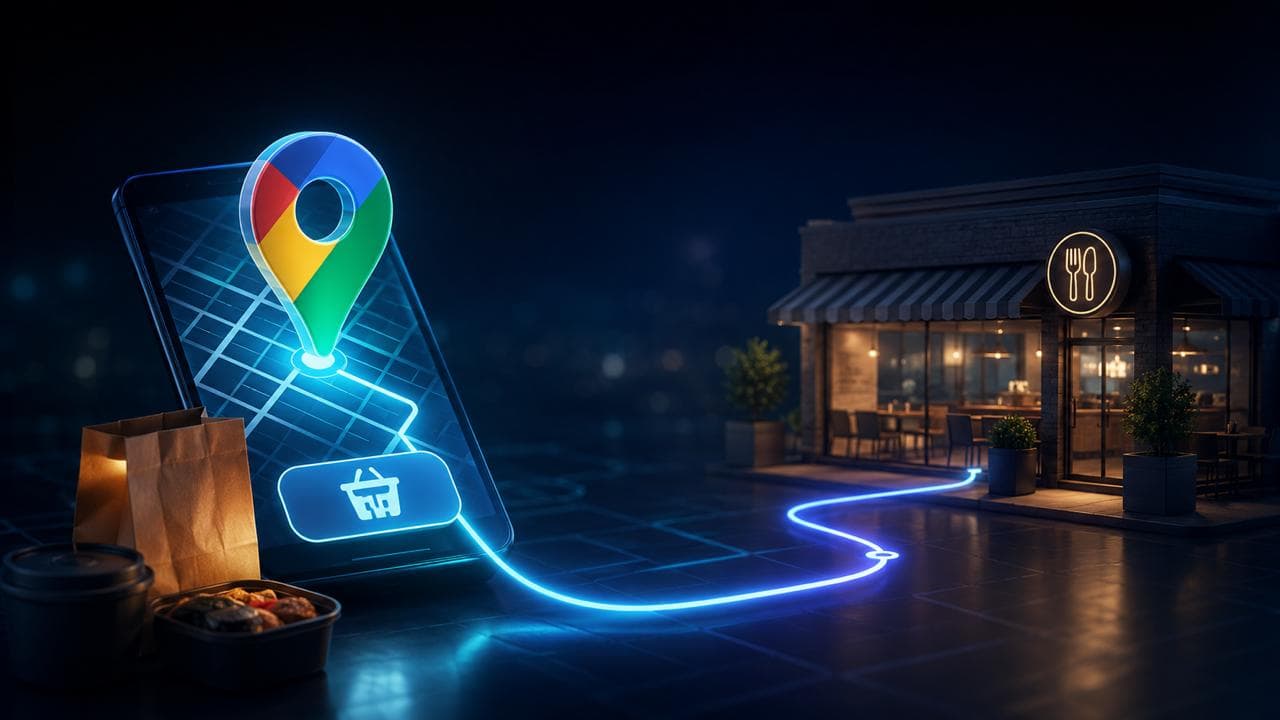
Agentic food ordering in Google Maps is a conversational flow in which Ask Maps interprets a spoken or typed food request, surfaces matching open restaurants, and once the guest selects one, adds the requested dish to a cart for review and checkout. Google began rolling the capability out in the United States on August 6, 2026. Google Maps Blog
Ask Maps itself is not new. Google introduced it on March 12, 2026 as a conversational experience that answers complex real-world questions, drawing on more than 300 million places and a contributor community of over 500 million people, and launched it first in the United States and India on Android and iOS. What changed in August is that the conversation can now end in a transaction. Google Maps Blog
What the August release actually added:
- Ordering as a completed task: a request such as ordering a specific dish for pickup on the way home is resolved end to end, rather than returning a list of restaurants for the user to work through.
- Named launch partners: food ordering is rolling out with Square and Toast, with Uber Eats named as coming soon, so in practice today the orderable universe tracks partner coverage rather than any restaurant being able to opt in.
- Automatic cart assembly: once a restaurant is selected, Ask Maps can add the dish directly to the cart so the guest reviews and completes rather than rebuilding the order.
- Optional personal context: with Personal Intelligence, a user can choose to connect Ask Maps to Gmail, with other apps such as Calendar named as coming later.
- Adjacent verticals in the same surface: the same release added hotel and local event discovery, signalling that food is the first local commerce vertical rather than the only one.
For an operator, the consequential detail is where the shortlist now gets built. The guest still picks the restaurant, but the set of options they pick from is assembled inside Google's conversational surface, upstream of the restaurant's own website and app, which makes the accuracy of the data Google holds about the menu a revenue variable rather than a listings chore. Google Maps Blog
How Does the Ask Maps Ordering Flow Actually Work?
The flow compresses several steps that a guest would normally perform manually across a search engine, a restaurant site and a checkout page. Google's own example is a request for a specific noodle dish, for pickup, along the route home, which is three constraints resolved in a single utterance.
- The guest states a request in natural language: by voice or text, including the dish, the fulfilment method and any constraint such as being on the way home.
- Ask Maps resolves the constraints against the map: it looks for restaurants that are open, that sit along the stated route, and that can serve the dish being described.
- The menu is matched: the request is mapped against a partner restaurant's menu, which is what surfaces that restaurant as an answer rather than a generic listing.
- The guest selects a restaurant: Google's description keeps this step with the user, so the agent narrows the field but does not make the final choice on the guest's behalf.
- The cart is assembled automatically: once a restaurant is selected, Ask Maps adds the identified dish to the cart on the partner system so the guest can review and complete the order.
- Checkout happens on the partner rail: for Square sellers, customers browse the menu, customize the order and complete checkout using Order by Cash App.
- The order lands in the existing operating stack: orders flow directly into the seller's current Square setup, including the point of sale and the kitchen display system.
One caveat is worth stating plainly, because it is the sort of gap that gets filled with assumptions. Google's announcement describes cart assembly and order review but does not spell out the payment authorization mechanics, and neither Google nor Square has published a public specification for the Ask Maps ordering handoff. The observable contract today is a partner integration, not an open interface a third party can implement against. Square Press, Google Maps Blog
What Is the Universal Commerce Protocol for Food?
The Universal Commerce Protocol for Food is the food vertical of Google's Universal Commerce Protocol, an open standard defining how AI agents discover, order from and check out with restaurants across surfaces including Search, Maps and Gemini. Google described it in the Ask Maps announcement as something it will continue to co-develop with partners. Google Maps Blog, Toast Investor Relations
The base protocol is further along than the food extension. UCP was published on January 11, 2026, developed by Google with Shopify, Etsy, Wayfair, Target and Walmart, and endorsed by more than twenty partners including Adyen, American Express, Mastercard, Stripe and Visa. It is licensed under Apache 2.0. Google Developers Blog, UCP Specification Repository, Google for Developers
What the core protocol already standardizes:
- Capability discovery: a business publishes its capabilities and payment configuration in a standard JSON manifest at a well-known path, letting agents discover features without hardcoded integrations.
- Checkout as endpoints: a merchant exposes a standard checkout session API rather than a bespoke cart integration per surface, with operations to create, retrieve, update, complete and cancel a session.
- Separated payment roles: the protocol distinguishes payment instruments from payment handlers, so a merchant can keep its processor while supporting many agent surfaces.
- Order lifecycle sync: order status flows back through webhooks, which is what lets an agent report on an order after it has been placed.
- Transport flexibility: businesses can integrate over APIs, Agent2Agent or the Model Context Protocol, and the protocol is compatible with the Agent Payments Protocol for secure agentic payments.
The food vertical now has formal governance rather than a stated intention. A Food Technical Council was opened for nominations on June 17, 2026 to drive the technical direction, roadmap, capabilities and schema for local food ordering and delivery, operating under the UCP Governing Council alongside the Shopping Tech Council. On July 16, 2026 five inaugural members were seated: Block (Square), DoorDash, Google, Toast and Uber Eats. UCP Food Technical Council Charter, UCP Food Tech Council Announcement
What has not happened yet is publication. No food capability schema has shipped in the specification repository, so today's Ask Maps ordering runs on bilateral partner integrations while the standard that would open it to any restaurant platform is still being drafted by that council. UCP Specification Repository
How Does Ask Maps Compare to Other Agentic Ordering Surfaces?
Two protocol families now carry most agentic commerce traffic, and they arrive at food from opposite directions. The table below compares the surfaces a restaurant might be asked about, by the protocol underneath and the on-ramp a merchant actually uses.
| Surface | Protocol | Where checkout runs | Merchant on-ramp |
|---|---|---|---|
| Ask Maps food ordering | Partner integrations today; UCP for Food in development | Partner system such as Square or Toast | Business Profile plus a supported point of sale |
| AI Mode and Gemini checkout | Universal Commerce Protocol | Merchant endpoints with a Google Pay handler | Merchant Center plus three REST endpoints |
| ChatGPT shopping | Agentic Commerce Protocol | The merchant's own checkout, per OpenAI's March 24, 2026 announcement; Instant Checkout, which ran checkout inside ChatGPT, launched with Etsy sellers | Product feeds and promotions shared over ACP, including through providers such as Salesforce and Stripe |
| DoorDash inside ChatGPT (grocery) | App integration on the OpenAI platform | DoorDash marketplace | Existing DoorDash merchant relationship |
Three differences matter more than the protocol names:
- Place resolution versus catalogue search: Ask Maps starts from a map and a route, so open hours, proximity and travel direction are first-class inputs. Retail agent surfaces start from a product catalogue where location is often irrelevant.
- Who owns the guest relationship: a marketplace integration puts a third party between the restaurant and the diner, while the Ask Maps partner model routes the order into the restaurant's own ordering system and point of sale.
- Open specification versus partner deal: ACP is published as an open standard co-developed by OpenAI and Stripe under Apache 2.0, and core UCP is published for merchants, while UCP for Food is still being drafted.
Note the scope difference in the last row. DoorDash's ChatGPT app launched in December 2025 for grocery shopping, with the company saying it plans to expand beyond groceries to more local categories, so it is not yet a like-for-like comparison with restaurant ordering in Maps. The practical read for a restaurant group is that these surfaces are not interchangeable channels to be prioritized: they are separate integration paths with different owners, and the one a given location can access today is largely decided by which point of sale it already runs. OpenAI, OpenAI product discovery update, Stripe Newsroom, DoorDash Newsroom
What Does a Restaurant Need to Be Orderable by an AI Agent?
Being readable is not the same as being orderable, so the transactable surface is structured menu data, hours, location and live availability, not marketing copy. A multimodal model can often read a PDF or photographed menu, but reading it does not produce the item entities, prices and option sets a system needs to construct a valid cart. Google Actions Center
Google's own menu feed schema is the clearest published statement of what that structure looks like. It models a Menu as the top-level catalogue, MenuSection as a grouping, MenuItem as a single food or drink item, and MenuItemOption for required choices such as size, with optional attributes covering dietary, allergen and nutritional data. Those feeds are uploaded as full refreshes on a daily cadence, though that cadence governs the Ordering Redirect integration rather than the Ask Maps partner flow. Google Actions Center
The launch integrations appear to move faster than that. Square states that information in Square pulls to a Google Business Profile and Ask Maps in real time, and that orders flow directly into the seller's existing Square setup. Google has not published a specification covering how availability propagates in the Ask Maps ordering path, so treat sync latency as a question to ask your vendor rather than a documented constant. Square Press
| Data element | Where it lives | Why an agent needs it |
|---|---|---|
| Location and hours | Google Business Profile | Filters the candidate set by open status and route proximity |
| Menu items and prices | POS sync or menu feed | Matches a named dish to an orderable item with a price |
| Required options and modifiers | MenuItemOption entities | Lets the agent complete a valid cart without a human choice |
| Ordering availability | Business Profile ordering settings | Determines whether ordering is offered at all |
| Live item availability | Point of sale | Prevents an agent ordering an item that has sold out |
The failure modes are mundane and expensive:
- Price drift: a price that is current in the point of sale and stale on the profile produces a cart the guest disputes at pickup, which is a service failure the agent will be blamed for.
- Unmodelled modifiers: if required choices live in free-text notes rather than option entities, an agent cannot construct a valid cart and the restaurant silently drops out of the answer.
- Sync path uncertainty: freshness depends entirely on how a restaurant's data reaches Google. Square states that information in Square pulls to Business Profile and Ask Maps in real time, while Google's separate menu feed integration runs on a daily full refresh.
- Manual profile edits: hand-maintained menus decay, which is precisely what an automatic point of sale sync exists to prevent.
It is worth correcting a common assumption here. Google states that structured data is not required for generative AI search and that there is no special schema markup to add, and instead points businesses to Merchant Center and Business Profile as the products that help their offerings appear in AI responses. Schema still earns rich results, but for this surface the operational data pipeline matters more than markup. Google Search Central, Google Search Central
Who Controls the Restaurant's Agentic Ordering Channel?
At launch, the on-ramp to Ask Maps ordering is a point of sale integration rather than a website change, which moves agentic distribution out of the marketing team and toward the systems vendor. Square sellers who activate a Google Business Profile surface in Ask Maps with menus, hours and location syncing automatically from the Square Dashboard, with no added setup, contracts or fees. Square Press
The economics are the reason this matters beyond convenience. Toast states that orders placed through Ask Maps flow through its first party ordering system, helping operators grow order volume without adding third party commission fees, and is funding a five dollar Toast Cash incentive from late August to seed early demand. A discovery channel with marketplace reach and first party economics is a genuinely different proposition from a delivery marketplace. Toast Investor Relations
Three structural consequences follow:
- Vendor choice becomes a distribution decision: whether a location can be ordered from inside Google Maps today depends largely on its supported ordering and platform integrations, which is a question operators previously answered on hardware and pricing alone.
- The aggregators are helping write the standard: DoorDash and Uber Eats hold seats on the Food Technical Council defining how agents order directly from restaurants, alongside Google, Toast and Block.
- Independents without a supported point of sale wait: a restaurant on an unsupported system can complete its Business Profile and ordering links, but cannot yet be transacted with conversationally in this surface.
Google Business Profile remains the layer every operator controls regardless of vendor. Businesses can turn on order acceptance, add third party providers and set preferred providers for pickup and delivery, which is the baseline that determines whether ordering is offered at all. Google Business Profile Help, Google Business Profile Help
What Should Restaurant Groups Watch Next?
The signal to watch is not the next Ask Maps feature but the moment food capabilities publish in the Universal Commerce Protocol, because that converts a set of partner deals into a specification any restaurant platform can implement. Until then, access is decided by vendor selection rather than engineering effort. UCP Specification Repository
Five developments will tell you how fast this channel matures:
- Food capability schemas landing in the spec: the Food Technical Council owns the roadmap and schema for local ordering and delivery, so published capabilities are the first moment a restaurant platform outside the launch partners can build in.
- Uber Eats moving from announced to live: Google named it as coming soon, and its arrival would put a delivery marketplace and two point of sale platforms in the same conversational surface.
- Geographic expansion of ordering: Ask Maps already spans more than 150 countries and territories in English, while ordering launched in the United States, so the gap between the two is the growth runway.
- The payments layer formalizing: UCP is compatible with the Agent Payments Protocol, which uses cryptographically signed mandates to evidence user intent, and that is the machinery agentic payment authorization will eventually run on.
- Personalization deepening: Personal Intelligence already connects Ask Maps to Gmail by opt in, with Calendar named as next, which changes what an agent knows about a diner before it recommends anything.
For a multi-location group, the reasonable posture is neither urgency nor dismissal. The work that makes a restaurant orderable by an agent is the same work that makes it accurate in conventional local search, so it pays for itself regardless of how quickly conversational ordering scales. Google Cloud Blog, Google Maps Blog
How to Make Your Restaurant Agent-Orderable
This sequence moves a location from findable to transactable, in deliberate order: menu structure is worthless if the profile behind it is unverified, and protocol work is premature while the daily data pipeline is still manual. Every step is a data hygiene task that also improves conventional local search, which makes it unusually low risk for an operator who is not yet convinced conversational ordering will become a material channel.
Claim and complete the Business Profile
Verify ownership of your Google Business Profile and fill in hours, location, service options and category. This is the record Ask Maps resolves against, and Google names Business Profile as one of the products that helps a business appear in AI responses.
Confirm the point of sale is syncing
Check that your POS is pushing menu, hours and location into Google rather than relying on manual edits. Square sellers get this automatically from the Square Dashboard once a Business Profile is active, with no added setup, contracts or fees.
Normalize the menu structure
Break the menu into sections and items with prices, and model required choices as explicit options rather than free text notes. Google's menu feed schema expects Menu, MenuSection, MenuItem and MenuItemOption entities, so unstructured PDFs cannot be ordered from.
Turn ordering on and test it as a guest
Enable order acceptance on the Business Profile, set your preferred pickup and delivery providers, then run a real request through Ask Maps yourself. Confirm the dish resolves, the cart populates correctly and the order lands in your POS and kitchen display.
Close the freshness gap
Decide who owns price changes and sold-out items, then confirm with your vendor how fast those actually reach Google. Square states its data pulls to Business Profile and Ask Maps in real time, but sync behaviour differs by integration path and is worth verifying rather than assuming.
Track the protocol, not just the feature
Follow the Universal Commerce Protocol for Food work in the UCP repository, where the Food Technical Council sets the roadmap and schema. When food capabilities publish, the integration surface will move from partner deals to a documented specification you can build against.
Frequently Asked Questions
- Can Google Maps actually order food for you?
- Partly. Ask Maps finds open restaurants along your route, and once you select one it automatically adds the dish you requested to a cart, which you then review and complete yourself. It began rolling out in the United States on August 6, 2026 with Square and Toast restaurants.
- Which restaurants can be ordered from in Ask Maps?
- Eligible Square and Toast restaurants at launch, with Uber Eats listed as coming soon. Square describes it as United States food and beverage sellers who activate a Google Business Profile, after which menus, hours and location sync automatically from the Square Dashboard with no added setup, contracts or fees.
- Does Google charge restaurants a commission on Ask Maps orders?
- Square states that its sellers need no added setup, contracts or fees to appear and take orders in Ask Maps. Toast states that Ask Maps orders flow through its own first party ordering system, letting operators grow order volume without adding third party commission fees.
- What is the Universal Commerce Protocol for Food?
- It is the food vertical of Google's Universal Commerce Protocol, defining how AI agents discover, order from and check out with restaurants. Its Food Technical Council was seated on July 16, 2026 with Block (Square), DoorDash, Google, Toast and Uber Eats as inaugural members.
- Where is Ask Maps food ordering available?
- Food ordering launched in the United States first. Ask Maps itself is broader, rolling out across Australia, Brazil, Canada, Indonesia, Japan and Mexico plus more than 150 countries and territories in English, with food ordering set to reach more countries over time.
- How is Ask Maps ordering different from ordering in ChatGPT?
- Ask Maps runs on Google's Universal Commerce Protocol and is anchored to physical places and routes, so it resolves location, hours and proximity. ChatGPT shopping runs on the Agentic Commerce Protocol, co-developed by OpenAI and Stripe, which launched with Instant Checkout for online retail merchants. Since OpenAI's March 24, 2026 announcement, ChatGPT uses ACP for product discovery and merchants complete the purchase in their own checkout.
- Do restaurants need schema markup to appear in Google AI answers?
- Not for generative AI features. Google states that structured data is not required for generative AI search and that no special schema markup is needed. Google points to Merchant Center and Business Profile instead, since those feed location and product data into AI responses.
Agents Can Only Order What They Can Read
Ask Maps now takes a food order end to end, and the restaurants that surface are the ones whose menus, hours, and availability are structured enough for an agent to act on. The same gap decides whether any local business is transactable or merely listed. The A.G.E.N.T.I.C. Framework scores that readiness across every agentic surface, from entity data through protocol integration.
Ready to find out where you stand? Book your free Agentic Commerce audit
About This Article and Author
Authored by Shahzad Safri, Founder and Agentic Web expert at agenticplug.ai, combining insights from the Google Maps Blog, Google Developers, Google Search Central, Google Business Profile, the Universal Commerce Protocol specification repository, Square, Toast, OpenAI, Stripe, and DoorDash.