What Google Universal Cart Means for Agentic Commerce Brands

 Add as a preferred source on Google
Direct Answer
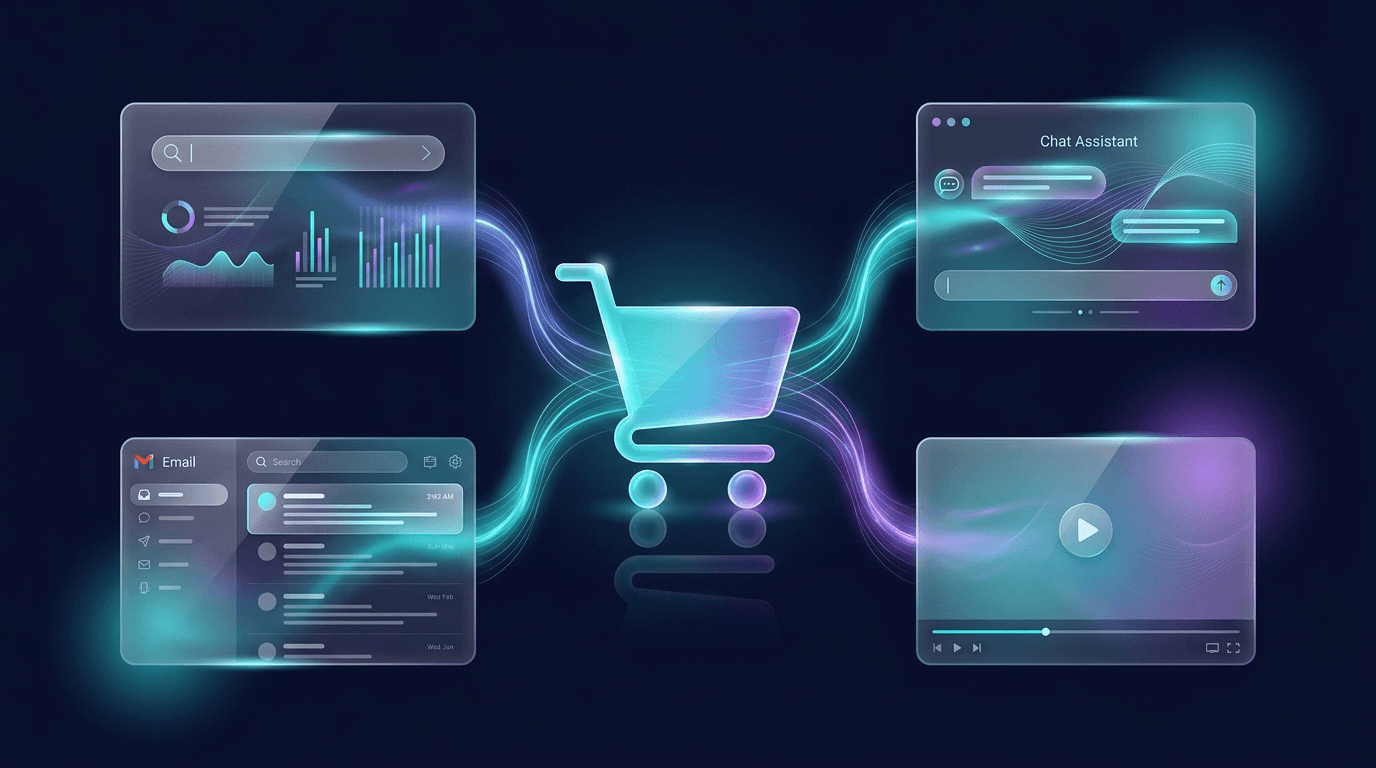
Google Universal Cart is a cross-surface, cross-merchant shopping cart that lets consumers add products to a single cart while browsing Google Search, chatting with the Gemini app, watching YouTube, or reading Gmail. It rolls out on Search and Gemini in the United States during summer 2026, expanding to YouTube and Gmail later in 2026, and runs on the Universal Commerce Protocol with Agent Payments Protocol enforcing user spending guardrails.
Key Takeaways
- Google Universal Cart unifies cart state across Search, the Gemini app, YouTube, and Gmail, replacing per-merchant carts with a single cart that follows the consumer across Google services.
- Eight named launch checkout merchants (Nike, Sephora, Target, Ulta Beauty, Walmart, Wayfair, Fenty, Steve Madden) plus Shopify merchants are live for direct checkout in Search and the Gemini app from summer 2026 in the United States.
- Universal Cart sits on top of the Universal Commerce Protocol, which now has a ten-member Tech Council including Google, Shopify, Etsy, Target, Wayfair, Amazon, Meta, Microsoft, Salesforce, and Stripe steering the open standard.
- Agent Payments Protocol enforces consumer-defined spending guardrails so agents only complete a purchase when stated criteria are met, addressing the trust gap that previously blocked autonomous checkout.
- Universal Cart adds capabilities that a normal cart cannot offer, including AI-reasoned compatibility checks, automatic price-drop and back-in-stock monitoring across merchants, and Google Wallet card-perk and loyalty optimization at checkout.
- Brands not on the launch roster should be reachable through Universal Cart by publishing the UCP service manifest at /.well-known/ucp, registering Merchant Center checkout-eligible product data, and joining the UCP waitlist.
What Is Google Universal Cart and What Does It Do
Google Universal Cart is an intelligent, cross-merchant shopping cart that maintains a single cart state for a consumer across Google Search, the Gemini app, YouTube, and Gmail. Google describes it as the new hub for shopping on Google, designed for the agentic era where consumers do not want a separate cart on every retailer's website and a separate cart on every AI surface. The cart sits on top of the Universal Commerce Protocol (UCP) and uses the Agent Payments Protocol (AP2) for authorized agent purchases, which lets Google offer a single buying experience that spans every Google surface and a growing list of merchants. Google Shopping Blog
What makes Universal Cart different from a conventional cart is the combination of cross-surface persistence, AI reasoning, and agent-authorized checkout. A consumer can drop a pair of running shoes in the cart from a Search result, return three hours later in the Gemini app to ask for compatible running socks, get an alert from Gmail when one of the items goes on sale, and then complete the purchase on YouTube without leaving the video.
- Single cart across Google services: Search, Gemini app, YouTube, and Gmail all read and write to the same cart object for a signed-in consumer.
- Multi-merchant by default: Items from Nike, Sephora, Target, Ulta Beauty, Walmart, Wayfair, Fenty, Steve Madden, and Shopify merchants can sit in one cart at the same time.
- Built on open protocols: The cart runs on UCP for merchant connection and AP2 for authorized agent payment, not a closed Google-only stack.
- Agent-completable: Consumers can authorize an agent to monitor prices, check inventory, and complete a purchase once user-defined criteria are met.
- Aware of payment perks: Universal Cart understands which card and which loyalty program produce the best outcome for the specific cart contents at checkout.
The underlying point is that Universal Cart is not a feature retrofitted onto Google Search. It is a separate runtime that any Google surface can talk to and that any UCP-compliant merchant can be sold from. That separation matters because it lets Google ship new surfaces (YouTube, Gmail) and new verticals (hotels, food delivery) without rebuilding the cart, and it lets merchants integrate once at the protocol layer rather than per-surface. Google Developers UCP Guide
Which Google Surfaces Does Universal Cart Span
Universal Cart spans four Google surfaces at full rollout, with Search and the Gemini app live in the United States from summer 2026 and YouTube and Gmail following later in 2026. Google describes the experience as the ability to "add things to your cart while you're browsing Search, chatting with Gemini, watching YouTube or even reading your Gmail," which is the first time a major platform has explicitly treated a shopping cart as a cross-surface object rather than a per-property feature. Google Shopping Blog
| Surface | Cart capability | Availability | Primary interaction |
|---|---|---|---|
| Google Search (AI Mode) | Add to cart, agent checkout | Summer 2026 (US) | Query plus inline shopping result |
| Gemini app | Conversational add to cart, agent checkout | Summer 2026 (US) | Multi-turn chat with the agent |
| YouTube | Add to cart inside video context | Later in 2026 | Watch then add featured product |
| Gmail | Read receipts, price alerts, restock notifications | Later in 2026 | Email-triggered cart actions |
The Search and Gemini surfaces matter most for launch. Google reports that "people shop across Google more than a billion times a day," and AI Mode in Search is where most of the shopping intent is moving as conversational queries replace keyword searches. Pairing the same cart with the Gemini app means a consumer can switch from a search-result-style result page to a chat assistant without losing cart state, which is the behavior agentic commerce requires. Google Shopping Blog
YouTube and Gmail arrive later in 2026 and bring two distinct behaviors. YouTube turns watch sessions into cart sessions by letting a viewer add a featured product to the cart without leaving the video. Gmail closes the loop on the post-cart phase by surfacing price drops, back-in-stock notifications, and merchant offers tied to cart contents in the same inbox where the consumer already reads delivery confirmations.
Which Merchants Are Live at Launch
Eight named merchants are live for Universal Cart direct checkout at launch, plus the entire Shopify merchant base via UCP. Google's announcement lists Nike, Sephora, Target, Ulta Beauty, Walmart, Wayfair, Fenty, and Steve Madden as the named checkout partners, with Shopify merchants joining through the Shopify-UCP integration. The cohort is deliberately small and brand-led, which is consistent with how Google has rolled out previous commerce surfaces. Google Shopping Blog
The composition of the launch list signals what Google prioritized when picking integration partners.
- Big-box and mass retail: Target, Walmart, and Wayfair anchor the cohort with breadth of catalog and existing UCP co-developer status from the January 2026 launch.
- Beauty depth: Sephora, Ulta Beauty, and Fenty triple-cover the beauty vertical, which is one of the highest-velocity categories for AI-driven product discovery.
- Athletic and footwear: Nike and Steve Madden cover athletic and fashion footwear, both categories with high price-monitoring and back-in-stock intent.
- Shopify as the long tail: Adding Shopify merchants via UCP gives Universal Cart access to millions of small and mid-size brands without requiring each to integrate independently.
The Shopify channel is the most important piece for brands not in the named cohort. Shopify was a co-developer of UCP alongside Etsy, Wayfair, Target, and Walmart when Google launched the protocol on January 11, 2026, and the Shopify-UCP integration means that a Shopify merchant whose checkout is eligible can surface in Universal Cart without negotiating a direct relationship with Google. Google Ads & Commerce Blog
How Universal Cart Connects to UCP and AP2 Under the Hood
Universal Cart connects to merchants through the Universal Commerce Protocol and authorizes agent purchases through the Agent Payments Protocol, with the cart object itself living on Google infrastructure. Merchants do not integrate with Universal Cart directly. They publish a UCP service manifest at /.well-known/ucp that exposes a standardized set of commerce primitives, and any Google surface (Search, Gemini, YouTube, Gmail) reads that manifest through the cart runtime. Google Developers Blog
The architecture splits cleanly into three layers that brands need to understand separately when planning their integration.
- Merchant layer (UCP manifest and capabilities): The merchant publishes a JSON manifest at /.well-known/ucp listing supported capabilities such as checkout, product discovery, and discount extensions. Each capability follows the UCP schema, which is transport-agnostic and supports REST API, Agent2Agent, and Model Context Protocol bindings.
- Payment layer (Agent Payments Protocol): AP2 mediates the actual payment authorization. Google describes AP2 as a protocol that "lets you set strict guardrails for agentic payment transactions" so that "the agent only makes the purchase when your criteria are met." This is the trust layer that makes autonomous agent checkout safe enough to ship.
- Cart layer (Universal Cart runtime): The cart itself sits on Google infrastructure and persists across surfaces. It calls UCP capabilities on merchants, applies AP2 guardrails for any agent-completed purchase, and exposes the unified cart UX inside each Google surface.
The payment design is the most important architectural decision. UCP "uniquely separates payment instruments (consumer payment methods) from payment handlers (processors)," which is what lets Google Wallet sit in the cart as the payment instrument while Stripe, Adyen, Mastercard, Visa, or American Express act as the payment handler for any given merchant. The agent never sees raw card numbers; it sees tokenized payment credentials and verifiable consent. Google Developers Blog
Governance over the protocol now sits with a ten-member Tech Council. Google, Shopify, Etsy, Target, and Wayfair were the founding members at the January 2026 launch, and Amazon, Meta, Microsoft, Salesforce, and Stripe joined the Tech Council on April 24, 2026. The Tech Council "aligns UCP's technical direction, reviewing contribution proposals and stewarding the open-source protocol," which means the cart that Google ships on its surfaces is built on a protocol that the major commerce platforms now collectively steer. UCP GitHub Discussion 379
What Universal Cart Does That a Standard Cart Cannot
Universal Cart adds four capabilities that a standard merchant cart cannot offer because they require AI reasoning across multiple merchants, cross-surface state, and access to consumer wallet metadata. Google describes the cart as one that "finds deals and price drops, giving you insights on price history and alerting you when an item is back in stock," that "proactively flag any product incompatibilities and suggest alternatives," and that "understands your payment method perks, loyalty information and merchant offers." None of these are possible on a per-merchant cart. Google Shopping Blog
The four differentiating capabilities each map to a distinct underlying mechanism.
- Cross-merchant price monitoring: Universal Cart pulls real-time pricing from every UCP-connected merchant in the Shopping Graph, which Google describes as "the world's most comprehensive catalog of over 60 billion product listings," so a price-drop alert can fire on any item in the cart regardless of which merchant supplies it.
- AI compatibility checking: Universal Cart uses Gemini reasoning to flag when items in the cart are technically incompatible. Google's launch example is PC components, but the same reasoning applies to outfit coordination, recipe-to-ingredient mapping, or hotel-to-flight matching.
- Wallet perk optimization: The cart reads the consumer's Google Wallet to identify which stored card offers the best perks (cashback category, loyalty multiplier, merchant offer) for the specific cart contents and surfaces that as the recommended payment at checkout.
- Back-in-stock detection: Universal Cart watches inventory state on UCP-connected merchants and alerts the consumer when an out-of-stock item returns, eliminating the need to bookmark a product page or sign up for retailer-specific alerts.
The compatibility check is the most novel capability. Most cart features can be approximated with merchant-specific tools, but cross-product compatibility reasoning is a Gemini capability that requires a model with knowledge of the product domain plus access to the structured product data inside the cart. This is one of the clearest cases where the AI surface and the cart are tightly coupled, because the reasoning cannot happen at the merchant layer.
How Universal Cart Reshapes Agentic Commerce Distribution
Universal Cart reshapes agentic commerce distribution by collapsing the cart from a per-merchant object into a Google-mediated object that spans every major Google surface. For brands, this changes three things at once: the surface where the cart lives, the data exchange format that determines whether the brand appears in the cart, and the payment relationship that determines who completes the transaction. Brands that were previously integrated only at the website cart layer now need an integration that lives at the protocol layer. Google Ads & Commerce Blog
The shifts cascade through every part of the agentic commerce stack.
- Cart ownership moves from merchant to platform: The cart now lives on Google, not on the merchant website, for any consumer using a Google surface. The merchant remains the Merchant of Record (per the UCP developer guide) but does not own the cart UX.
- Product feed quality becomes a moat: Universal Cart pulls from Merchant Center product data, which means the structure, completeness, and conversational-readiness of a merchant's feed directly determines whether the merchant surfaces in the cart at all.
- Discovery and checkout converge: A consumer can go from a Search or Gemini query to a completed purchase without ever loading the merchant website, which removes the brand site as a checkpoint in the journey.
- Distribution starts to look like a marketplace: A merchant on Universal Cart is competing against every other Universal Cart merchant for the same cart slot, which is closer to the Amazon search-results dynamic than the open web.
- Protocol membership becomes a prerequisite: Brands that are not reachable through UCP simply do not appear in Universal Cart, regardless of how well they rank in conventional search.
The structural implication is that brand visibility in Google's agentic surfaces depends on a different stack than the SEO stack most brands have invested in for the last decade. SEO answers the question "can a consumer find this brand on a results page." UCP and Universal Cart answer the question "can an agent transact with this brand from inside a Google surface." Those are different questions, and they require different optimization work. The shift from SEO to GEO and AEO is the discovery side of the same change. Universal Cart is the transaction side.
Where the Rollout Is Headed Next
The rollout expands geographically into Canada, Australia, and the United Kingdom in the coming months, and vertically into hotel booking and local food delivery on the same UCP infrastructure. Google states that UCP "checkout is expanding into more countries in the coming months, starting with Canada and Australia, and later in the U.K.," and that UCP is "coming to YouTube in the U.S., and to even more verticals, starting soon with hotel booking and local food delivery." The protocol that underpins Universal Cart is being treated as horizontal infrastructure for any vertical that involves cart, payment, and post-purchase. Google Shopping Blog
The vertical expansion is what makes Universal Cart strategically different from a retail-only cart.
- Hotel booking on UCP: A consumer asking the Gemini app about a weekend trip can hold both a hotel reservation and a related retail purchase in the same cart, with AP2 authorizing the payment when criteria are met.
- Local food delivery on UCP: Local food orders become UCP transactions, which means a single cart can hold groceries, restaurant pickup, and physical goods for the same consumer session.
- Geographic expansion: Canada and Australia get UCP checkout in the coming months, with the United Kingdom following, mapping to the same UCP merchant manifest pattern with localized payment handlers.
- YouTube vertical depth: YouTube gets UCP capability beyond just Universal Cart, which means creator-driven commerce can plug into the same checkout layer that brands already use on Search.
The vertical and geographic expansion is the reason Google is shipping a cart layer rather than a feature inside each surface. A retail-only cart that worked only in the United States would not justify the protocol cost. A cart that spans retail, travel, and food delivery across multiple countries on a single open standard is closer to the architecture that justifies the investment, which is why the merchants and verticals that adopt UCP early will keep arriving in the cart first as new geographies and verticals launch. For a deeper view of the protocol itself, see the UCP implementation guide and the UCP versus ACP comparison.
How to Make Your Brand Reachable Through Universal Cart
Brands need three integrations to surface in Universal Cart: a UCP service manifest, checkout-eligible Merchant Center product data, and a UCP-compatible payment handler. None are optional. A brand can rank well in conventional search and still be invisible inside Universal Cart if any of the three is missing. The six steps below extend the Network and Convert phases of the A.G.E.N.T.I.C. Framework to the new cart layer.
Publish a UCP service manifest
Publish a JSON manifest at /.well-known/ucp declaring the capabilities (checkout, product discovery, discounts, post-purchase) and transport bindings (REST, Agent2Agent, Model Context Protocol) the merchant supports.
Register checkout-eligible Merchant Center data
Submit product data to Google Merchant Center with accurate pricing, real-time inventory, structured attributes, and conversational-ready descriptions, and ensure each product is checkout-eligible per UCP requirements.
Choose a UCP-compatible payment handler
Select a payment handler (Adyen, Stripe, a card network) that supports tokenized payments and verifiable agent consent so the cart can authorize transactions without exposing raw card numbers.
Join the UCP merchant waitlist for direct checkout
Apply through the waitlist in the Google Developers UCP guide for direct checkout approval. Shopify merchants get this through the Shopify-UCP integration without a separate application.
Validate AP2 mandate handling
If agent-completed purchases are in scope, validate that the checkout flow honors AP2 digital mandates and respects the consumer-defined spending guardrails before completing the transaction.
Instrument citation and conversion measurement
Track how often Universal Cart added products, how often the cart converted, and which AI queries drove the addition, in line with the Track phase of the A.G.E.N.T.I.C. Framework.
Frequently Asked Questions
- What is Google Universal Cart?
- Google Universal Cart is a cross-surface, cross-merchant shopping cart that lets a consumer add products from multiple merchants to one cart while using Google Search, the Gemini app, YouTube, or Gmail. It runs on the Universal Commerce Protocol and uses the Agent Payments Protocol for agent-authorized checkout, with rollout starting in Search and the Gemini app in the United States during summer 2026.
- Which merchants are live in Google Universal Cart at launch?
- Eight named merchants are live for direct checkout at launch: Nike, Sephora, Target, Ulta Beauty, Walmart, Wayfair, Fenty, and Steve Madden, plus Shopify merchants via the Shopify-UCP integration. Additional merchants will surface through Universal Cart as they complete UCP integration and Merchant Center checkout eligibility.
- How does Universal Cart connect to the Universal Commerce Protocol?
- Universal Cart reads from each merchant's UCP service manifest at /.well-known/ucp and calls the declared checkout, product discovery, and discount capabilities. The cart object itself lives on Google infrastructure and is shared across Search, Gemini, YouTube, and Gmail, while the merchant remains the Merchant of Record for the transaction.
- What role does the Agent Payments Protocol play in Universal Cart?
- Agent Payments Protocol (AP2) enforces the spending guardrails a consumer sets for agentic purchases. Google states AP2 lets consumers set strict criteria so the agent only completes a purchase when those criteria are met. AP2 issues tamper-proof digital mandates that the merchant validates at checkout to honor the agent's authority.
- How does Universal Cart differ from a regular shopping cart?
- Universal Cart persists across multiple Google surfaces, holds items from multiple merchants simultaneously, uses Gemini reasoning to flag product incompatibilities, monitors prices and stock across merchants, and surfaces the best Google Wallet card perk for the specific cart contents. A regular cart lives on one merchant site and cannot do any of those.
- What do brands need to do to appear in Universal Cart?
- Brands need a UCP service manifest at /.well-known/ucp, checkout-eligible Merchant Center product data, and a UCP-compatible payment handler. Shopify merchants get this through the Shopify-UCP integration. Non-Shopify merchants apply through the UCP merchant waitlist documented in the Google Developers UCP guide.
- Where is Universal Cart available geographically?
- Universal Cart launches in the United States on Search and the Gemini app in summer 2026, with YouTube and Gmail following later in 2026. UCP checkout is expanding to Canada and Australia in the coming months and to the United Kingdom afterward, with additional countries and verticals planned beyond the initial rollout.
Universal Cart Is the New Checkout Surface. Is Your Brand Inside It?
Google just made a single shopping cart live across Search, the Gemini app, YouTube, and Gmail, powered by the Universal Commerce Protocol and Agent Payments Protocol. Brands that are not reachable through UCP and Merchant Center checkout simply do not appear in Universal Cart. The A.G.E.N.T.I.C. Framework covers the work it takes to be discoverable, structured, and transactable across every agentic surface, not just Google.
Ready to find out where you stand? Book your free Agentic Commerce audit
About This Article and Author
Authored by Shahzad Safri, Founder and Agentic Web expert at agenticplug.ai, combining insights from the Google Shopping Blog, the Google Ads and Commerce Blog, the Google Developers Blog, the Google Developers UCP Guide, and the UCP Tech Council GitHub Discussions.