Amazon Shop Direct Merchant Workspace: A Merchant's Guide

 Add as a preferred source on Google
Direct Answer
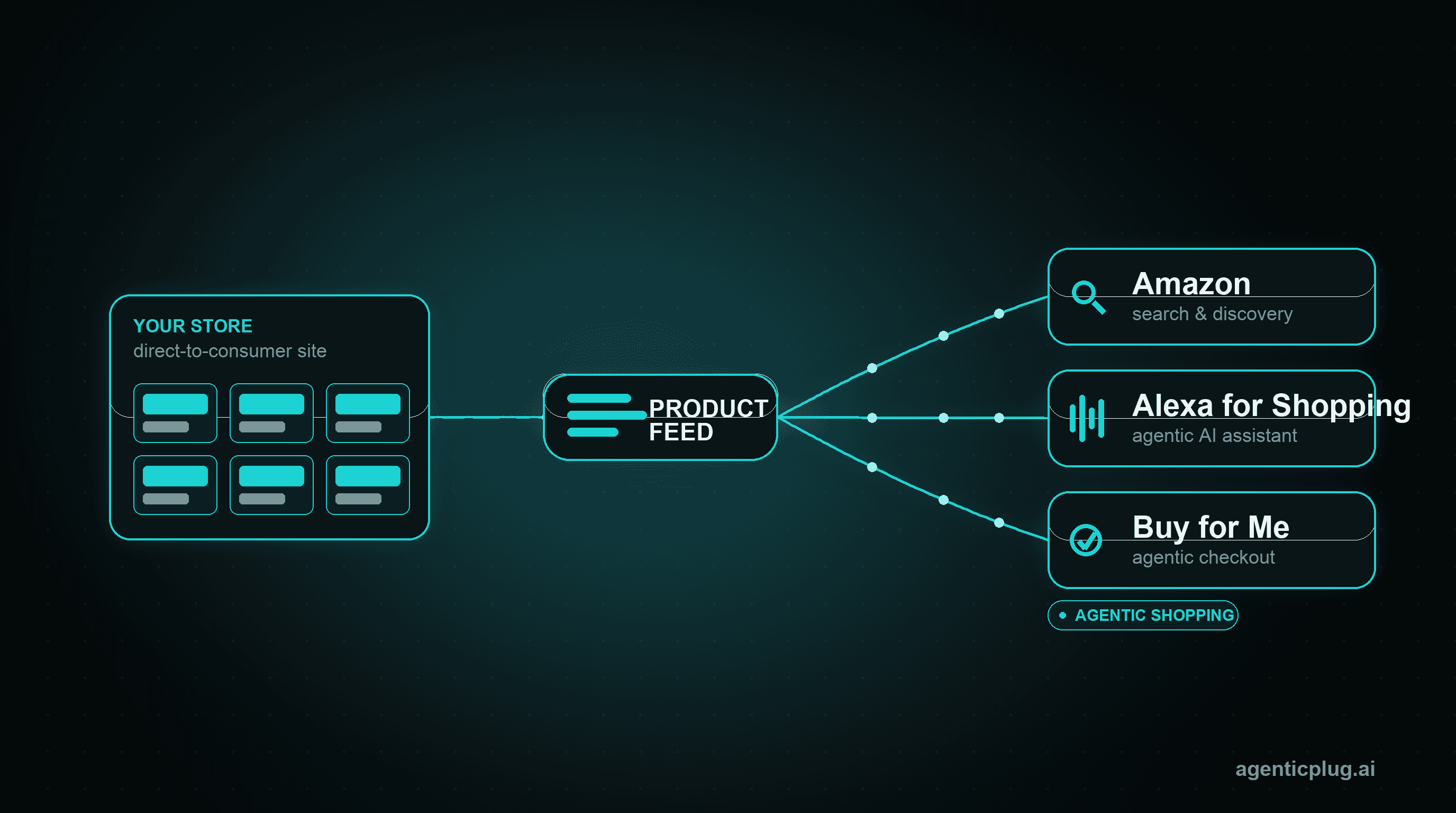
Amazon's Shop Direct Merchant Workspace is a free, self-service portal, launched November 4, 2026, that lets eligible merchants connect their own online store to Amazon and Alexa for Shopping so Amazon customers can discover their products. Shoppers either visit the merchant's site or let Amazon's Buy for Me agent complete the purchase there, and the merchant keeps the sale.
Key Takeaways
- Amazon's Shop Direct Merchant Workspace, launched November 4, 2026, is a free, self-service portal where eligible merchants connect their own store to Amazon and Alexa for Shopping, submit product feeds, and see which of their products are live to Amazon customers.
- Shoppers reach a Shop Direct product two ways: they tap through to the merchant's own website, or they use Buy for Me, Amazon's agentic AI buying tool, which completes the checkout on the merchant's site on the shopper's behalf.
- Shop Direct is not the same as selling on Amazon. The merchant keeps its store, catalog, checkout, and customer relationship, lists for free, and handles fulfillment, delivery, returns, and customer service through its own existing processes.
- Buy for Me runs on Amazon Bedrock using foundation models including Amazon Nova and Anthropic's Claude, and completes the purchase after the shopper confirms delivery, taxes, shipping, and payment on Amazon's interface.
- Shop Direct is Amazon's own agentic channel built on proprietary feeds and the Selling Partner API, not an open cross-network protocol, so merchants optimize to be chosen by Amazon's shopping agent rather than running an agent of their own.
- Because an AI agent reads the merchant's feed before recommending a product, near real-time, complete, accurate catalog data is what makes a store's products eligible to be found in Shop Direct; Amazon does not publicly disclose how its agent then ranks or recommends them.
What Is Amazon's Shop Direct Merchant Workspace?
Amazon's Shop Direct Merchant Workspace is a free, self-service portal, launched November 4, 2026, that lets any eligible merchant connect its own online store to Amazon so its products can be discovered by customers in Amazon search and in Alexa for Shopping, Amazon's agentic AI shopping assistant. Source: Amazon
Amazon frames the Workspace as the simplest way into Shop Direct, its agentic shopping program. What the portal actually gives a merchant:
- A direct AI connector: Amazon describes the Workspace as a fast, free, direct AI connector from a merchant's store to Alexa for Shopping and Amazon, giving customers near real-time information about the merchant's products.
- Self-service registration: eligible merchants register for Shop Direct and connect their catalog themselves, without first going through an account representative or a third-party feed syndicator.
- Feed submission and management: merchants submit product feeds in widely adopted formats and manage their participation from one place, reusing the catalogs they built for other shopping destinations.
- Live product visibility: the Workspace shows merchants which of their products are active and available to Amazon customers through Shop Direct at any given time.
- No fees, opt out anytime: there are no fees to participate in Shop Direct, merchants choose which selection to include, and they can opt out whenever they want.
Amanda Doerr, Amazon's vice president of Core Shopping, framed the Workspace as a way for merchants to join using what they already have, built around the catalogs they maintain for other shopping destinations rather than a new one made for Amazon. Amazon positions Shop Direct itself as a growing experience it says makes it simple for merchants to have their selection discovered by Amazon customers. Source: Amazon
Amazon describes participation as open to eligible merchants without defining the eligibility criteria in the announcement, so the practical gate is registering, verifying a store, and connecting a catalog. The portal is the merchant-facing side of a program Amazon has been widening in stages, from a feed arrangement run through syndicators to a self-serve front door.
The Workspace closes a gap in how Shop Direct was joined. When Amazon added product feeds in March 2026, merchants had to work through a feed syndicator or email Amazon directly, and the portal now gives any eligible store a direct, self-serve way in. Source: Amazon
How Does Shop Direct Work for Shoppers?
Shop Direct surfaces products from stores across the web when a customer searches on Amazon or in Alexa for Shopping. Those results carry a Shop Direct label and the merchant's store name, and from there the shopper has one of two ways to buy. Source: Amazon
A shopper either taps through to the merchant's own site or lets Amazon's agentic buying tool complete the purchase. The table below compares the two paths.
| Dimension | Shop Direct (visit the store) | Buy for Me (agentic purchase) |
|---|---|---|
| Where the purchase happens | On the merchant's own website | Confirmed on Amazon, then completed on the merchant's site by Amazon's AI |
| What the shopper does | Taps Shop Direct, gets a leaving-Amazon notice, buys on the merchant site | Taps Buy for Me, confirms address, taxes, shipping, and payment on Amazon |
| Who completes checkout | The shopper | Amazon's agentic AI, on the shopper's behalf |
| Which products qualify | All Shop Direct products | Eligible Shop Direct products only |
| Who handles fulfillment | The merchant | The merchant |
In the first path, the customer taps the Shop Direct button on a product, sees a notice that they are leaving Amazon, and lands on the merchant's site to see the full details and complete the purchase. In the second, the customer stays on Amazon's interface until the agent has placed the order on the merchant's site for them. Source: Amazon
What stays the same across both paths matters most to a merchant:
- The merchant is the seller of record: Amazon passes the customer's name and address to the store, and the merchant owns the transaction either way.
- The merchant fulfills: shipping, delivery, returns, exchanges, and customer service run through the merchant's existing processes, not Amazon's.
- The audience is Amazon's full U.S. base: Shop Direct is available to all U.S. customers on Amazon.com, the Shopping app, mobile web browsers, and Alexa for Shopping.
- The scale is already large: Amazon says Shop Direct products appear in hundreds of millions of searches monthly.
The entry point is widening too. Shop Direct results now appear not only in Amazon's search but inside Alexa for Shopping, the assistant Amazon built by combining its Rufus shopping expertise with Alexa+, so a shopper can reach an outside merchant's product by asking a question rather than only by typing a query. Source: Amazon
For a merchant, the distinction between the two paths is really about where checkout happens, not who gets paid. In both cases the sale closes on the merchant's own terms, which is what separates Shop Direct from a traditional marketplace listing. Source: Amazon
How Does Buy for Me Complete an Agentic Purchase?
Buy for Me is Amazon's agentic buying tool: for eligible products, a shopper confirms the order on Amazon's interface and Amazon's AI then completes the checkout on the merchant's website on the shopper's behalf. Amazon introduced it in April 2025 as a beta in the Amazon Shopping app. Source: Amazon
The mechanics are worth understanding, because they are what turns a recommendation into a completed transaction:
- The shopper confirms, the agent executes: the customer reviews delivery address, taxes, shipping fees, and payment method on an Amazon checkout page, then taps Buy for Me to have Amazon make the purchase on the brand's site.
- An encrypted handoff: Amazon securely passes the customer's encrypted name, address, and payment details to the merchant's checkout, and says it cannot see the customer's separate orders on that brand's site.
- Built on Amazon Bedrock: Buy for Me runs on Amazon Bedrock and uses foundation models including Amazon Nova and Anthropic's Claude to complete the purchase from start to finish.
- The shopper stays in control: Amazon frames the customer as directing an AI agent that acts on their behalf, and merchants choose whether their products are eligible.
- Tracked like any order: the customer receives the merchant's order confirmation and tracks the purchase under a Buy for Me Orders tab, while the merchant fulfills it.
Amazon introduced Buy for Me as a beta in the Amazon Shopping app on iOS and Android for a subset of U.S. customers, starting with a limited set of brand stores and products and expanding from there. It defines agentic AI as software that performs specific tasks with minimal human intervention, at the direction of and on behalf of a customer, and stresses that the customer stays in control of the agent acting for them. Source: Amazon
Buy for Me is the clearest example of what agentic means in this program. The agent does not only recommend a product, it carries out the purchase, which moves the merchant's checkout from something a human operates to something an AI operates on a human's instruction. Source: Amazon
How Is Shop Direct Different From Selling in Amazon's Store?
Shop Direct is not the same as selling on Amazon's marketplace. With Shop Direct a merchant keeps its own store, catalog, checkout, and customer relationship and lists for free, while selling in Amazon's store through Seller Central means transacting inside Amazon, usually with its fees and often its fulfillment. Source: Amazon
The table below sets the two side by side.
| Dimension | Shop Direct | Selling in Amazon's store (Seller Central) |
|---|---|---|
| Where the sale happens | On the merchant's own website | Inside Amazon's store |
| Who owns checkout | The merchant | Amazon |
| Cost to participate | No fees to participate | Selling and referral fees apply |
| Fulfillment | The merchant, through its own processes | The merchant or Fulfillment by Amazon |
| Customer relationship | The merchant keeps it | Amazon intermediates it |
| How to join | The Shop Direct Merchant Workspace | Amazon Seller Central |
The two can overlap. Amazon says its existing sellers may also be eligible to list, through Shop Direct, selection they do not sell in Amazon's store, and it directs interested sellers to email shopdirect@amazon.com. Merchants who want Amazon fulfillment and ads are pointed to Seller Central instead. Source: Amazon
Amazon says product feeds give merchants a streamlined way to reach customers who are actively searching for their products, and that participating stores can put their selection in front of Amazon's hundreds of millions of customers while keeping inventory, pricing, and order handling on their own systems. Source: Amazon
For a brand that already runs a strong direct-to-consumer site, Shop Direct is a discovery channel that does not surrender the storefront. The merchant gains Amazon's audience without converting its catalog into Amazon listings or handing Amazon the checkout and the customer.
Where Does Shop Direct Sit in the Agentic Commerce Shift?
Shop Direct is Amazon building its own agentic shopping channel rather than adopting an open, cross-network protocol. Products reach Amazon through proprietary feeds and the Selling Partner API, and the agent that discovers, recommends, and buys them is Amazon's own, from Alexa for Shopping to Buy for Me. Source: Amazon
Two features of the channel shape how a merchant should think about it:
- Proven scale: since Shop Direct launched in 2025, tens of millions of customers have discovered hundreds of millions of unique products from other stores, and by March 2026 it spanned over 100 million products from more than 400,000 merchants.
- A closed channel, not an open protocol: Shop Direct uses Amazon's own feeds, the Selling Partner API, and a Shop Direct API, unlike the cross-network standards such as the Agentic Commerce Protocol and the Universal Commerce Protocol that any platform can implement.
- The platform owns the agent: in Shop Direct, Amazon operates both the shopping assistant and the buying agent, so a merchant optimizes to be chosen by Amazon's agent rather than running an agent of its own.
- A developer path: solution providers build Shop Direct integrations through the Selling Partner API, and named feed partners include Feedonomics, Salsify, CEDCommerce, and VersaFeed.
The momentum behind the channel is the reason to weigh it. Amazon says it has referred customers to items they wanted to buy from other stores millions of times, and that tens of millions of the products in Shop Direct can already be bought through Buy for Me. Alexa for Shopping, where those products appear, merges Rufus, which Amazon says helped over 300 million customers in 2025, with Alexa+, available across hundreds of millions of devices. Source: Amazon
That concentration cuts two ways for a merchant. A single feed into Amazon's channel reaches an audience no open protocol yet matches at that scale, but it also means the terms of discovery, from eligibility to how products are ranked and labeled, are set by Amazon. A balanced program treats Shop Direct as one distribution channel, not the whole agentic strategy.
As shoppers increasingly start a purchase inside one assistant, being present in Amazon's agentic channel becomes a distribution decision that sits alongside, not instead of, being discoverable in open-protocol agents such as ChatGPT and Google. Source: Amazon
What Does Shop Direct Mean for Merchant Discoverability?
Shop Direct turns a merchant's product feed into what an AI agent reads before it recommends a product. Amazon's connector gives customers near real-time information from the merchant's catalog, so a complete, accurate feed is what makes a store's products eligible to surface at all. How the agent then ranks and recommends among eligible products, Amazon does not publicly disclose. Source: Amazon
Being listed is the start, not the finish. What actually earns an agent's recommendation runs on the data underneath:
- Reuse, do not rebuild: the Workspace accepts widely adopted shopping feed formats, so merchants can reuse the catalogs they already maintain for other channels rather than creating a new one from scratch.
- Near real-time data: Amazon highlights that the connector keeps product information current, so pricing, inventory, and availability signals have to be accurate and fresh for an agent to trust and surface them.
- Complete attributes matter: structured attributes are how a catalog is processed and matched to a shopper's request, so thin or inconsistent data can leave a product ineligible or harder to find, even though Amazon does not publish the exact weighting its agent applies.
- One feed, many agents: the same clean, structured catalog that serves Shop Direct is the asset that makes a store legible to agents beyond Amazon, so the work compounds across channels.
The upside is that the effort is reusable. Because Shop Direct takes the feed a merchant already maintains, the same discipline that makes a catalog accurate and complete for Amazon's agent, clear titles, full attributes, and honest availability, is the discipline that makes it readable to every other shopping agent a buyer might use. A feed built for one agent rarely goes to waste on the next.
What a merchant can see is limited but useful. The Workspace reports which products are active and available through Shop Direct, which is the first signal to watch, because a product that is not active is not eligible to be surfaced or bought. Treating that view as a live feed-health check, rather than a one-time setup screen, is how a merchant keeps its selection in the running.
This is where listing ends and optimization begins. Being present in Shop Direct makes a store reachable by Amazon's agent, but being recommended depends on data quality, entity clarity, and visibility across the assistants shoppers use, which is the discipline our agentic commerce optimization work and the A.G.E.N.T.I.C. Framework are built around. Getting into the Workspace is the first move, and the steps below cover it.
How to List Your Store on Amazon Shop Direct
Amazon's Shop Direct Merchant Workspace is a free, self-service way to connect your store to Amazon and Alexa for Shopping. Follow these four steps to register, verify, and get your catalog live, then keep it clean enough for AI agents to choose.
Create a Shop Direct merchant account
Register for Shop Direct in the Merchant Workspace at shopdirect.amazon.com. The portal is free to join, carries no participation fees, and lets you opt out at any time, so there is no commitment in signing up and connecting a catalog.
Verify your business website
Confirm ownership of the store you want to connect. Verification ties your Shop Direct account to the website where Amazon customers will land and complete their purchases, which is the site that stays your store of record throughout.
Share your catalog
Submit your product feed through a solution provider such as Feedonomics, Salsify, CEDCommerce, or VersaFeed, or integrate directly with the Selling Partner API. Amazon accepts widely adopted feed formats, so you can reuse an existing catalog rather than building a new one.
Keep the feed accurate and complete
Use the Workspace to see which products are active, and keep attributes, pricing, and inventory current. Near real-time, complete product data keeps your items eligible and reliably discoverable; it is the foundation Amazon's shopping agent reads, even though Amazon does not publish how it ranks what it recommends.
Frequently Asked Questions
- Is Amazon Shop Direct free for merchants?
- Yes. Amazon states there are no fees to participate in Shop Direct, and merchants choose which products to include and can opt out at any time. The Merchant Workspace is free and self-service. A third-party feed provider you use to connect your catalog may charge for its own service, and your usual store and fulfillment costs still apply.
- Does Shop Direct mean I sell on Amazon's website?
- No. Shop Direct keeps the sale on your own site. Your products appear in Amazon search and Alexa for Shopping labeled Shop Direct, but the shopper either taps through to your store or has Amazon's Buy for Me agent complete the checkout on your site. You remain the seller and handle fulfillment.
- What is Amazon Buy for Me?
- Buy for Me is Amazon's agentic buying tool. For eligible products, a shopper confirms the order details on Amazon, then Amazon's AI completes the purchase on the merchant's website on the shopper's behalf. Amazon launched it in April 2025 as a beta, running on Amazon Bedrock with models including Amazon Nova and Claude.
- Can existing Amazon sellers use Shop Direct?
- Amazon says its sellers may also be eligible to list, through Shop Direct, selection they do not sell in Amazon's store, and directs them to email shopdirect@amazon.com. Sellers who want to sell inside Amazon with services like Fulfillment by Amazon and Amazon Ads are pointed to Seller Central instead.
- What product feed formats and providers does Shop Direct support?
- The Merchant Workspace accepts widely adopted shopping feed formats, so merchants can reuse catalogs built for other channels. Named solution providers include Feedonomics, Salsify, CEDCommerce, and VersaFeed, and merchants can also integrate directly through Amazon's Selling Partner API using the Shop Direct API documentation.
- Is Shop Direct the same as Alexa for Shopping?
- No. Alexa for Shopping is Amazon's agentic AI shopping assistant, which brings together Rufus and Alexa+. Shop Direct is the program that lets products from outside stores appear to shoppers, including inside Alexa for Shopping. The Merchant Workspace is how a merchant connects its store to both Amazon and that assistant.
Listed on Amazon Shop Direct. Is Your Catalog Agent-Ready?
Amazon's Shop Direct Merchant Workspace gets your store in front of its shopping agents, but whether Alexa for Shopping and Buy for Me actually surface and buy your products comes down to catalog completeness, entity clarity, and visibility across AI engines, which is the work our A.G.E.N.T.I.C. Framework is built around.
Ready to find out where you stand? Book your free Agentic Commerce audit
About This Article and Author
Authored by Shahzad Safri, Founder and Agentic Web expert at agenticplug.ai, drawing on primary reporting from Amazon.