
Shopify Fall '26 Edition: Every Store Is Now Agent-Ready by Default

 Add as a preferred source on Google
Direct Answer
Shopify's Fall '26 Edition, released October 28, 2026, made every store agent-ready by default: WebMCP tools are now built into every Liquid and Hydrogen storefront and checkout, and a keyless connection called shop.dev lets any AI agent reach Shopify's catalog, cart, checkout, and Shop Pay. Default readiness is not the same as optimized.
Key Takeaways
- Shopify's Fall '26 Edition, announced October 28, 2026, builds WebMCP tools into every Liquid and Hydrogen storefront and checkout, so browser-based AI agents can search products, update the cart, and complete checkout after the buyer approves.
- shop.dev is a single keyless connection that lets any agent or app reach Shopify Catalog, Shop sign-in, cart, checkout, and Shop Pay, and Shop.md turns an agent into a personal shopper across more than one billion products.
- The release extends Shopify's Spring '26 move that removed the approval requirement to build on its agentic commerce layer and opened the Catalog API to every developer with just an API key.
- Agent-ready by default removes the plumbing, not the strategy: product data quality, catalog enrichment, entity clarity, and visibility across ChatGPT, Google AI Mode, and Perplexity still decide whether an agent recommends you.
- Shopify reports that AI searches powered by Shopify Catalog convert at twice the rate of searches using scraped data, which makes structured, agent-readable product data a revenue lever rather than a nicety.
- Shopify's new Knowledge base, under Sales channels then Agentic in the admin, lets merchants review and publish the facts AI agents receive about their store, so approved policies reach agents instead of guessed ones.
What Did Shopify Announce in the Fall '26 Edition for Agentic Commerce?
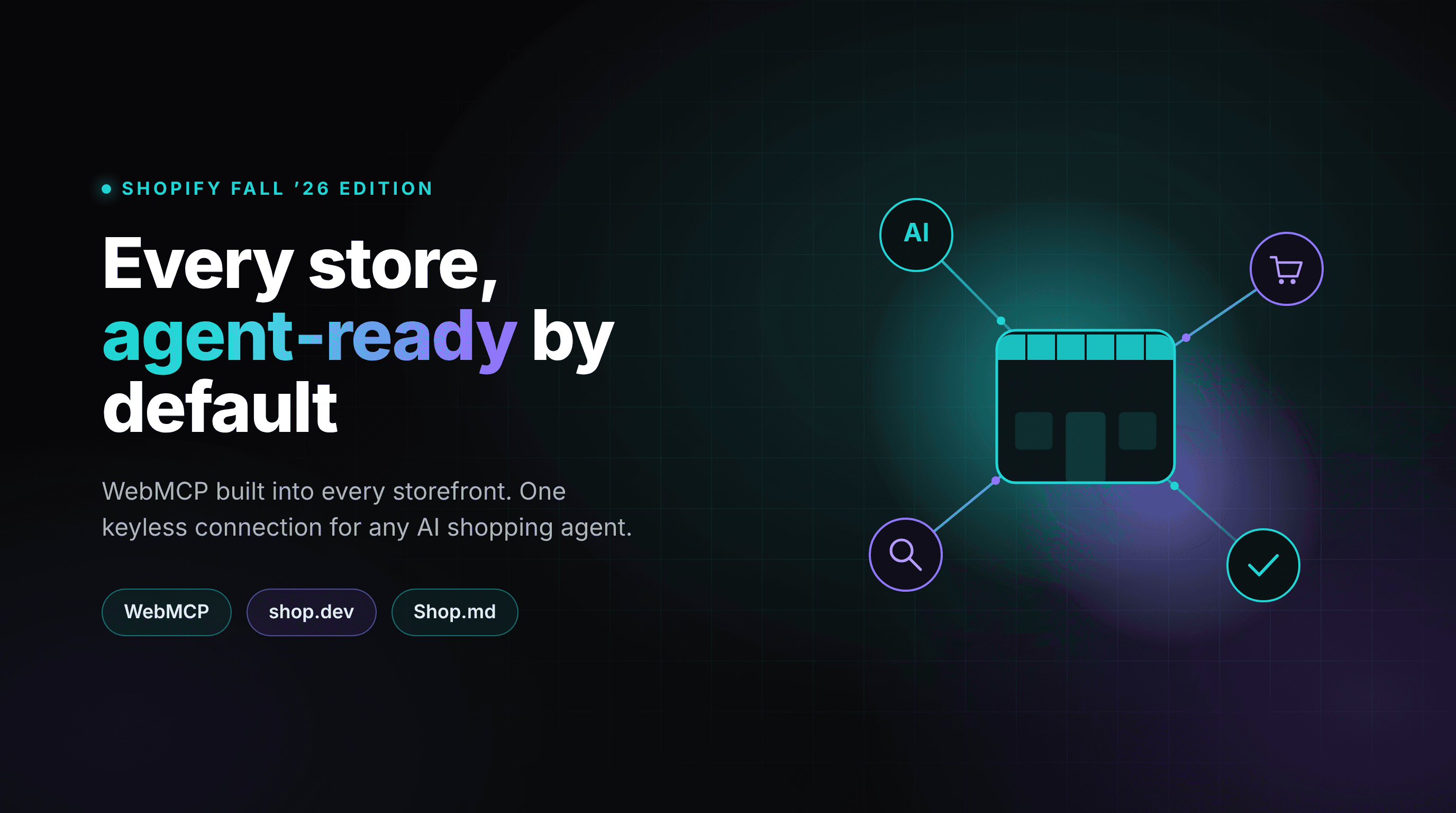
Shopify's Fall '26 Edition, released on October 28, 2026, turned agentic commerce into a default capability of every store rather than an opt-in project. The centerpiece is that WebMCP tools now ship inside every Liquid and Hydrogen storefront and checkout, and a new keyless connection called shop.dev gives any agent one path to Shopify's catalog, cart, checkout, and Shop Pay. Source: Shopify
Five announcements matter most for merchants and brands preparing for AI shopping agents:
- WebMCP in every storefront: browser agents can search products, update the cart, and complete checkout on a Liquid or Hydrogen store after the buyer approves, using the same validation as the checkout page.
- shop.dev: one connection, with no key required, that reaches Shopify Catalog, sign-in with Shop, cart, checkout, and Shop Pay for any agent or app.
- Shop.md: a skill that turns an agent into a personal shopper, searching over one billion products and checking out with Shop Pay from a buyer's stated preferences and recent purchases.
- Universal Checkout for partners: a single checkout for products from multiple brands, with discovery through Shopify Catalog and payment through Shop Pay, while each merchant keeps its own rules and orders.
- Catalog API filter expansion: a single request can now filter to products with 3D models or video, return links to that media, and surface sale prices and safety warnings per product.
The practical effect is a change in who has to build first. Before Fall '26, making a store transactable by an agent was a development project, and now the default storefront ships with the tools, so a merchant's job shifts from building the plumbing to deciding how well its catalog and brand are represented to the agents that use it. Source: Shopify
Shopify framed the release as an extension of its Spring '26 Edition rather than a replacement, with VP of Product Vanessa Lee describing developers as "part of the same flywheel as merchants." The same edition brought Hydrogen to general availability, rebuilt to run on any framework and any runtime, and shipped Vercel Shop, an open source Next.js template built on the Hydrogen SDK. The agentic tools, in other words, arrived inside a broader push to make the whole developer surface agent-aware. Source: Shopify
What Does "Agent-Ready by Default" Actually Mean?
Agent-ready by default means the agent-facing tools are already present on the storefront without the merchant installing anything. In Shopify's Fall '26 Edition, WebMCP tools are built into every Liquid and Hydrogen storefront and checkout, so a browser agent can act on the page the moment it arrives, with no app, plugin, or custom endpoint required. Source: Shopify
WebMCP is a browser API that brings Model Context Protocol-style tool calling to web pages. It lets a web page publish its own functions as tools an AI agent can discover and call, which is what makes a storefront usable by an agent rather than only readable by one.
- Published as page tools: WebMCP exposes storefront actions such as search, update cart, and check out through a browser API an agent can call directly, each defined by a name, a description, and an input schema.
- Buyer stays in control: on Shopify storefronts the agent completes checkout only after the buyer approves, and the transaction runs through the same validation as the normal checkout page.
- A draft web standard: WebMCP is a draft community group report from the W3C Web Machine Learning Community Group, with contributors from Microsoft and Google, and is not yet a finished W3C standard.
- Early browser support: the API, exposed as navigator.modelContext or document.modelContext, is in early preview in Chrome, so coverage across stable browsers is still arriving.
What changed from the earlier model is the absence of setup. A merchant previously had to adopt an app or build a custom endpoint to expose actions to an agent, and now those tools are compiled into the theme itself. A store whose owner has never heard of WebMCP can still be operated by a browser agent that visits it, because the capability now travels with the storefront rather than with any add-on the merchant chose to install. Source: Shopify
The implication for store owners is that reach is no longer the gating problem, representation is. Every Shopify store now answers an agent's call, so the contest moves to whether an agent chooses your products over a competitor whose catalog is described more completely. Our guide to WebMCP and agentic commerce covers the mechanics in depth. Source: W3C Web Machine Learning Community Group
What Are shop.dev and Shop.md, and How Do They Change Agent Discovery?
shop.dev is a single connection that lets any agent or app reach Shopify Catalog, sign-in with Shop, cart, checkout, and Shop Pay, with no API key required. Shop.md is a skill built on that same connection that turns an agent into a personal shopper across more than one billion products. Source: Shopify
Together they move the point of discovery off the storefront and into the agent. Where WebMCP serves an agent that is already on your store, shop.dev and Shop.md serve an agent that is shopping across Shopify's whole catalog on a buyer's behalf.
- One keyless connection: shop.dev collapses catalog search, Shop sign-in, cart, checkout, and Shop Pay into a single integration, so a developer wiring up an agent does not assemble them separately.
- Agent as personal shopper: Shop.md searches over one billion products and makes recommendations from a buyer's preferences and recent purchases, then checks out with Shop Pay.
- Multi-brand checkout: Universal Checkout for partners lets an agent buy products from multiple brands in one checkout, with discovery through Shopify Catalog and each merchant's rules and orders still handled by Shopify.
- Built on the Catalog API: these surfaces rest on the Catalog API that Shopify opened to every developer in its Spring '26 Edition, which turned its global catalog into structured, queryable infrastructure for agents with just an API key.
The Catalog API is what makes these surfaces possible. Shopify describes it as structured, queryable infrastructure for AI agents, and its Spring '26 Edition added image search, multi-modal search, a lookup endpoint, richer metadata, and Shop sign-in support. An agent can now find a product from a photo or a natural-language description rather than an exact keyword, and it reads the same clean data whether it is Shop.md or an agent a third party built. Source: Shopify
Checkout travels with those agents too. Shop Pay now runs inside personal AI agents, starting with Muse from Meta, Claude Duet, and Instinct, and the buyer's card is tokenized and never shared with the agent. A shopper can discover a product in an outside agent and pay with a checkout they already trust, without the merchant building anything for that surface. Source: Shopify
For a brand, the shift is that an agent can now find, compare, and buy your products without a shopper ever landing on your site. That makes the completeness and accuracy of your Shopify Catalog data the deciding factor in whether Shop.md or a third-party agent surfaces you at all, long before any on-storefront interaction happens. Source: Shopify
On-Storefront vs Off-Storefront Agents: What Is the Difference?
Shopify's Fall '26 tools address two different kinds of agent, and the distinction decides where a merchant's effort goes. An on-storefront agent acts on your own site through WebMCP, while an off-storefront agent discovers and buys your products from inside another app, such as ChatGPT or Google AI Mode, through shop.dev and the Catalog API. The table below maps the two.
| Dimension | On-storefront agent (WebMCP) | Off-storefront agent (shop.dev, Catalog API) |
|---|---|---|
| Where it acts | On your Liquid or Hydrogen storefront and checkout | Inside another agent or app, such as ChatGPT or Shop.md |
| How it is enabled | WebMCP tools shipped by default in Fall '26 | The shop.dev connection and the Catalog API, opened to all developers |
| What the buyer sees | Your branded storefront, driven by an agent | An agent's interface, with your products among many |
| What decides selection | Your on-page actions and checkout validation | Your Catalog data quality and cross-engine visibility |
| Who handles payment | Shop Pay on your store | Shop Pay through shop.dev, with orders still run by Shopify |
Most merchants need both. Being agent-ready on your storefront captures the shopper an agent brings to your site, and being present in Shopify Catalog with clean data captures the far larger pool of shoppers whose agent never visits your site at all. Source: Shopify
The two also call for different measurements. On-storefront success looks like agent-completed checkouts on your own site, while off-storefront success looks like appearing, and being chosen, inside the answers an agent assembles from Shopify Catalog across many merchants. Collapsing both into a single revenue number hides which half is working, which is why a serious agentic commerce program tracks them apart from the outset.
Why Is "Default" Not the Same as "Optimized"?
Agent-ready by default removes the integration work, not the competitive work. Every Shopify store can now be reached by an agent, which means the storefront is table stakes and the differentiator becomes how well your products, brand, and policies are represented in the data the agent reads before it recommends or buys. Source: Shopify
Shopify's own data shows why representation pays. AI searches powered by Shopify Catalog convert at twice the rate of searches that rely on scraped data, so the quality of your structured catalog data translates directly into completed agent purchases. What still needs deliberate work:
- Catalog completeness: missing attributes, inconsistent naming, or thin descriptions leave an agent unable to match your product to a buyer's request, so it recommends a competitor it understands better.
- Rich media and safety data: the expanded Catalog API filters now surface 3D models, video, sale prices, and safety warnings, so products carrying that data are eligible for agent results that bare listings are not.
- Entity and brand clarity: agents recommend brands they can identify confidently, which depends on consistent, machine-readable identity across your site and the wider web, not only inside Shopify.
- Trust tier and profile: Shopify's agent profiles use trust tiers that unlock broader access, including direct checkout completion, so how an agent is authenticated changes what it can do on your store.
- Cross-engine visibility: being transactable on Shopify does not guarantee you are cited in ChatGPT, Google AI Mode, or Perplexity, where a growing share of product discovery now begins.
- Policies agents can read: shipping, returns, and support terms stated in structured, machine-readable form let an agent answer a buyer's pre-purchase questions and complete checkout without handing off, which keeps the sale from stalling.
None of these is a one-time fix. An agent re-reads your catalog and the wider web every time it answers a shopper, so representation is a standing discipline rather than a project with an end date. The brands that win agent recommendations treat catalog completeness, structured data, and AI-engine visibility as an ongoing program, and they judge it by citation share and agent-referred revenue rather than by clicks and keyword positions.
Shopify also gives merchants a direct lever over what agents say about them. The Fall '26 Edition added a Knowledge base at Sales channels, then Agentic, in the admin, where a merchant reviews and publishes the facts agents receive about their store, such as return windows, shipping destinations, and gift services. Shopify drafts those facts from the storefront and suggests updates, but nothing reaches an agent without the merchant's sign-off, which turns policy accuracy into something the merchant controls rather than something an agent guesses. Source: Shopify
This is the gap between plumbing and strategy. Shopify has removed the reason a store could not be reached by an agent, but it has not decided which store an agent prefers. That decision runs on data quality, entity clarity, and visibility across the engines buyers actually use, which is the work our A.G.E.N.T.I.C. Framework is built around. Source: Shopify
Where Does Shopify's Move Fit in the Agentic Commerce Protocol Landscape?
Shopify's Fall '26 release is one layer in a fast-forming protocol stack, and it leans on standards Shopify helped create. WebMCP handles the agent on the page, the Universal Commerce Protocol handles the agent buying from the outside, and Shopify's roadmap points at a cross-merchant cart that reaches beyond its own platform. The table below places each layer.
| Layer | What it does | How Shopify uses it |
|---|---|---|
| WebMCP | Publishes storefront actions as tools a browser agent can call | Built into every Liquid and Hydrogen storefront and checkout |
| Catalog API | Turns the product catalog into queryable infrastructure for agents | Powers shop.dev and Shop.md, opened to all developers in Spring '26 |
| Universal Commerce Protocol (UCP) | Open standard for how agents transact with merchants | Co-developed by Google and Shopify; Shopify ships UCP-compliant MCP servers |
| Universal Cart | Combines items from any merchant into one cart | A separate early-access API, available by waitlist |
Two points matter when comparing protocols:
- UCP is not ACP: the Universal Commerce Protocol was co-developed by Google and Shopify, with broad industry support from Amazon, Meta, Etsy, Target, and Wayfair, while the Agentic Commerce Protocol was built by Stripe and OpenAI, and a store can support more than one at once.
- MCP under the hood: Shopify's Cart MCP and Checkout MCP servers are UCP-compliant, so the same storefront can serve agents that speak the Model Context Protocol.
- A cross-merchant future: Universal Cart, in early access by waitlist, points at agents assembling a single cart from many merchants, which is where platform boundaries start to blur.
Under those layers sits a concrete developer workflow. Shopify ships a command-line tool and an AI Toolkit with a dedicated UCP skill, agents authenticate by hosting a profile at a well-known URL that is referenced on every request, and they discover products through either a Global Catalog spanning merchants or a Storefront Catalog scoped to one. Cart MCP builds and edits carts, Checkout MCP converts them into checkouts, and order webhooks plus a get_order tool report status back to the agent. Source: Shopify
For how the two commerce protocols compare in practice, see our UCP versus ACP breakdown. The takeaway for a Shopify merchant is that the platform now speaks several of these standards for you, which returns the decision to the one thing no protocol settles: whether your catalog and brand are the ones an agent picks. Source: Shopify, Google Developers
How to Get Your Shopify Store Ready for AI Shopping Agents
Shopify's Fall '26 Edition makes the storefront agent-ready by default, but winning agent-driven sales depends on the data and visibility work underneath. Follow these six steps to move from reachable to recommended.
Confirm WebMCP is live on your theme
Verify your store runs a current Liquid or Hydrogen theme so the Fall '26 WebMCP tools are present in your storefront and checkout. Hydrogen is now generally available and rebuilt to work with any framework and runtime.
Audit your Shopify Catalog data
Review every product for complete attributes, consistent naming, and accurate inventory signals. AI searches on Shopify Catalog convert at twice the rate of scraped data, so gaps here cost completed sales.
Enrich products with rich media and compliance data
Add 3D models, video, accurate sale prices, and required safety warnings. The expanded Catalog API filters surface these, making enriched products eligible for agent results that bare listings miss.
Set your agent profile and trust tier
Register an agent profile and choose the trust tier appropriate to the actions you allow, since higher tiers unlock broader access including direct checkout completion. Profiles are hosted at a well-known URL and referenced on every request.
Test discovery across AI engines
Run buyer-intent queries through ChatGPT, Google AI Mode, and Perplexity to see whether your products surface, not only whether your store can transact. Being reachable is not the same as being recommended.
Measure agent-referred revenue
Track which sales originate from agent interactions so you can tie catalog and visibility improvements to revenue, rather than relying on traditional traffic and ranking metrics.
Frequently Asked Questions
- Is my Shopify store automatically ready for AI shopping agents?
- Yes, in part. Shopify's Fall '26 Edition builds WebMCP tools into every Liquid and Hydrogen storefront and checkout, so an agent can act on your store by default. Whether an agent chooses your products still depends on your catalog data and visibility.
- What is the difference between shop.dev and Shop.md?
- shop.dev is the connection: one keyless integration giving any agent access to Shopify Catalog, Shop sign-in, cart, checkout, and Shop Pay. Shop.md is a skill built on that connection that turns an agent into a personal shopper across more than one billion products.
- Do I still need to optimize if WebMCP is built in?
- Yes. WebMCP makes your store reachable, not preferred. Agents recommend the products they understand best, so complete catalog data, rich media, clear brand identity, and visibility across AI engines still decide whether an agent surfaces and buys from you.
- Does Shopify's agent tooling replace being found in ChatGPT or Google AI Mode?
- No. WebMCP serves agents already on your storefront. Being discovered inside ChatGPT, Google AI Mode, or Perplexity depends on your Shopify Catalog data and cross-engine visibility, which is a separate layer from the on-storefront tools.
- What is WebMCP?
- WebMCP is a browser API that brings Model Context Protocol-style tool calling to web pages, letting a page publish its functions as tools an AI agent can call. It is a draft W3C Web Machine Learning Community Group report, with contributors from Microsoft and Google.
- When did Shopify's Fall '26 Edition launch?
- Shopify announced the Fall '26 Edition on October 28, 2026. It extends the Spring '26 Edition from June 17, 2026, which removed the approval requirement to build on Shopify's agentic commerce layer and opened the Catalog API to every developer.
- Can merchants control what AI agents say about their store?
- Yes. Shopify's Fall '26 Edition added a Knowledge base under Sales channels, then Agentic, in the admin, where merchants review and publish the facts agents receive, such as return windows and shipping destinations. Shopify drafts them from the storefront, but nothing reaches an agent without the merchant's approval.
Your Shopify Store Is Agent-Ready. Is It Agent-Preferred?
Shopify's Fall '26 Edition makes every storefront reachable by AI agents by default. Whether an agent actually recommends and buys your products comes down to catalog data, entity clarity, and visibility across AI engines, which is the work our A.G.E.N.T.I.C. Framework is built around.
Ready to find out where you stand? Book your free Agentic Commerce audit
About This Article and Author
Authored by Shahzad Safri, Founder and Agentic Web expert at agenticplug.ai, combining insights from Shopify, Google Developers, and the W3C Web Machine Learning Community Group.